
逆转录酶失活促进 SAMHD1 限制循环细胞中的 HIV-1。
Attenuation of reverse transcriptase facilitates SAMHD1 restriction of HIV-1 in cycling cells.
机构信息
Retroviral Replication Laboratory, The Francis Crick Institute, London, UK.
LabGenius, London, UK.
出版信息
Retrovirology. 2023 May 1;20(1):5. doi: 10.1186/s12977-023-00620-z.
BACKGROUND
SAMHD1 is a deoxynucleotide triphosphohydrolase that restricts replication of HIV-1 in differentiated leucocytes. HIV-1 is not restricted in cycling cells and it has been proposed that this is due to phosphorylation of SAMHD1 at T592 in these cells inactivating the enzymatic activity. To distinguish between theories for how SAMHD1 restricts HIV-1 in differentiated but not cycling cells, we analysed the effects of substitutions at T592 on restriction and dNTP levels in both cycling and differentiated cells as well as tetramer stability and enzymatic activity in vitro.
RESULTS
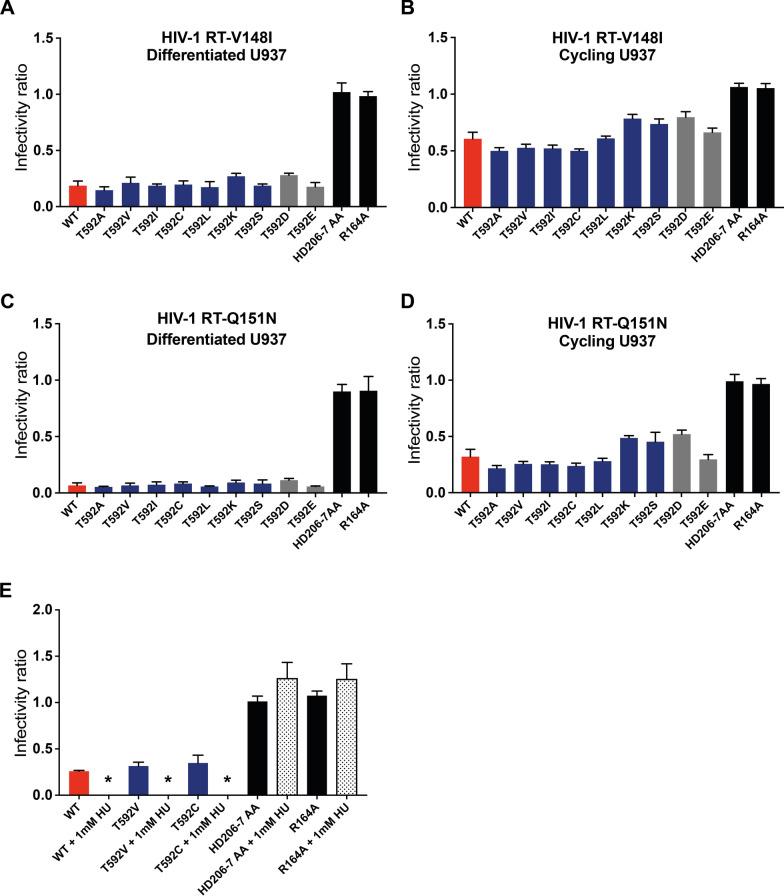
We first showed that HIV-1 restriction was not due to SAMHD1 nuclease activity. We then characterised a panel of SAMHD1 T592 mutants and divided them into three classes. We found that a subset of mutants lost their ability to restrict HIV-1 in differentiated cells which generally corresponded with a decrease in triphosphohydrolase activity and/or tetramer stability in vitro. Interestingly, no T592 mutants were able to restrict WT HIV-1 in cycling cells, despite not being regulated by phosphorylation and retaining their ability to hydrolyse dNTPs. Lowering dNTP levels by addition of hydroxyurea did not give rise to restriction. Compellingly however, HIV-1 RT mutants with reduced affinity for dNTPs were significantly restricted by wild-type and T592 mutant SAMHD1 in both cycling U937 cells and Jurkat T-cells. Restriction correlated with reverse transcription levels.
CONCLUSIONS
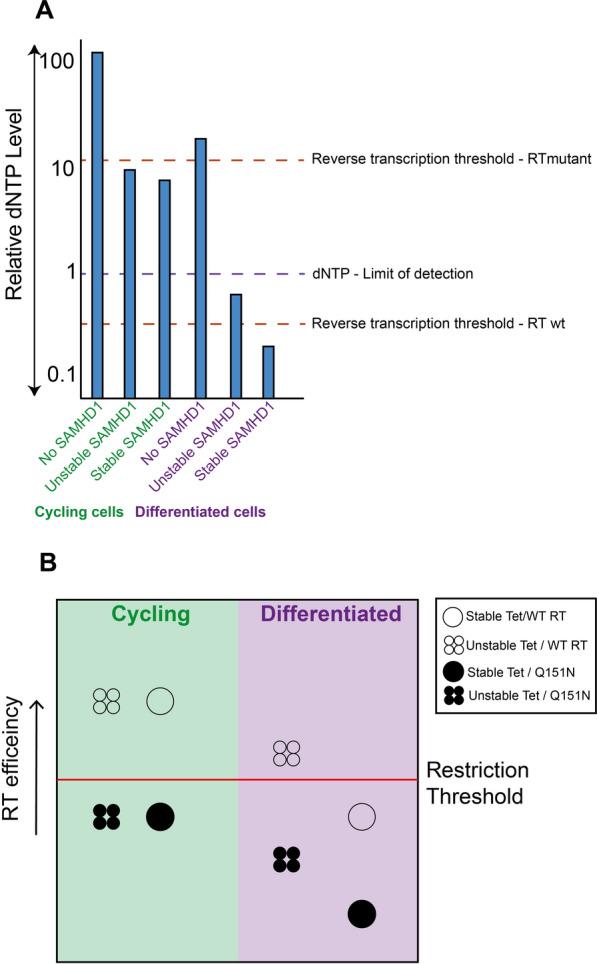
Altogether, we found that the amino acid at residue 592 has a strong effect on tetramer formation and, although this is not a simple "on/off" switch, this does correlate with the ability of SAMHD1 to restrict HIV-1 replication in differentiated cells. However, preventing phosphorylation of SAMHD1 and/or lowering dNTP levels by adding hydroxyurea was not enough to restore restriction in cycling cells. Nonetheless, lowering the affinity of HIV-1 RT for dNTPs, showed that restriction is mediated by dNTP levels and we were able to observe for the first time that SAMHD1 is active and capable of inhibiting HIV-1 replication in cycling cells, if the affinity of RT for dNTPs is reduced. This suggests that the very high affinity of HIV-1 RT for dNTPs prevents HIV-1 restriction by SAMHD1 in cycling cells.
背景
SAMHD1 是一种脱氧核苷酸三磷酸水解酶,可限制 HIV-1 在分化的白细胞中的复制。HIV-1 在循环细胞中不受限制,有人提出,这是由于这些细胞中 SAMHD1 的 T592 磷酸化使酶活性失活所致。为了区分 SAMHD1 在分化但非循环细胞中限制 HIV-1 的理论,我们分析了 T592 取代对循环和分化细胞中限制和 dNTP 水平的影响,以及四聚体稳定性和体外酶活性。
结果
我们首先表明,HIV-1 的限制不是由于 SAMHD1 的核酸酶活性。然后,我们对一组 SAMHD1 T592 突变体进行了特征分析,并将其分为三类。我们发现,一组突变体丧失了在分化细胞中限制 HIV-1 的能力,这通常与体外三磷酸水解酶活性和/或四聚体稳定性降低相对应。有趣的是,尽管不受磷酸化调节并保留水解 dNTP 的能力,但没有 T592 突变体能限制 WT HIV-1 在循环细胞中复制。通过添加羟基脲降低 dNTP 水平并没有导致限制。然而,具有降低的 dNTP 亲和力的 HIV-1 RT 突变体在循环 U937 细胞和 Jurkat T 细胞中均被野生型和 T592 突变 SAMHD1 显著限制。限制与逆转录水平相关。
结论
总之,我们发现残基 592 上的氨基酸对四聚体形成有很强的影响,尽管这不是一个简单的“开/关”开关,但这确实与 SAMHD1 限制 HIV-1 在分化细胞中复制的能力相关。然而,通过添加羟基脲阻止 SAMHD1 的磷酸化和/或降低 dNTP 水平不足以恢复循环细胞中的限制。尽管如此,降低 HIV-1 RT 对 dNTP 的亲和力表明,限制是由 dNTP 水平介导的,我们首次观察到,如果 RT 对 dNTP 的亲和力降低,SAMHD1 是活跃的,并能够抑制循环细胞中的 HIV-1 复制。这表明 HIV-1 RT 对 dNTP 的极高亲和力阻止了 SAMHD1 在循环细胞中对 HIV-1 的限制。




 Zotero 插件