
脑脊液 PDGFRβ 与衰老、血脑屏障损伤、神经炎症及阿尔茨海默病病理改变的相关性研究
Associations of CSF PDGFRβ With Aging, Blood-Brain Barrier Damage, Neuroinflammation, and Alzheimer Disease Pathologic Changes.
机构信息
From the Clinical Memory Research Unit (C.C., N.M.-C., S.P., K.A., O.S., E.S., S.J., O.H.), Department of Clinical Sciences, Lund University; Memory Clinic (C.C., S.P., E.S., O.H.), Skåne University Hospital, Malmö; Department of Neurology (N.M.-C.), Skåne University Hospital, Wallenberg Center for Molecular Medicine (N.M.-C.), and Department of Clinical Sciences Lund (D.v.W.), Diagnostic Radiology, Lund University; Imaging and Function (D.v.W.), Skåne University Health Care, Lund; Department of Psychiatry and Neurochemistry (H.Z., K.B.), the Sahlgrenska Academy at the University of Gothenburg; Clinical Neurochemistry Laboratory (H.Z., K.B.), Sahlgrenska University Hospital, Mölndal, Sweden; Department of Neurodegenerative Disease (H.Z.), UCL Institute of Neurology; UK Dementia Research Institute at UCL (H.Z.), London, United Kingdom; Hong Kong Center for Neurodegenerative Diseases (H.Z.), Clear Water Bay, China; and Department of Neuropsychology (K.A.), Ruhr University Bochum, Germany.
出版信息
Neurology. 2023 Jul 4;101(1):e30-e39. doi: 10.1212/WNL.0000000000207358. Epub 2023 May 3.
BACKGROUND AND OBJECTIVES
Injured pericytes in the neurovascular unit release platelet-derived growth factor β (PDGFRβ) into the CSF. However, it is not clear how pericyte injury contributes to Alzheimer disease (AD)-related changes and blood-brain barrier (BBB) damage. We aimed to test whether CSF PDGFRβ was associated with different AD-associated and age-associated pathologic changes leading to dementia.
METHODS
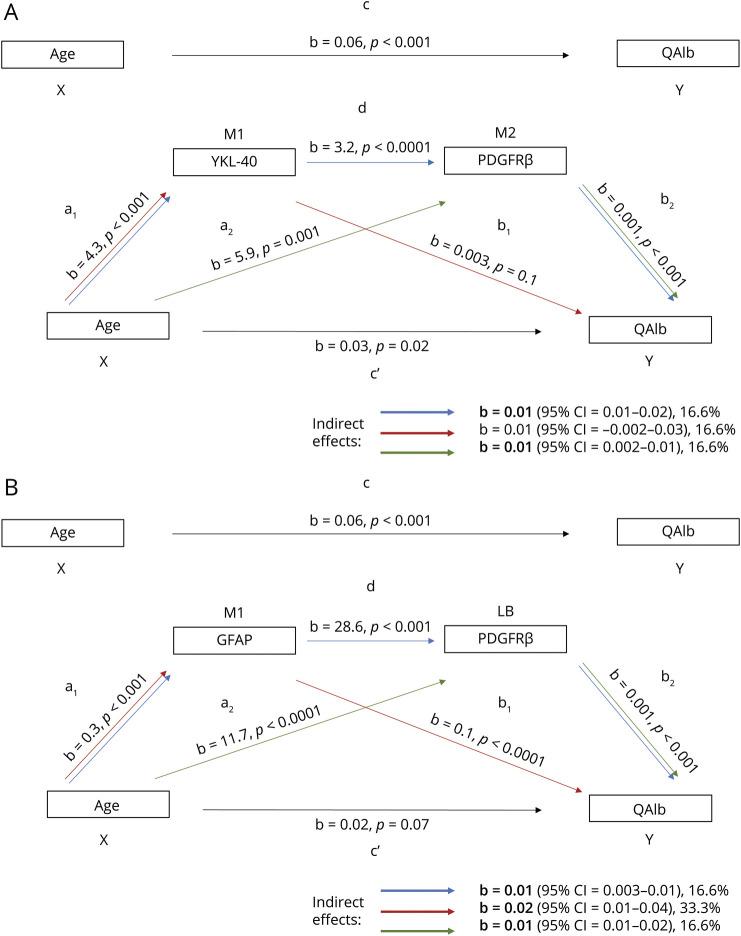
PDGFRβ was measured in the CSF of 771 participants with cognitively unimpaired (CU, n = 408), mild cognitive impairment (MCI, n = 175), and dementia (n = 188) from the Swedish BioFINDER-2 cohort. We then checked association with β-amyloid (Aβ)-PET and tau-PET standardized uptake value ratio, ε4 genotype and MRI measurements of cortical thickness, white matter lesions (WMLs), and cerebral blood flow. We also analyzed the role of CSF PDGFRβ in the relationship between aging, BBB dysfunction (measured by CSF/plasma albumin ratio, QAlb), and neuroinflammation (i.e., CSF levels of YKL-40 and glial fibrillary acidic protein [GFAP], preferentially expressed in reactive astrocytes).
RESULTS
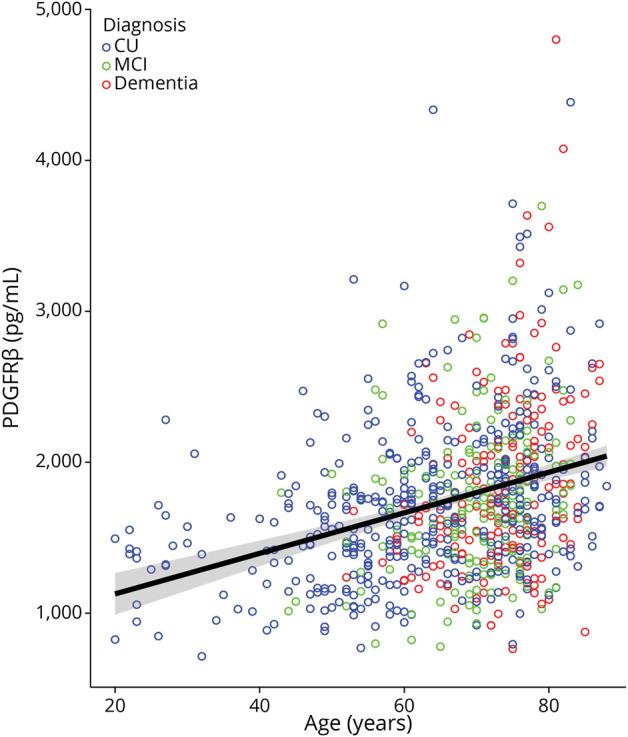
The cohort had a mean age of 67 years (CU = 62.8, MCI = 69.9, dementia = 70.4), and 50.1% were male (CU = 46.6%, MCI = 53.7%, dementia = 54.3%). Higher CSF PDGFRβ concentrations were related to higher age ( = 19.1, β = 0.5, 95% CI 16-22.2, < 0.001), increased CSF neuroinflammatory markers of glial activation YKL-40 ( = 3.4, β = 0.5, 95% CI 2.8-3.9, < 0.001), GFAP ( = 27.4, β = 0.4, 95% CI 20.9-33.9, < 0.001), and worse BBB integrity measured by QAlb ( = 37.4, β = 0.2, 95% CI 24.9-49.9, < 0.001). Age was also associated with worse BBB integrity, and this was partly mediated by PDGFRβ and neuroinflammatory markers (16%-33% of total effect). However, PDGFRβ showed no associations with ε4 genotype, PET imaging of Aβ and tau pathology, or MRI measures of brain atrophy and WMLs ( > 0.05).
DISCUSSION
In summary, pericyte damage, reflected by CSF PDGFRβ, may be involved in age-related BBB disruption together with neuroinflammation, but is not related to Alzheimer-related pathologic changes.
背景和目的
神经血管单元中的受损周细胞会将血小板衍生生长因子β(PDGFRβ)释放到脑脊液中。然而,周细胞损伤如何导致阿尔茨海默病(AD)相关变化和血脑屏障(BBB)损伤尚不清楚。我们旨在测试脑脊液 PDGFRβ 是否与导致痴呆的不同 AD 相关和与年龄相关的病理变化有关。
方法
我们测量了来自瑞典 BioFINDER-2 队列的认知正常(CU,n=408)、轻度认知障碍(MCI,n=175)和痴呆(n=188)的 771 名参与者的脑脊液中的 PDGFRβ。然后,我们检查了与β-淀粉样蛋白(Aβ)-PET 和 tau-PET 标准化摄取比值、ε4 基因型以及皮质厚度、白质病变(WML)和脑血流的 MRI 测量的关联。我们还分析了脑脊液 PDGFRβ 在衰老、BBB 功能障碍(通过脑脊液/血浆白蛋白比值 QAlb 测量)和神经炎症(即脑脊液 YKL-40 和胶质纤维酸性蛋白 [GFAP] 水平,GFAP 优先在反应性星形胶质细胞中表达)之间的关系中的作用。
结果
该队列的平均年龄为 67 岁(CU=62.8,MCI=69.9,痴呆=70.4),50.1%为男性(CU=46.6%,MCI=53.7%,痴呆=54.3%)。较高的脑脊液 PDGFRβ 浓度与较高的年龄相关(=19.1,β=0.5,95%CI 16-22.2,<0.001),脑脊液神经胶质激活的神经炎症标志物 YKL-40(=3.4,β=0.5,95%CI 2.8-3.9,<0.001)和 GFAP(=27.4,β=0.4,95%CI 20.9-33.9,<0.001)增加,以及 QAlb 测量的 BBB 完整性恶化(=37.4,β=0.2,95%CI 24.9-49.9,<0.001)。年龄也与 BBB 完整性恶化有关,而这部分是由 PDGFRβ 和神经炎症标志物介导的(总效应的 16%-33%)。然而,PDGFRβ 与 ε4 基因型、Aβ 和 tau 病理学的 PET 成像或 MRI 测量的脑萎缩和 WML 无关联(>0.05)。
讨论
总之,反映在脑脊液 PDGFRβ 中的周细胞损伤可能与年龄相关的 BBB 破坏以及神经炎症有关,但与 AD 相关的病理变化无关。


 Zotero 插件