
少突胶质细胞很重要:早期逆境的动物研究综述。
Oligodendrocytes matter: a review of animal studies on early adversity.
机构信息
Division of Experimental and Molecular Psychiatry, Department of Psychiatry, Psychotherapy and Preventive Medicine, LWL University Hospital, Ruhr-University Bochum, Bochum, Germany.
Institute for Systems Medicine and Department of Human Medicine, MSH Medical School Hamburg, Hamburg, Germany.
出版信息
J Neural Transm (Vienna). 2023 Sep;130(9):1177-1185. doi: 10.1007/s00702-023-02643-4. Epub 2023 May 3.
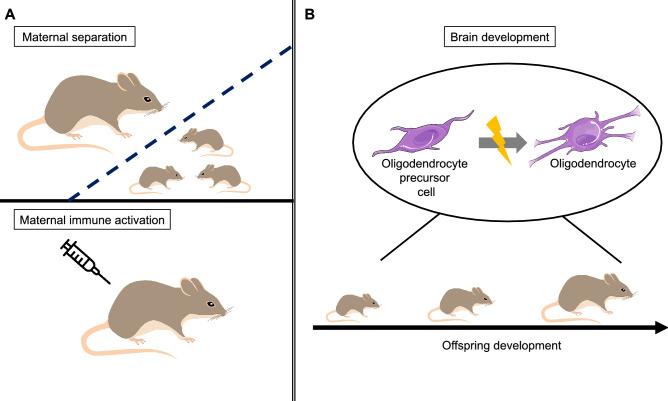
Exposure to adversities in early life appears to affect the development of white matter, especially oligodendrocytes. Furthermore, altered myelination is present in regions subjected to maturation during the developmental time when early adversities are experienced. In this review, studies applying two well-established animal models of early life adversity, namely maternal separation and maternal immune activation, focusing on oligodendrocyte alterations and resulting implications for psychiatric disorders are discussed. Studies revealed that myelination is reduced as a result of altered oligodendrocyte expression. Furthermore, early adversity is associated with increased cell death, a simpler morphology, and inhibited oligodendrocyte maturation. However, these effects seem to be region- specific as some brain regions show increased expression while others show decreased expression of oligodendroglia-related genes, and they occur especially in regions of ongoing development. Some studies furthermore suggest that early adversity leads to premature differentiation of oligodendrocytes. Importantly, especially early exposure results in stronger oligodendrocyte-related impairments. However, resulting alterations are not restricted to exposure during the early pre- and postnatal days as social isolation after weaning leads to fewer internodes and branches and shorter processes of oligodendrocytes in adulthood. Eventually, the found alterations may lead to dysfunction and long-lasting alterations in structural brain development associated with psychiatric disorders. To date, only few preclinical studies have focused on the effects of early adversity on oligodendrocytes. More studies including several developmental stages are needed to further disentangle the role of oligodendrocytes in the development of psychiatric disorders.
早期生活中的逆境经历似乎会影响白质的发育,尤其是少突胶质细胞。此外,在经历早期逆境的发育时期,成熟过程中所涉及的区域会出现髓鞘改变。在这篇综述中,讨论了应用两种成熟的早期生活逆境动物模型,即母婴分离和母体免疫激活,来研究少突胶质细胞改变及其对精神障碍的影响。研究表明,髓鞘形成减少是由于少突胶质细胞表达改变所致。此外,早期逆境与细胞死亡增加、形态更简单以及少突胶质细胞成熟受阻有关。然而,这些效应似乎具有区域特异性,因为一些脑区的少突胶质细胞相关基因表达增加,而另一些脑区则表达减少,而且这些变化尤其发生在正在发育的区域。一些研究还表明,早期逆境会导致少突胶质细胞过早分化。重要的是,特别是早期暴露会导致更强的少突胶质细胞相关损伤。然而,所产生的改变不仅限于早期出生前后的暴露,因为断奶后的社会隔离会导致成年期少突胶质细胞的节间和分支减少,以及过程缩短。最终,这些发现的改变可能会导致与精神障碍相关的结构性脑发育的功能障碍和持久改变。迄今为止,只有少数临床前研究关注了早期逆境对少突胶质细胞的影响。需要更多包括多个发育阶段的研究来进一步阐明少突胶质细胞在精神障碍发展中的作用。
 Zotero 插件