
模拟情景记忆在空间学习中的功能。
Modeling the function of episodic memory in spatial learning.
作者信息
Zeng Xiangshuai, Diekmann Nicolas, Wiskott Laurenz, Cheng Sen
机构信息
Department of Computer Science, Institute for Neural Computation, Ruhr University Bochum, Bochum, Germany.
International Graduate School of Neuroscience, Ruhr University Bochum, Bochum, Germany.
出版信息
Front Psychol. 2023 Apr 17;14:1160648. doi: 10.3389/fpsyg.2023.1160648. eCollection 2023.
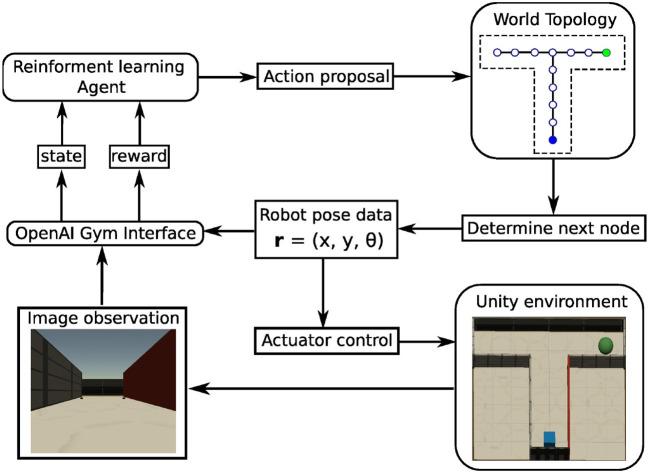
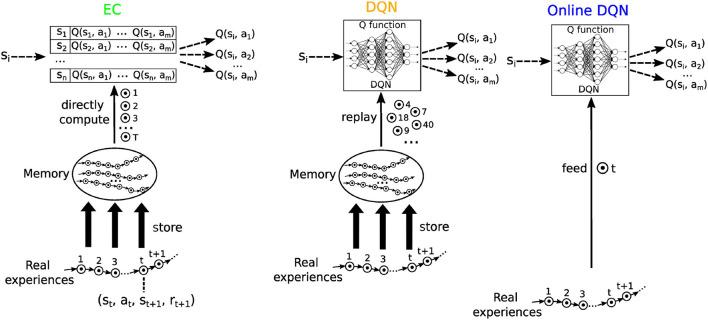
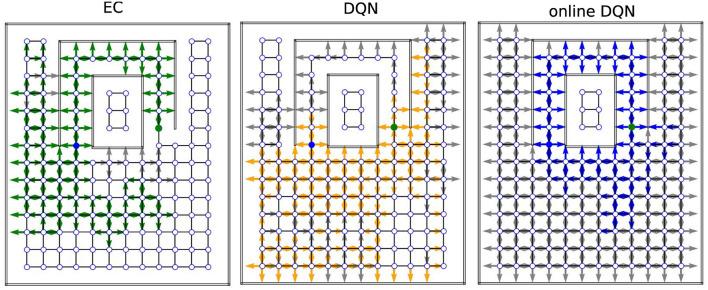
Episodic memory has been studied extensively in the past few decades, but so far little is understood about how it drives future behavior. Here we propose that episodic memory can facilitate learning in two fundamentally different modes: retrieval and replay, which is the reinstatement of hippocampal activity patterns during later sleep or awake quiescence. We study their properties by comparing three learning paradigms using computational modeling based on visually-driven reinforcement learning. Firstly, episodic memories are retrieved to learn from single experiences (one-shot learning); secondly, episodic memories are replayed to facilitate learning of statistical regularities (replay learning); and, thirdly, learning occurs online as experiences arise with no access to memories of past experiences (online learning). We found that episodic memory benefits spatial learning in a broad range of conditions, but the performance difference is meaningful only when the task is sufficiently complex and the number of learning trials is limited. Furthermore, the two modes of accessing episodic memory affect spatial learning differently. One-shot learning is typically faster than replay learning, but the latter may reach a better asymptotic performance. In the end, we also investigated the benefits of sequential replay and found that replaying stochastic sequences results in faster learning as compared to random replay when the number of replays is limited. Understanding how episodic memory drives future behavior is an important step toward elucidating the nature of episodic memory.
在过去几十年里,情景记忆已经得到了广泛研究,但到目前为止,对于它如何驱动未来行为却知之甚少。在此,我们提出情景记忆可以通过两种根本不同的模式促进学习:检索和重演,重演是指在后续睡眠或清醒静止状态下海马体活动模式的恢复。我们通过基于视觉驱动强化学习的计算建模,比较三种学习范式来研究它们的特性。首先,检索情景记忆以从单一经历中学习(一次性学习);其次,重演情景记忆以促进对统计规律的学习(重演学习);第三,随着经历的出现在线学习,无法获取过去经历的记忆(在线学习)。我们发现情景记忆在广泛的条件下有利于空间学习,但只有当任务足够复杂且学习试验次数有限时,性能差异才有意义。此外,访问情景记忆的两种模式对空间学习的影响不同。一次性学习通常比重演学习更快,但后者可能会达到更好的渐近性能。最后,我们还研究了顺序重演的好处,发现当重演次数有限时,与随机重演相比,重演随机序列能导致更快的学习。理解情景记忆如何驱动未来行为是阐明情景记忆本质的重要一步。







 Zotero 插件