
在PPM1D磷酸酶的人工智能预测结构中发现一个隐秘口袋,这解释了其变构抑制剂的结合位点和效力。
Discovery of a cryptic pocket in the AI-predicted structure of PPM1D phosphatase explains the binding site and potency of its allosteric inhibitors.
作者信息
Meller Artur, De Oliveira Saulo, Davtyan Aram, Abramyan Tigran, Bowman Gregory R, van den Bedem Henry
机构信息
Department of Biochemistry and Molecular Biophysics, Washington University in St. Louis, St. Louis, MO, United States.
Medical Scientist Training Program, Washington University in St. Louis, St. Louis, MO, United States.
出版信息
Front Mol Biosci. 2023 Apr 18;10:1171143. doi: 10.3389/fmolb.2023.1171143. eCollection 2023.
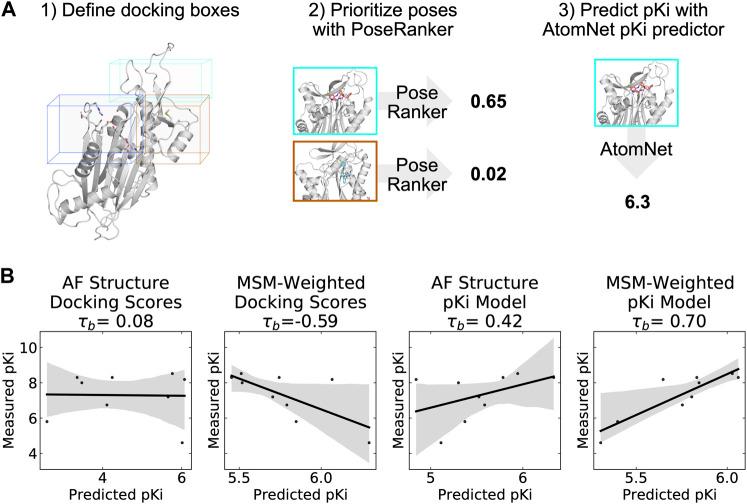
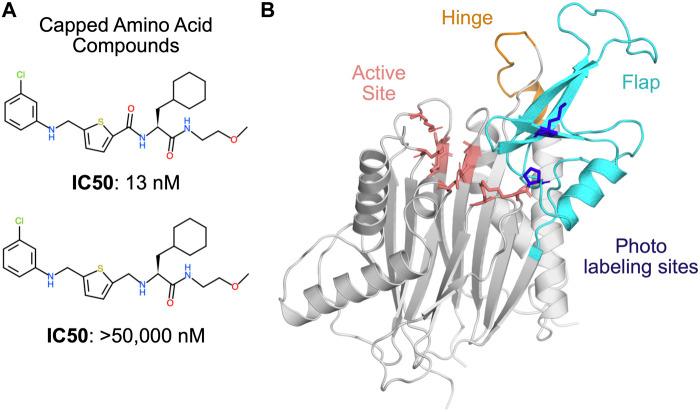
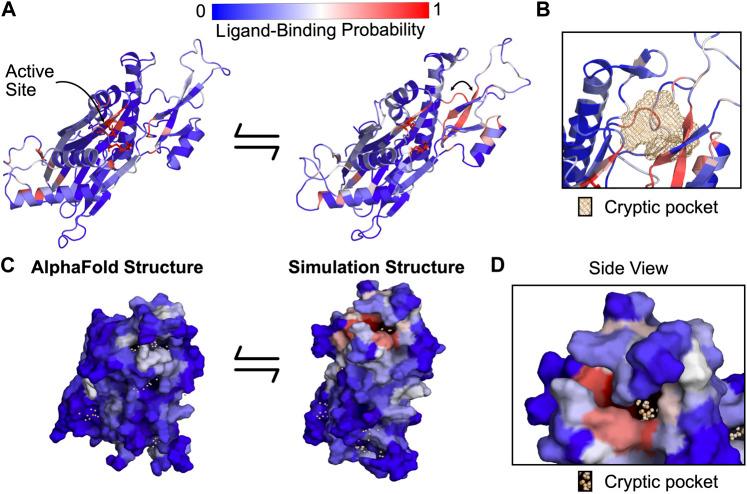
Virtual screening is a widely used tool for drug discovery, but its predictive power can vary dramatically depending on how much structural data is available. In the best case, crystal structures of a ligand-bound protein can help find more potent ligands. However, virtual screens tend to be less predictive when only ligand-free crystal structures are available, and even less predictive if a homology model or other predicted structure must be used. Here, we explore the possibility that this situation can be improved by better accounting for protein dynamics, as simulations started from a single structure have a reasonable chance of sampling nearby structures that are more compatible with ligand binding. As a specific example, we consider the cancer drug target PPM1D/Wip1 phosphatase, a protein that lacks crystal structures. High-throughput screens have led to the discovery of several allosteric inhibitors of PPM1D, but their binding mode remains unknown. To enable further drug discovery efforts, we assessed the predictive power of an AlphaFold-predicted structure of PPM1D and a Markov state model (MSM) built from molecular dynamics simulations initiated from that structure. Our simulations reveal a cryptic pocket at the interface between two important structural elements, the flap and hinge regions. Using deep learning to predict the pose quality of each docked compound for the active site and cryptic pocket suggests that the inhibitors strongly prefer binding to the cryptic pocket, consistent with their allosteric effect. The predicted affinities for the dynamically uncovered cryptic pocket also recapitulate the relative potencies of the compounds (τ = 0.70) better than the predicted affinities for the static AlphaFold-predicted structure (τ = 0.42). Taken together, these results suggest that targeting the cryptic pocket is a good strategy for drugging PPM1D and, more generally, that conformations selected from simulation can improve virtual screening when limited structural data is available.
虚拟筛选是药物发现中广泛使用的工具,但其预测能力会因可用结构数据的多少而有很大差异。在最佳情况下,配体结合蛋白的晶体结构有助于找到更有效的配体。然而,当只有无配体晶体结构可用时,虚拟筛选的预测性往往较差,如果必须使用同源模型或其他预测结构,则预测性更差。在这里,我们探讨了通过更好地考虑蛋白质动力学来改善这种情况的可能性,因为从单一结构开始的模拟有合理的机会采样与配体结合更兼容的附近结构。作为一个具体例子,我们考虑癌症药物靶点PPM1D/Wip1磷酸酶,一种缺乏晶体结构的蛋白质。高通量筛选已导致发现了几种PPM1D的变构抑制剂,但其结合模式仍不清楚。为了推动进一步的药物发现工作,我们评估了PPM1D的AlphaFold预测结构和基于该结构的分子动力学模拟构建的马尔可夫状态模型(MSM)的预测能力。我们的模拟揭示了两个重要结构元件(襟翼和铰链区域)之间界面处的一个隐秘口袋。使用深度学习预测每个对接化合物在活性位点和隐秘口袋处的姿态质量表明,抑制剂强烈倾向于结合到隐秘口袋,这与其变构效应一致。对动态发现的隐秘口袋的预测亲和力也比静态AlphaFold预测结构的预测亲和力(τ = 0.42)更好地概括了化合物的相对效力(τ = 0.70)。综上所述,这些结果表明,靶向隐秘口袋是针对PPM1D进行药物研发的一个好策略,更普遍地说,当可用结构数据有限时,从模拟中选择的构象可以改善虚拟筛选。


 Zotero 插件