
全细胞蛋白质组显示与生物膜形成有关的中国大环内酯类耐药百日咳博德特氏菌的特征。
The whole-cell proteome shows the characteristics of macrolides-resistant Bordetella pertussis in China linked to the biofilm formation.
机构信息
Department of Epidemiology and Health Statistics, School of Public Health, Xi'an Jiaotong University Health Science Center, Xi'an, 710061, China.
National Regional Children's Medical Center (Northwest), Key Laboratory of Precision Medicine to Pediatric Diseases of Shaanxi Province, Xi'an Key Laboratory of Children's Health and Diseases, Shaanxi Institute for Pediatric Diseases; Xi'an Children's Hospital, Affiliated Children's Hospital of Xi'an Jiaotong University, No. 69, Xijuyuan Lane, Xi'an, 710003, China.
出版信息
Arch Microbiol. 2023 May 6;205(6):219. doi: 10.1007/s00203-023-03566-0.
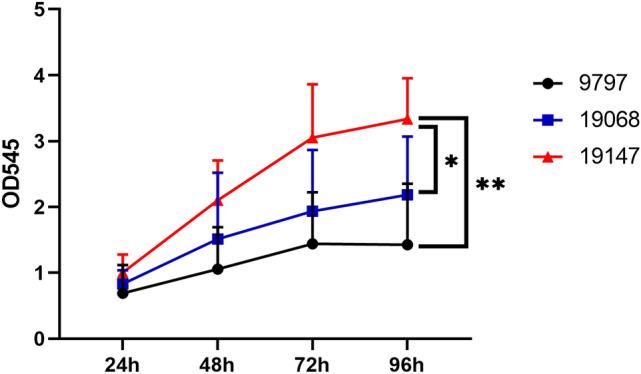
The macrolides-resistant Bordetella pertussis (MR-Bp) isolates in China evolved from the ptxP1/fhaB3 allele and rapidly became predominant, suggestive of an adaptive transmission ability. This was different from the global prevalent ptxP3 strains, in which MR-Bp was rarely reported. The study aimed to determine the underlying mechanism responsible for fitness and resistance in these two strains. We identify proteomic differences between ptxP1/fhaB3 and ptxP3/fhaB1 strains using tandem mass tag (TMT)-based proteomics. We then performed in-depth bioinformatic analysis to determine differentially expressed genes (DEGs), followed by gene ontology (GO), and protein-protein interaction (PPI) network analysis. Further parallel reaction monitoring (PRM) analysis confirmed the expression of four target proteins. Finally, the crystal violet method was used to determine biofilm-forming ability. The results showed that the main significantly different proteins between the two represent isolates were related to biofilm formation. Furthermore, we have confirmed that ptxP1/fhaB3 showed hyperbiofilm formation in comparison with ptxP3/fhaB1. It is suggested that the resistance and adaptability of ptxP1/fhaB3 strains may be related to the formation of biofilm through proteomics. In a word, we determined the significantly different proteins between the ptxP1/fhaB3 and ptxP3/fhaB1 strains through whole-cell proteome, which were related to biofilm formation.
中国耐大环内酯类百日咳博德特氏菌(MR-Bp)分离株源自 ptxP1/fhaB3 等位基因,且迅速成为主要流行株,提示其具有适应性传播能力。这与全球流行的 ptxP3 菌株不同,在这些菌株中很少报道 MR-Bp。本研究旨在确定这两种菌株的适应性和耐药性的潜在机制。我们使用串联质量标签(TMT)-基于蛋白质组学的方法来确定 ptxP1/fhaB3 和 ptxP3/fhaB1 菌株之间的蛋白质组差异。然后,我们进行了深入的生物信息学分析,以确定差异表达基因(DEGs),随后进行基因本体论(GO)和蛋白质-蛋白质相互作用(PPI)网络分析。进一步的平行反应监测(PRM)分析证实了四个靶蛋白的表达。最后,使用结晶紫法测定生物膜形成能力。结果表明,这两种分离株之间主要的显著差异蛋白与生物膜形成有关。此外,我们已经证实 ptxP1/fhaB3 与 ptxP3/fhaB1 相比表现出超生物膜形成。提示 ptxP1/fhaB3 菌株的耐药性和适应性可能与生物膜形成有关。总之,我们通过全细胞蛋白质组确定了 ptxP1/fhaB3 和 ptxP3/fhaB1 菌株之间的显著差异蛋白,这些蛋白与生物膜形成有关。


 Zotero 插件