
腹部肥胖是胰腺癌比总体肥胖更重要的因果风险因素。
Abdominal obesity is a more important causal risk factor for pancreatic cancer than overall obesity.
机构信息
INSERM UMR 1283, CNRS UMR 8199, European Genomic Institute for Diabetes (EGID), Institut Pasteur de Lille, F-59000, Lille, France.
University of Lille, Lille University Hospital, Lille, F-59000, France.
出版信息
Eur J Hum Genet. 2023 Aug;31(8):962-966. doi: 10.1038/s41431-023-01301-3. Epub 2023 May 10.
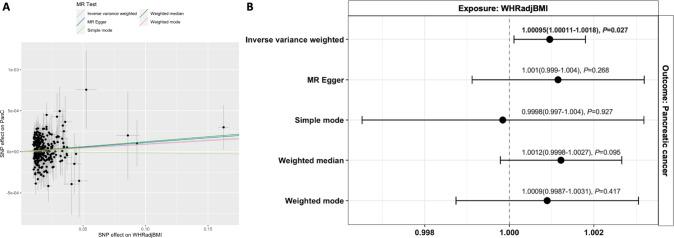
Obesity and type 2 diabetes (T2D) are associated with increased risk of pancreatic cancer. Here we assessed the relationship between pancreatic cancer and two distinct measures of obesity, namely total adiposity, using BMI, versus abdominal adiposity, using BMI adjusted waist-to-hip ratio (WHRadjBMI) by utilising polygenic scores (PGS) and Mendelian randomisation (MR) analyses. We constructed z-score weighted PGS for BMI and WHRadjBMI using publicly available data and tested for their association with pancreatic cancer defined in UK biobank (UKBB). Using publicly available summary statistics, we then performed bi-directional MR analyses between the two obesity traits and pancreatic cancer. PGS was significantly (multiple testing-corrected) associated with pancreatic cancer (OR[95%CI] = 1.0804[1.025-1.14], P = 0.0037). The significance of association declined after T2D adjustment (OR[95%CI] = 1.073[1.018-1.13], P = 0.00904). PGS association with pancreatic cancer was at the margin of statistical significance (OR[95%CI] = 1.047[0.99-1.104], P = 0.086). T2D adjustment effectively lost any suggestive association of PGS with pancreatic cancer (OR[95%CI] = 1.039[0.99-1.097], P = 0.14). MR analyses showed a nominally significant causal effect of WHRadjBMI on pancreatic cancer (OR[95%CI] = 1.00095[1.00011-1.0018], P = 0.027) but not for BMI on pancreatic cancer. Overall, we show that abdominal adiposity measured using WHRadjBMI, may be a more important causal risk factor for pancreatic cancer compared to total adiposity, with T2D being a potential driver of this relationship.
肥胖和 2 型糖尿病(T2D)与胰腺癌风险增加有关。在这里,我们利用多基因风险评分(PGS)和孟德尔随机化(MR)分析,评估了胰腺癌与两种不同肥胖测量方法(体重指数(BMI)表示的总体肥胖程度和 BMI 校正腰围-臀围比(WHRadjBMI)表示的腹部肥胖程度)之间的关系。我们利用公开可用的数据构建了 BMI 和 WHRadjBMI 的 z 评分加权 PGS,并在英国生物库(UKBB)中测试了它们与胰腺癌的关联。然后,我们利用公开可用的汇总统计数据,在两种肥胖特征与胰腺癌之间进行了双向 MR 分析。PGS 与胰腺癌显著相关(多重检验校正后 OR[95%CI] = 1.0804[1.025-1.14],P = 0.0037)。在调整了 T2D 后,这种关联的显著性下降(OR[95%CI] = 1.073[1.018-1.13],P = 0.00904)。PGS 与胰腺癌的关联具有统计学意义(OR[95%CI] = 1.047[0.99-1.104],P = 0.086)。T2D 调整有效地消除了 PGS 与胰腺癌之间任何有提示意义的关联(OR[95%CI] = 1.039[0.99-1.097],P = 0.14)。MR 分析表明,WHRadjBMI 与胰腺癌之间存在名义上显著的因果关系(OR[95%CI] = 1.00095[1.00011-1.0018],P = 0.027),但 BMI 与胰腺癌之间没有因果关系。总的来说,我们表明,与 BMI 表示的总体肥胖程度相比,WHRadjBMI 测量的腹部肥胖程度可能是胰腺癌的一个更重要的因果风险因素,而 T2D 可能是这种关系的一个潜在驱动因素。

 Zotero 插件