
炎症作为囊性纤维化气道表面液体 pH 值的调节剂。
Inflammation as a Regulator of the Airway Surface Liquid pH in Cystic Fibrosis.
机构信息
Department of Internal Medicine, University of Michigan, Ann Arbor, MI 48109, USA.
Departments of Internal Medicine and Molecular Physiology and Biophysics, Pappajohn Biomedical Institute, Roy J. and Lucille A. Carver College of Medicine, University of Iowa, Iowa City, IA 52242, USA.
出版信息
Cells. 2023 Apr 7;12(8):1104. doi: 10.3390/cells12081104.
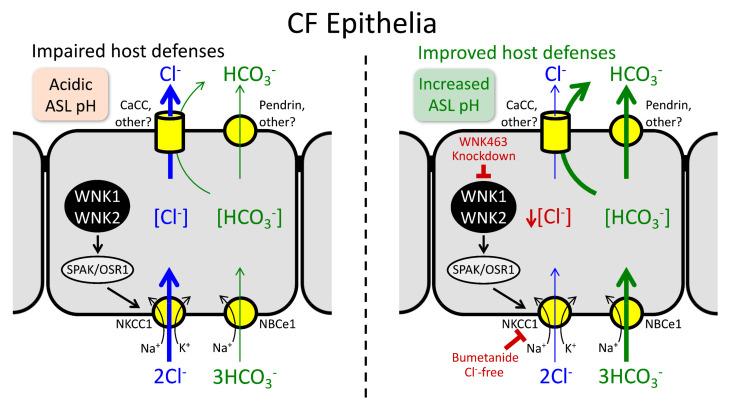
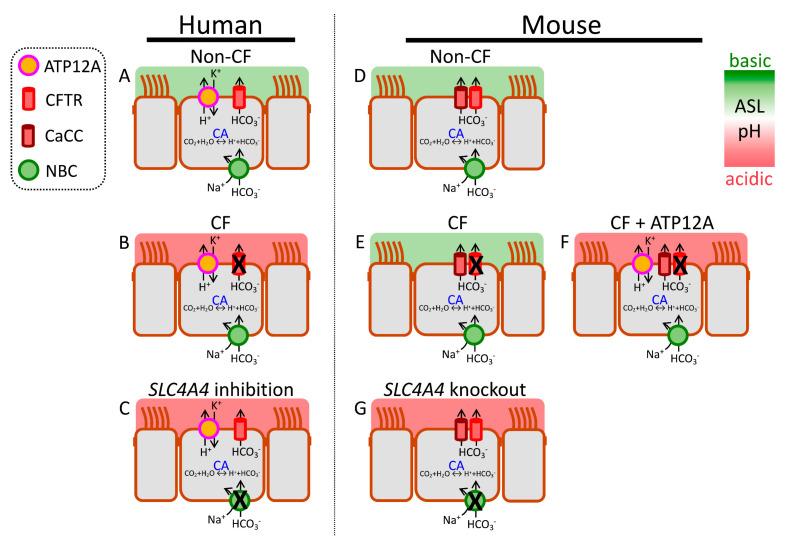
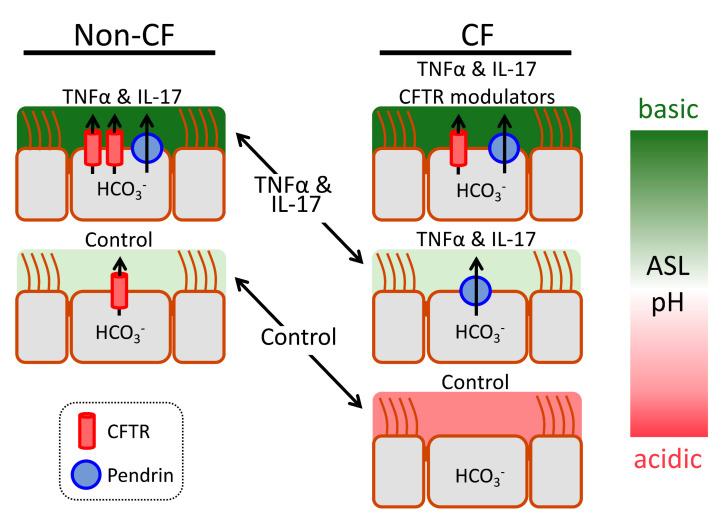
The airway surface liquid (ASL) is a thin sheet of fluid that covers the luminal aspect of the airway epithelium. The ASL is a site of several first-line host defenses, and its composition is a key factor that determines respiratory fitness. Specifically, the acid-base balance of ASL has a major influence on the vital respiratory defense processes of mucociliary clearance and antimicrobial peptide activity against inhaled pathogens. In the inherited disorder cystic fibrosis (CF), loss of cystic fibrosis transmembrane conductance regulator (CFTR) anion channel function reduces HCO secretion, lowers the pH of ASL (pH), and impairs host defenses. These abnormalities initiate a pathologic process whose hallmarks are chronic infection, inflammation, mucus obstruction, and bronchiectasis. Inflammation is particularly relevant as it develops early in CF and persists despite highly effective CFTR modulator therapy. Recent studies show that inflammation may alter HCO and H secretion across the airway epithelia and thus regulate pH. Moreover, inflammation may enhance the restoration of CFTR channel function in CF epithelia exposed to clinically approved modulators. This review focuses on the complex relationships between acid-base secretion, airway inflammation, pH regulation, and therapeutic responses to CFTR modulators. These factors have important implications for defining optimal ways of tackling CF airway inflammation in the post-modulator era.
气道表面液(ASL)是覆盖气道上皮腔面的一层薄液。ASL 是几种一线宿主防御的部位,其组成是决定呼吸健康的关键因素。具体而言,ASL 的酸碱平衡对黏液纤毛清除和抗菌肽针对吸入病原体的活性等重要呼吸防御过程有重大影响。在遗传性疾病囊性纤维化(CF)中,囊性纤维化跨膜电导调节因子(CFTR)阴离子通道功能丧失会减少 HCO3-的分泌,降低 ASL 的 pH 值(pH),并损害宿主防御。这些异常引发了一个病理过程,其特征是慢性感染、炎症、黏液阻塞和支气管扩张。炎症尤其相关,因为它在 CF 中很早就出现,并持续存在,尽管 CFTR 调节剂治疗非常有效。最近的研究表明,炎症可能会改变气道上皮细胞的 HCO3-和 H+分泌,从而调节 pH 值。此外,炎症可能会增强 CF 上皮细胞暴露于临床批准的调节剂后 CFTR 通道功能的恢复。这篇综述重点介绍了酸碱性分泌、气道炎症、pH 值调节以及 CFTR 调节剂治疗反应之间的复杂关系。这些因素对于在后调节剂时代确定治疗 CF 气道炎症的最佳方法具有重要意义。

 Zotero 插件