
通过宏基因组下一代测序直接检测和鉴定假体关节感染病原体。
Direct detection and identification of periprosthetic joint infection pathogens by metagenomic next-generation sequencing.
机构信息
Department of Orthopedics, The First Affiliated Hospital of Xi'an Jiaotong University, 277 West Yanta Road, Xi'an, 710061, Shaanxi, China.
Department of Joint Surgery, Honghui Hospital, Xi'an Jiaotong University, 555 East Youyi Road, Xi'an, 710000, Shaanxi, China.
出版信息
Sci Rep. 2023 May 16;13(1):7897. doi: 10.1038/s41598-023-35215-3.
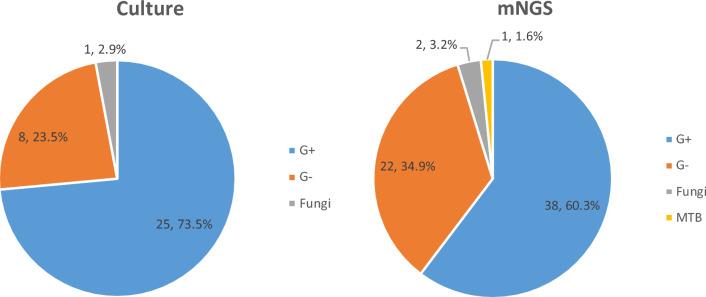
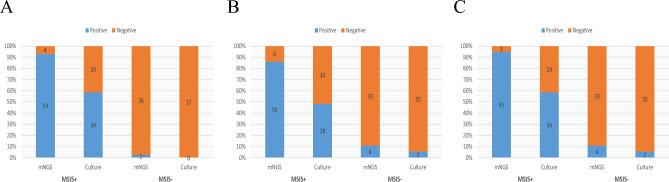
This study assessed the application of metagenomic next-generation sequencing in pathogen detection of periprosthetic joint infections. A total of 95 cases who previously had undergone hip and knee replacement undergoing revision from January 2018 to January 2021 were included in this study. Specimens of synovial fluid and deep-tissue were collected for culture and metagenomic next-generation sequencing, and patients were retrospectively categorized as infected or aseptic using the Musculoskeletal Infection Society criteria after revision surgery. The sensitivity, specificity, positive and negative predictive values were compared. A total of 36 cases had positive culture results and 59 cases had positive metagenomic next-generation sequencing results. Culture was positive in 34 infected cases (58.6%) and 2 aseptic cases (5.4%). Metagenomic next-generation sequencing was positive in 55 infected cases (94.8%) and 4 aseptic cases (10.8%). Five cases diagnosed with infection had other potential pathogens detected by metagenomic next-generation sequencing. Among the 24 culture-negative periprosthetic joint infections, metagenomic next-generation sequencing was able to identify potential pathogens in 21 cases (87.5%). From sampling to reporting, the average time needed for culture was 5.2 (95% CI 3.1-7.3) days, while that for metagenomic next-generation sequencing was 1.3 (95% CI 0.9-1.7) days. Metagenomic next-generation sequencing is more advantageous in pathogen detection of periprosthetic joint infection after total joint replacement, especially in patients with multiple infections or negative culture results.
本研究评估了宏基因组下一代测序在假体关节感染病原体检测中的应用。纳入了 2018 年 1 月至 2021 年 1 月期间因翻修而接受髋关节和膝关节置换的 95 例患者。收集滑膜液和深部组织标本进行培养和宏基因组下一代测序,根据翻修手术后的肌肉骨骼感染协会标准,回顾性将患者分为感染或无菌。比较了敏感性、特异性、阳性和阴性预测值。共有 36 例培养阳性,59 例宏基因组下一代测序阳性。34 例感染病例(58.6%)和 2 例无菌病例(5.4%)培养阳性。55 例感染病例(94.8%)和 4 例无菌病例(10.8%)宏基因组下一代测序阳性。5 例感染诊断病例通过宏基因组下一代测序检测到其他潜在病原体。在 24 例培养阴性的假体关节感染中,宏基因组下一代测序能够在 21 例(87.5%)病例中识别潜在病原体。从采样到报告,培养的平均时间为 5.2 天(95%CI 3.1-7.3),而宏基因组下一代测序的平均时间为 1.3 天(95%CI 0.9-1.7)。宏基因组下一代测序在全关节置换后假体关节感染的病原体检测中更具优势,特别是在存在多种感染或培养结果阴性的患者中。
 Zotero 插件