
62 个纽约州各县的过早死亡率和潜在生命损失年(YPLL)及相关协变量的纵向趋势(2011-2020 年)。
Longitudinal trends (2011-2020) of premature mortality and years of potential life loss (YPLL) and associated covariates of the 62 New York State counties.
机构信息
Department of Health Equity, Administration and Technology, School of Health Sciences, Human Services and Nursing, New York, USA.
City University of New York (CUNY) Institute for Health Equity, New York, USA.
出版信息
Int J Equity Health. 2023 May 16;22(1):89. doi: 10.1186/s12939-023-01902-w.
BACKGROUND
New York State (NYS) is the 27 largest state and the 4 most populous state in the U.S., with close to 20 million people in 62 counties. Territories with diverse populations present the best opportunity to study health outcomes and associated covariates, and how these differ across different populations and groups. The County Health Ranking and Roadmaps (CHR&R) ranks counties by linking the population's characteristics and health outcomes and contextual factors in a synchronic approach.
METHODS
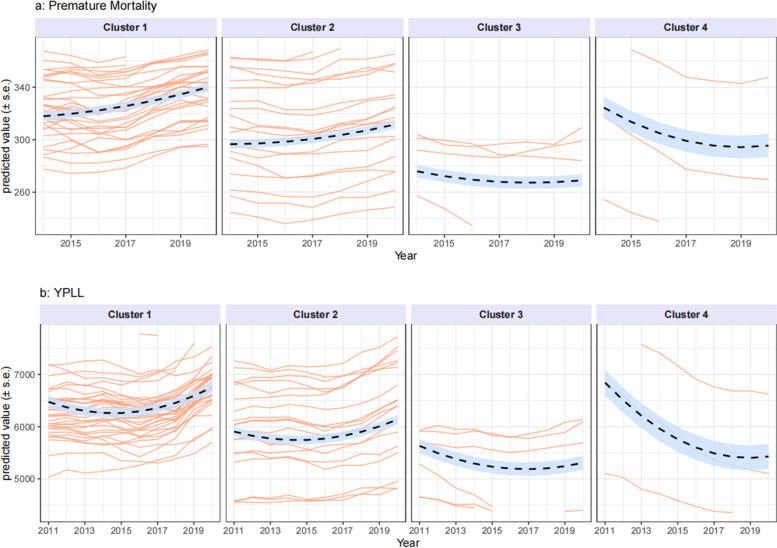
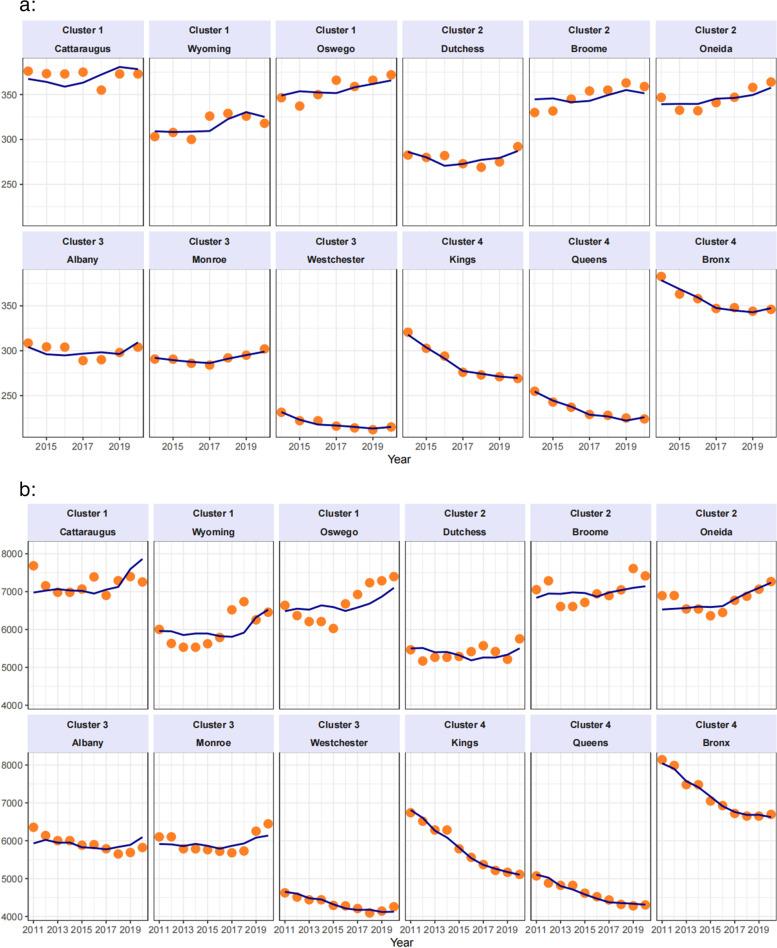
The goal of this study is to analyze the longitudinal trends in NYS counties of age-adjusted premature mortality rate and years of potential life loss rate (YPLL) from 2011-2020 using (CHR&R) data to identify similarities and trends among the counties of the state. This study used a weighted mixed regression model to analyze the longitudinal trend in health outcomes as a function of the time-varying covariates and clustered the 62 counties according to the trend over time in the covariates.
RESULTS
Four clusters of counties were identified. Cluster 1, which represents 33 of the 62 counties in NYS, contains the most rural counties and the least racially and ethnically diverse counties. Clusters 2 and 3 mirror each other in most covariates and Cluster 4 is comprised of 3 counties (Bronx, Kings/Brooklyn, Queens) representing the most urban and racial and ethnic diverse counties in the state.
CONCLUSION
The analysis clustered counties according to the longitudinal trends of the covariates, and by doing so identified clusters of counties that shared similar trends among the covariates, to later examine trends in the health outcomes through a regression model. The strength of this approach lies in the predictive feature of what is to come for the counties by understanding the covariates and setting prevention goals.
背景
纽约州(NYS)是美国第 27 大州和第 4 大人口州,拥有近 2000 万人口,分布在 62 个县。人口多样化的地区为研究健康结果及其相关协变量提供了最佳机会,也为研究不同人群和群体之间的差异提供了最佳机会。县健康排名和路线图(CHR&R)通过同步方法将人口特征与健康结果和背景因素联系起来,对各县进行排名。
方法
本研究的目的是使用(CHR&R)数据分析 2011-2020 年纽约州各县年龄调整后过早死亡率和潜在生命损失年率(YPLL)的纵向趋势,以确定该州各县之间的相似性和趋势。本研究使用加权混合回归模型分析健康结果的纵向趋势作为时间变化协变量的函数,并根据协变量随时间的变化对 62 个县进行聚类。
结果
确定了 4 个县聚类。第 1 组代表纽约州 62 个县中的 33 个县,包含最多的农村县和最少的种族和族裔多样化的县。第 2 组和第 3 组在大多数协变量上相互镜像,第 4 组由 3 个县(布朗克斯、国王/布鲁克林、皇后区)组成,代表该州人口最多的城市和县和最多样化的种族和族裔。
结论
分析根据协变量的纵向趋势对各县进行聚类,并通过这种方式确定了具有相似协变量趋势的县聚类,以便通过回归模型进一步检查健康结果的趋势。这种方法的优势在于通过了解协变量和设定预防目标,预测各县的未来情况。


 Zotero 插件