
晚期非小细胞肺癌患者在一线进展后接受过免疫治疗的情况下使用免疫检查点抑制剂。
Immune checkpoint inhibitors beyond first-line progression with prior immunotherapy in patients with advanced non-small cell lung cancer.
作者信息
Xu Manyi, Hao Yue, Zeng Xiaohong, Si Jinfei, Song Zhengbo
机构信息
The Second Clinical Medical College of Zhejiang Chinese Medical University, Hangzhou, China.
Cancer Hospital of the University of Chinese Academy of Sciences, Zhejiang Cancer Hospital, Hangzhou, China.
出版信息
J Thorac Dis. 2023 Apr 28;15(4):1648-1657. doi: 10.21037/jtd-22-1611. Epub 2023 Mar 28.
BACKGROUND
Immunotherapy, monotherapy, and immunotherapy plus platinum-based chemotherapy are the standard treatments for advanced non-small cell lung cancer (NSCLC) patients with negative driver genes. However, the impact of similar continuing immunotherapy beyond progression (IBP) of first-line immunotherapy for advanced NSCLC has not yet been shown. This study aimed to estimate the impact of immunotherapy beyond first-line progression (IBF) and evaluate the factors associated with second-line efficacity.
METHODS
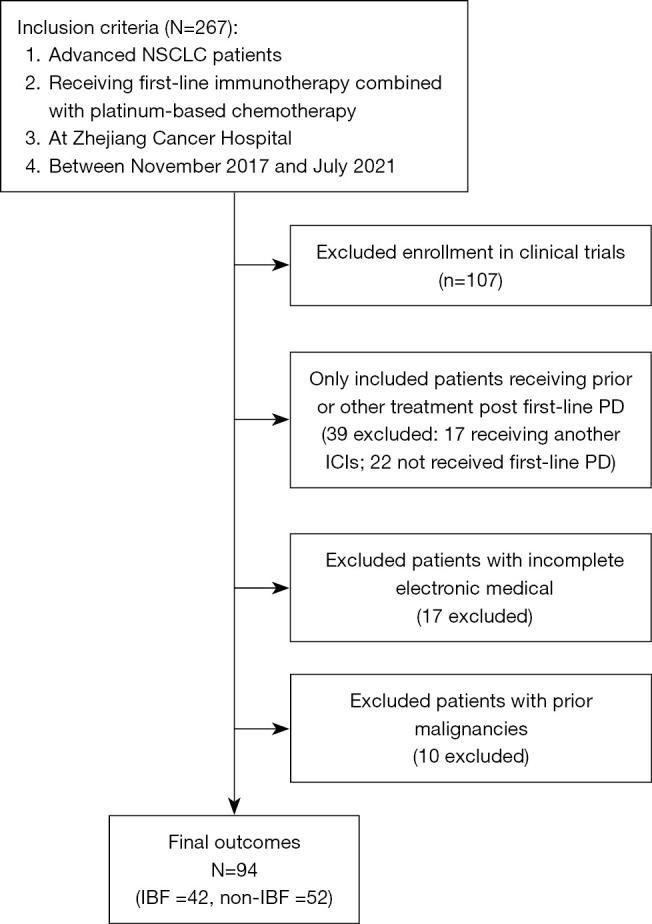
Ninety-four cases of advanced NSCLC patients with progressive disease (PD) post first-line treatment with platinum-based chemotherapy plus immunotherapy and administrated prior immune checkpoint inhibitors (ICIs) between November 2017 and July 2021 were retrospectively analyzed. Survival curves were plotted using the Kaplan-Meier method. Cox proportional hazards regression analyses were applied to determine predictive factors independently associated with second-line efficacity.
RESULTS
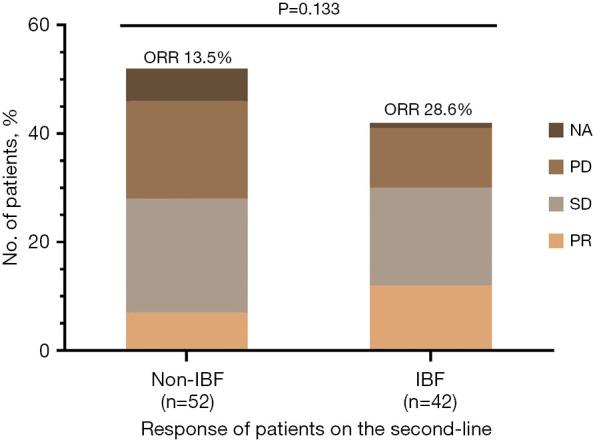
A total of 94 patients were incorporated in this study. Patients who continued the original ICIs after initial PD were defined as IBF (n=42), whereas those who discontinued immunotherapy were defined as non-IBF (n=52). The second-line objective response rates (ORR, ORR = CR + PR) of patients in the IBF and non-IBF groups were 13.5% 28.6%, respectively (P=0.070). No significant survival difference was found between patients in the IBF and non-IBF groups in first-line median progression-free survival (PFS) (mPFS1, 6.2 . 5.1 months, P=0.490), second-line median PFS (mPFS2, 4.5 . 2.6 months, P=0.216), or median overall survival (OS) (mOS, 14.4 . 8.3 months, P=0.188). However, the benefits inPFS2 were observed in individuals performed PFS1 >6 months (group A) than those of PFS1 ≤6 months (group B) (median PFS2, 4.6 . 3.2 months, P=0.038). Multivariate analyses did not reveal any independent prognostic factors for efficacy.
CONCLUSIONS
The benefits of continuing prior ICIs administration beyond first-line immunotherapy progression might not be obvious in patients with advanced NSCLC, but those first line treatment showed a longer period may receive efficacy benefits.
背景
免疫疗法、单一疗法以及免疫疗法联合铂类化疗是驱动基因阴性的晚期非小细胞肺癌(NSCLC)患者的标准治疗方法。然而,一线免疫疗法进展后继续进行类似免疫疗法(IBP)对晚期NSCLC的影响尚未得到证实。本研究旨在评估一线进展后免疫疗法(IBF)的影响,并评估与二线疗效相关的因素。
方法
回顾性分析了2017年11月至2021年7月期间94例一线接受铂类化疗联合免疫疗法且之前接受过免疫检查点抑制剂(ICI)治疗后出现疾病进展(PD)的晚期NSCLC患者。采用Kaplan-Meier法绘制生存曲线。应用Cox比例风险回归分析确定与二线疗效独立相关的预测因素。
结果
本研究共纳入94例患者。初始PD后继续使用原ICI的患者被定义为IBF(n = 42),而停止免疫治疗的患者被定义为非IBF(n = 52)。IBF组和非IBF组患者的二线客观缓解率(ORR,ORR = CR + PR)分别为13.5%和28.6%(P = 0.070)。IBF组和非IBF组患者在一线中位无进展生存期(PFS)(mPFS1,6.2对5.1个月,P = 0.490)、二线中位PFS(mPFS2,4.5对2.6个月,P = 0.216)或中位总生存期(OS)(mOS,14.4对8.3个月,P = 0.188)方面均未发现显著的生存差异。然而,PFS1>6个月(A组)的患者在PFS2方面比PFS1≤6个月(B组)的患者更有获益(中位PFS2,4.6对3.2个月,P = 0.038)。多因素分析未发现任何疗效的独立预后因素。
结论
对于晚期NSCLC患者,一线免疫疗法进展后继续使用先前的ICI可能没有明显益处,但一线治疗时间较长的患者可能会获得疗效益处。



 Zotero 插件