
阿泊替尼治疗重度和/或难治性特应性皮炎患者的疗效和安全性:随机 3 期 JADE COMPARE 试验的事后分析。
Efficacy and Safety of Abrocitinib in Patients with Severe and/or Difficult-to-Treat Atopic Dermatitis: A Post Hoc Analysis of the Randomized Phase 3 JADE COMPARE Trial.
机构信息
Oregon Health & Science University, Portland, OR, USA.
The George Washington University School of Medicine and Health Sciences, Washington, DC, USA.
出版信息
Am J Clin Dermatol. 2023 Jul;24(4):609-621. doi: 10.1007/s40257-023-00785-5. Epub 2023 May 22.
BACKGROUND
Traditional systemic immunosuppressants and advanced therapies improve signs and symptoms of moderate-to-severe atopic dermatitis (AD). However, data are limited in severe and/or difficult-to-treat AD. In the phase 3 JADE COMPARE trial of patients with moderate-to-severe AD receiving background topical therapy, once-daily abrocitinib 200 mg and 100 mg showed significantly greater reductions in the symptoms of AD than placebo and significantly greater improvement in itch response (with abrocitinib 200 mg) than dupilumab at week 2.
OBJECTIVE
This study assessed the efficacy and safety of abrocitinib and dupilumab in a subset of patients with severe and/or difficult-to-treat AD in a post hoc analysis of the JADE COMPARE trial.
METHODS
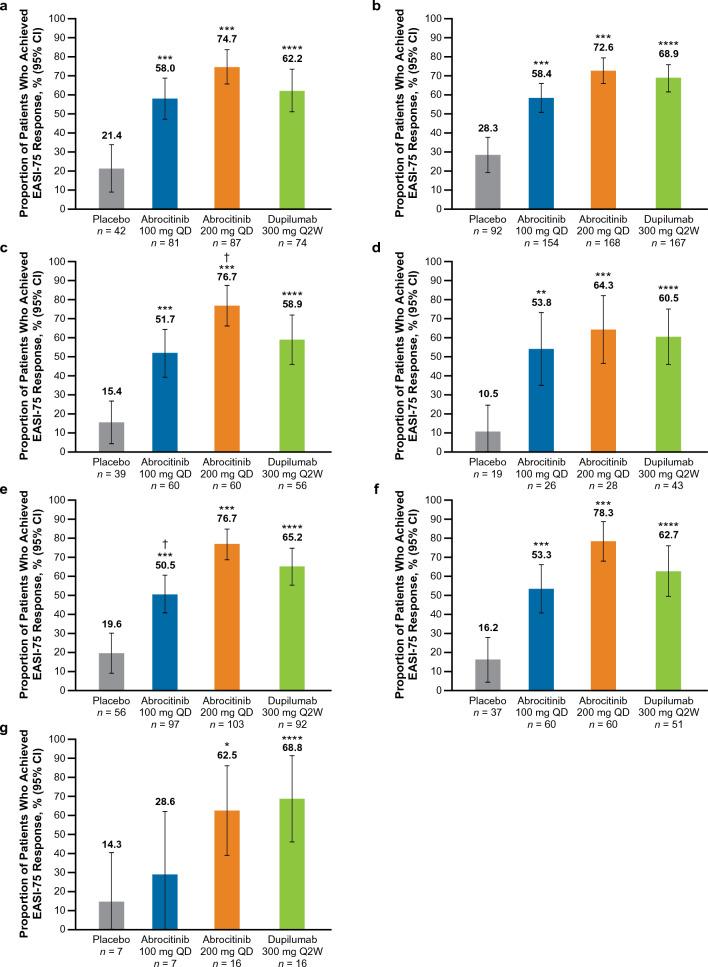
Adults with moderate-to-severe AD received once-daily oral abrocitinib 200 mg or 100 mg, dupilumab 300 mg subcutaneous injection every 2 weeks, or placebo with concomitant medicated topical therapy. Severe and/or difficult-to-treat AD subgroups were classified by baseline characteristics [Investigator's Global Assessment (IGA) 4, Eczema Area and Severity Index (EASI) > 21, failure or intolerance to prior systemic agents (excluding patients who took only corticosteroids), percentage of body surface area (%BSA) > 50, upper quartiles of EASI (EASI > 38) and %BSA (%BSA > 65), and combined subgroup of IGA 4, EASI > 21, and %BSA > 50, and failure or intolerance to prior systemic agents (excluding patients who took only corticosteroids)]. Assessments included IGA score of 0 (clear) or 1 (almost clear) and a ≥ 2-point improvement from baseline, ≥ 75% and ≥ 90% improvement from baseline in EASI (EASI-75 and EASI-90), ≥ 4-point improvement from baseline in Peak Pruritus-Numerical Rating Scale (PP-NRS4), time to PP-NRS4, least squares mean (LSM) change from baseline in 14-day PP-NRS (days 2-15), Patient-Oriented Eczema Measure (POEM), and Dermatology Life Quality Index (DLQI) up to week 16.
RESULTS
The proportion of patients achieving IGA 0/1, EASI-75, and EASI-90 responses was significantly greater with abrocitinib 200 mg than placebo (nominal p < 0.05) across all subgroups with severe and/or difficult-to-treat AD. Across most subgroups, PP-NRS4 response was significantly greater with abrocitinib 200 mg than placebo (nominal p < 0.01); the time to achieve this response was shorter with abrocitinib 200 mg (range 4.5-6.0 days) than abrocitinib 100 mg (range 5.0-17.0 days), dupilumab (range 8.0-11.0 days), and placebo (range 3.0-11.5 days). LSM change from baseline in POEM and DLQI was significantly greater with abrocitinib 200 mg than placebo (nominal p < 0.001) across all subgroups. Clinically meaningful differences were observed between abrocitinib and dupilumab for most evaluated endpoints across several subgroups, including in patients who failed or were intolerant to prior systemic therapy.
CONCLUSIONS
Abrocitinib provided rapid and substantially greater improvements in skin clearance and quality of life compared with placebo and dupilumab in subgroups of patients with severe and/or difficult-to-treat AD. These findings support the use of abrocitinib for severe and/or difficult-to-treat AD.
TRIAL REGISTRATION
ClinicalTrials.gov, NCT03720470.
背景
传统的全身性免疫抑制剂和先进的治疗方法可改善中重度特应性皮炎(AD)的体征和症状。然而,在严重和/或难治性 AD 患者中,数据有限。在中度至重度 AD 患者接受背景局部治疗的 3 期 JADE COMPARE 试验中,每日一次阿布昔替尼 200mg 和 100mg 显著降低 AD 症状,与安慰剂相比,瘙痒反应显著改善(阿布昔替尼 200mg 组),与度普利尤单抗相比,瘙痒反应显著改善(阿布昔替尼 200mg 组)与度普利尤单抗相比,瘙痒反应显著改善(阿布昔替尼 200mg 组)在第 2 周。
目的
本研究在后 JADE COMPARE 试验的事后分析中评估了阿布昔替尼和度普利尤单抗在严重和/或难治性 AD 患者亚组中的疗效和安全性。
方法
中度至重度 AD 患者每日口服阿布昔替尼 200mg 或 100mg、度普利尤单抗 300mg 每 2 周皮下注射一次,或同时给予经批准的局部治疗药物。严重和/或难治性 AD 亚组根据基线特征进行分类[研究者全球评估(IGA)4、湿疹面积和严重程度指数(EASI)>21、对既往全身药物治疗失败或不耐受(不包括仅接受皮质类固醇的患者)、体表面积百分比(%BSA)>50、EASI 的上四分位数(EASI>38)和%BSA(%BSA>65),以及 IGA 4、EASI>21 和%BSA>50,以及既往全身药物治疗失败或不耐受(不包括仅接受皮质类固醇的患者)]。评估包括 IGA 评分 0(清除)或 1(几乎清除)和自基线至少 2 分改善,EASI 自基线至少 75%和 90%改善(EASI-75 和 EASI-90),自基线至少 4 分改善Peak Pruritus-Numerical Rating Scale(PP-NRS4),PP-NRS4 的时间,14 天 PP-NRS(第 2-15 天)的最小平方均数(LSM)变化,患者为导向的湿疹测量(POEM)和皮肤病生活质量指数(DLQI)至第 16 周。
结果
与安慰剂相比,在所有严重和/或难治性 AD 患者亚组中,阿布昔替尼 200mg 达到 IGA 0/1、EASI-75 和 EASI-90 反应的患者比例显著更高(名义 p<0.05)。在大多数亚组中,与安慰剂相比,PP-NRS4 反应显著更大(名义 p<0.01);与阿布昔替尼 100mg(范围 5.0-17.0 天)、度普利尤单抗(范围 8.0-11.0 天)和安慰剂(范围 3.0-11.5 天)相比,达到这一反应的时间更短(范围 4.5-6.0 天)。与安慰剂相比,LSM 自基线在 POEM 和 DLQI 中的变化更大(名义 p<0.001)在所有亚组中。
结论
与安慰剂和度普利尤单抗相比,阿布昔替尼在严重和/或难治性 AD 患者亚组中提供了更快且显著更大的皮肤清除率和生活质量改善。这些发现支持使用阿布昔替尼治疗严重和/或难治性 AD。
试验注册
ClinicalTrials.gov,NCT03720470。



 Zotero 插件