
四聚体雌激素受体 α/14-3-3ζ 蛋白复合物的分子基础和双重配体调控。
Molecular basis and dual ligand regulation of tetrameric estrogen receptor α/14-3-3ζ protein complex.
机构信息
Department of Biomedical Engineering and Institute for Complex Molecular Systems, Laboratory of Chemical Biology, Eindhoven University of Technology, Eindhoven, The Netherlands.
Department of Physical and Macromolecular Chemistry, Faculty of Science, Charles University, Prague, Czech Republic.
出版信息
J Biol Chem. 2023 Jul;299(7):104855. doi: 10.1016/j.jbc.2023.104855. Epub 2023 May 22.
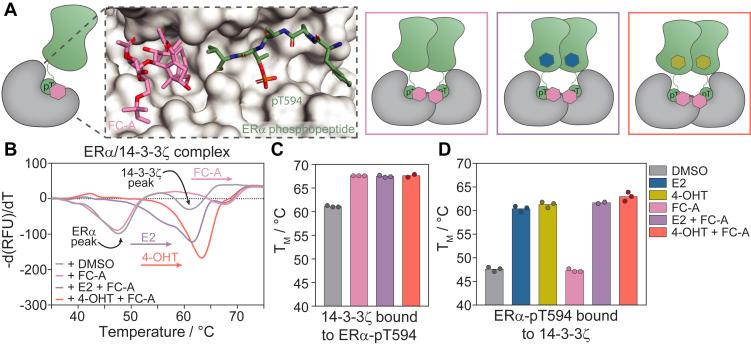
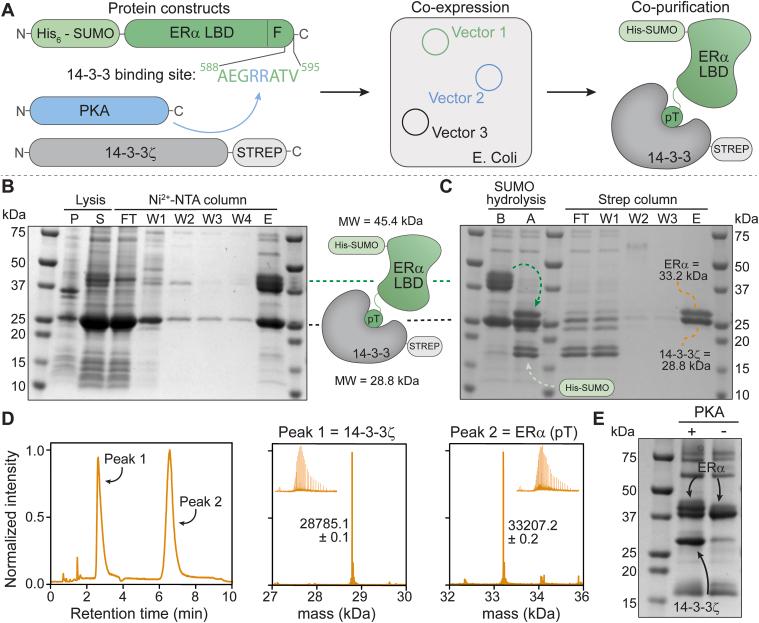
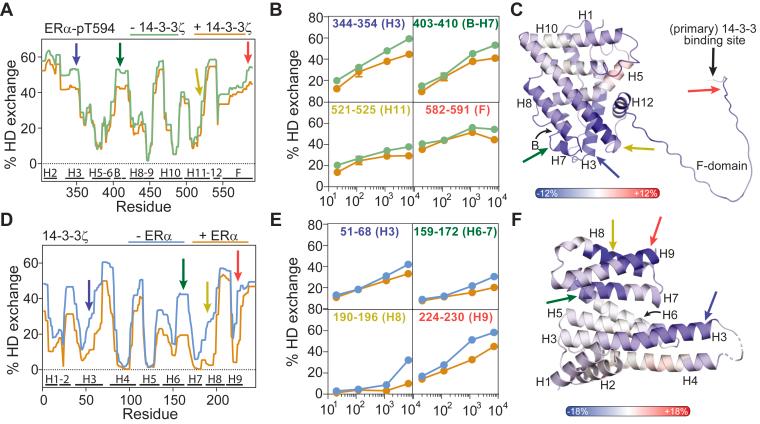
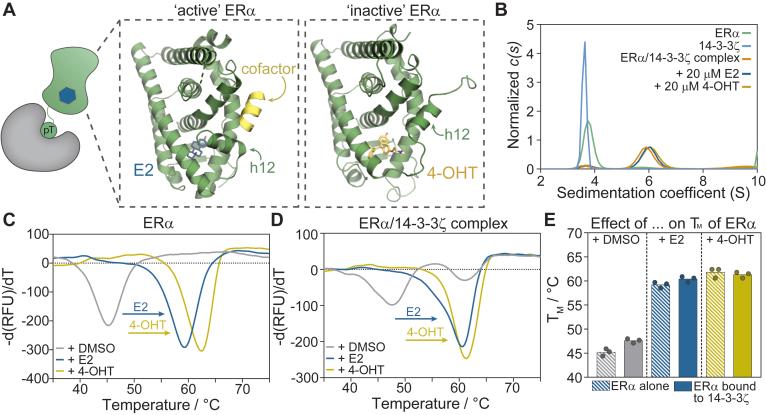
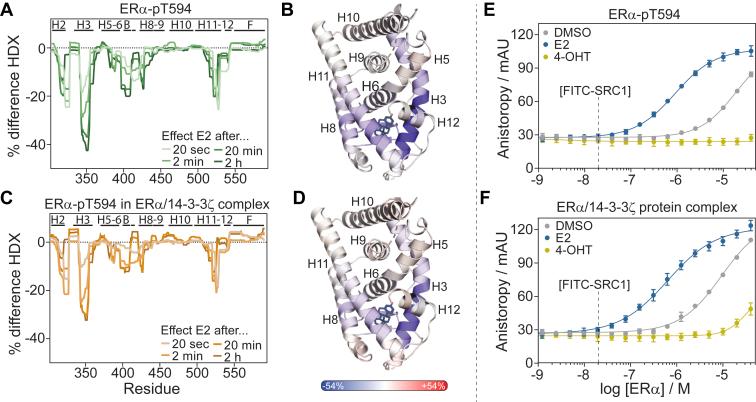
Therapeutic strategies targeting nuclear receptors (NRs) beyond their endogenous ligand binding pocket have gained significant scientific interest driven by a need to circumvent problems associated with drug resistance and pharmacological profile. The hub protein 14-3-3 is an endogenous regulator of various NRs, providing a novel entry point for small molecule modulation of NR activity. Exemplified, 14-3-3 binding to the C-terminal F-domain of the estrogen receptor alpha (ERα), and small molecule stabilization of the ERα/14-3-3ζ protein complex by the natural product Fusicoccin A (FC-A), was demonstrated to downregulate ERα-mediated breast cancer proliferation. This presents a novel drug discovery approach to target ERα; however, structural and mechanistic insights into ERα/14-3-3 complex formation are lacking. Here, we provide an in-depth molecular understanding of the ERα/14-3-3ζ complex by isolating 14-3-3ζ in complex with an ERα protein construct comprising its ligand-binding domain (LBD) and phosphorylated F-domain. Bacterial co-expression and co-purification of the ERα/14-3-3ζ complex, followed by extensive biophysical and structural characterization, revealed a tetrameric complex between the ERα homodimer and the 14-3-3ζ homodimer. 14-3-3ζ binding to ERα, and ERα/14-3-3ζ complex stabilization by FC-A, appeared to be orthogonal to ERα endogenous agonist (E2) binding, E2-induced conformational changes, and cofactor recruitment. Similarly, the ERα antagonist 4-hydroxytamoxifen inhibited cofactor recruitment to the ERα LBD while ERα was bound to 14-3-3ζ. Furthermore, stabilization of the ERα/14-3-3ζ protein complex by FC-A was not influenced by the disease-associated and 4-hydroxytamoxifen resistant ERα-Y537S mutant. Together, these molecular and mechanistic insights provide direction for targeting ERα via the ERα/14-3-3 complex as an alternative drug discovery approach.
靶向核受体(NRs)的治疗策略超出了它们的内源性配体结合口袋,这一策略引起了科学界的极大兴趣,因为它需要解决与药物耐药性和药理学特征相关的问题。14-3-3 是各种 NRs 的内源性调节剂,为小分子调节 NR 活性提供了一个新的切入点。例如,14-3-3 与雌激素受体α(ERα)的 C 端 F 结构域结合,天然产物 Fusicoccin A(FC-A)稳定 ERα/14-3-3ζ 蛋白复合物,从而下调 ERα 介导的乳腺癌增殖。这为靶向 ERα 提供了一种新的药物发现方法;然而,缺乏对 ERα/14-3-3 复合物形成的结构和机制见解。在这里,我们通过分离与包含其配体结合域(LBD)和磷酸化 F 结构域的 ERα 蛋白构建体结合的 14-3-3ζ,提供了对 ERα/14-3-3ζ 复合物的深入分子理解。细菌共表达和共纯化 ERα/14-3-3ζ 复合物,然后进行广泛的生物物理和结构表征,揭示了 ERα 同源二聚体和 14-3-3ζ 同源二聚体之间的四聚体复合物。14-3-3ζ 与 ERα 的结合,以及 FC-A 稳定 ERα/14-3-3ζ 复合物,似乎与 ERα 内源性激动剂(E2)结合、E2 诱导的构象变化和辅助因子募集无关。同样,ERα 拮抗剂 4-羟基他莫昔芬抑制辅助因子募集到 ERα LBD,而 ERα 与 14-3-3ζ 结合。此外,FC-A 稳定 ERα/14-3-3ζ 蛋白复合物不受与疾病相关和 4-羟基他莫昔芬耐药的 ERα-Y537S 突变体的影响。总之,这些分子和机制见解为通过 ERα/14-3-3 复合物作为替代药物发现方法靶向 ERα 提供了方向。


 Zotero 插件