
地舒单抗的长期使用及其与骨骼相关事件和颌骨坏死的关系。
Long-term use of denosumab and its association with skeletal-related events and osteonecrosis of the jaw.
机构信息
Department of Internal Medicine, National Cheng Kung University Hospital, College of Medicine, National Cheng Kung University, Tainan, Taiwan.
School of Pharmacy, Institute of Clinical Pharmacy and Pharmaceutical Sciences, College of Medicine, National Cheng Kung University, Tainan, Taiwan.
出版信息
Sci Rep. 2023 May 24;13(1):8403. doi: 10.1038/s41598-023-35308-z.
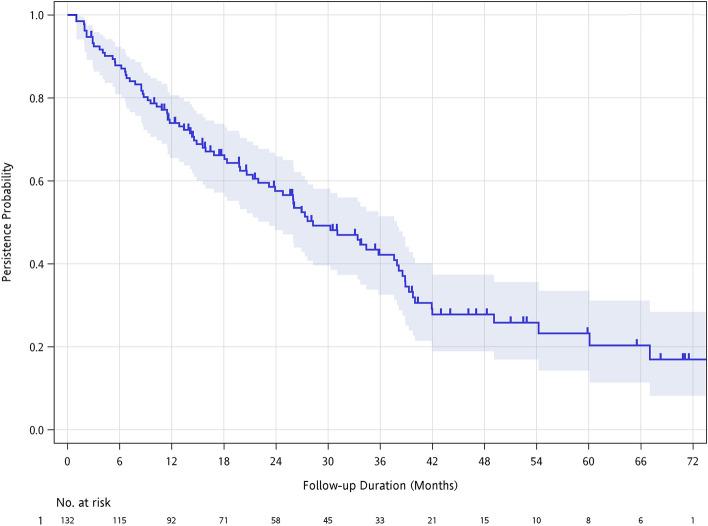
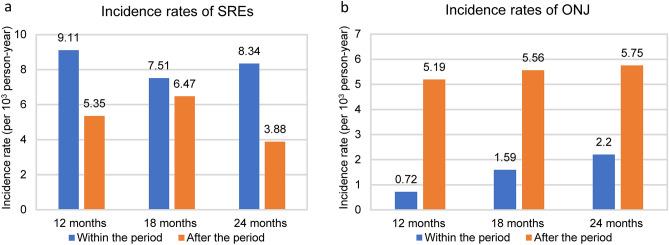
Denosumab, an inhibitor of receptor activator of nuclear factor kappa-B ligand, reduces skeletal-related events (SREs) and is approved for solid tumors with bone metastases. We studied long-term denosumab efficacy and safety because real-world data is scarce. This single-arm, single-center retrospective study included denosumab-treated breast cancer patients with bone metastases. Kaplan-Meier survival curves assessed exposure, SREs, osteonecrosis of the jaw (ONJ), and death. 132 patients were enrolled. The median denosumab exposure was 28.3 months (range 1.0-84.9). In the first year, 11.1% experienced SREs. This increased to 18.6% in the second, 21% in the third, and 35.1% in the fourth year and beyond. The median time to first on-study SRE has not been reached. 10 denosumab users (7.6%) developed ONJ. ONJ incidence was 0.9% in the first year, 6.2% in the second, 13.6% in the third, and 16.2% in subsequent years. The median time to first on-study ONJ has not been reached yet. Seven patients resumed denosumab after careful management of ONJ. Our data suggest that long-term treatment with denosumab may further prevent or postpone SREs at the cost of an increased risk of ONJ. The majority of patients who resumed denosumab did not experience a recurrence of ONJ.
地舒单抗是一种核因子κB 配体受体激活剂抑制剂,可减少骨骼相关事件(SREs),并已批准用于伴有骨转移的实体瘤。由于缺乏真实世界的数据,我们研究了地舒单抗的长期疗效和安全性。这项单臂、单中心回顾性研究纳入了接受地舒单抗治疗的伴有骨转移的乳腺癌患者。采用 Kaplan-Meier 生存曲线评估暴露、SREs、颌骨坏死(ONJ)和死亡情况。共纳入 132 例患者。地舒单抗的中位暴露时间为 28.3 个月(范围 1.0-84.9)。第一年有 11.1%的患者发生 SREs。第二年增至 18.6%,第三年增至 21%,第四年及以后增至 35.1%。首次研究相关 SRE 的中位时间尚未达到。10 例(7.6%)地舒单抗使用者发生 ONJ。第一年的 ONJ 发生率为 0.9%,第二年为 6.2%,第三年为 13.6%,随后各年为 16.2%。首次研究相关 ONJ 的中位时间尚未达到。7 例患者在对 ONJ 进行精心管理后恢复了地舒单抗治疗。我们的数据表明,长期使用地舒单抗可能会进一步预防或推迟 SREs,但会增加 ONJ 的风险。大多数恢复地舒单抗治疗的患者未出现 ONJ 复发。



 Zotero 插件