
亚洲风湿性心脏病负担、趋势和不平等,1990-2019 年。
Rheumatic heart disease burden, trends, and inequalities in Asia, 1990-2019.
机构信息
Department of Pharmacy, Fujian Maternity and Child Health Hospital, College of Clinical Medicine for Obstetrics & Gynecology and Pediatrics, Fujian Medical University, Fuzhou, China.
出版信息
Glob Health Action. 2023 Dec 31;16(1):2215011. doi: 10.1080/16549716.2023.2215011.
BACKGROUND
Rheumatic heart disease (RHD) is a serious global public health problem.
OBJECTIVES
This study aims to characterise the regional burden, trends, and inequalities of RHD in countries and territories in the Asian Region.
METHODS
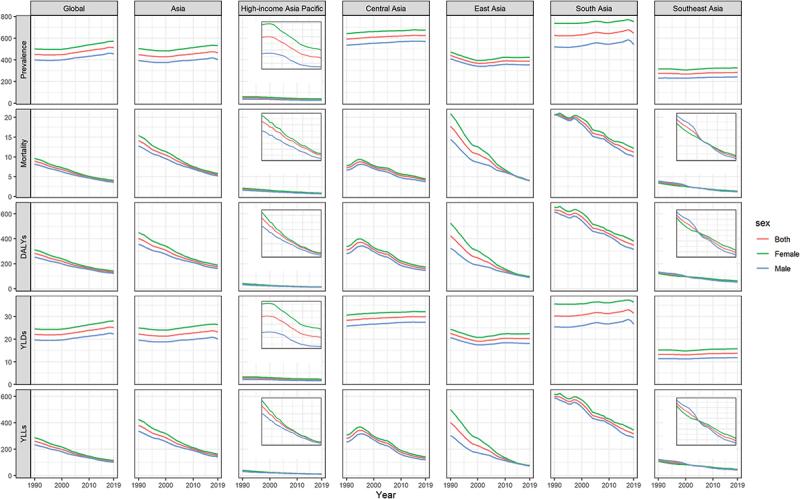
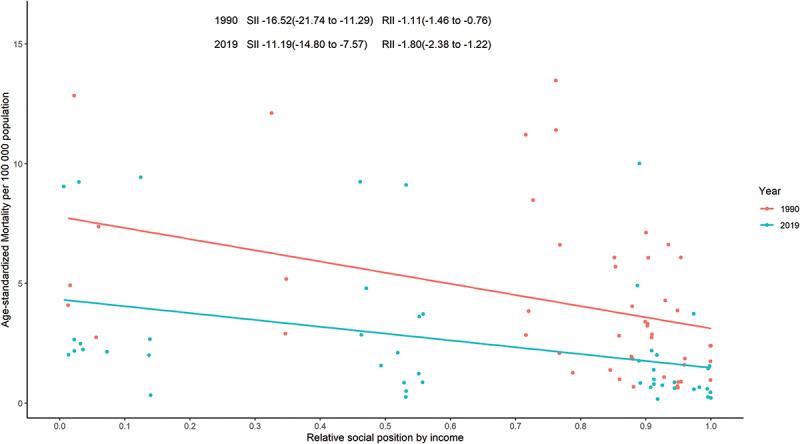
The RHD disease burden was measured in terms of the numbers of cases and deaths, prevalence, disability-adjusted life years (DALYs), disability-loss healthy life years (YLDs), and years of life lost (YLLs) in 48 countries in the Asian Region. Data on RHD were extracted from the 2019 Global Burden of Disease. This study analysed changing trends in the burden between 1990 and 2019, quantified regional inequalities in mortality, and classified countries by 2019 YLLs.
RESULTS
There were an estimated 22 246 127 cases of RHD in the Asian Region in 2019 and 249 830 deaths. The prevalence of RHD in the Asian Region in 2019 was 9% lower than the global estimate, while mortality was 41% higher. The mortality rate for RHD in the Asian Region trended downwards from 1990 to 2019, with an average annual percentage change of -3.2% (95% UI -3.3 to -3.1). From 1990 to 2019, absolute inequality in RHD-related mortality decreased in the Asian Region while relative inequality increased. Of the 48 countries studied, twelve had the highest level of RHD YLLs in 2017 and the smallest reduction in YLLs from 1990 to 2019.
CONCLUSION
Although the burden of RHD in the Asian Region has steadily decreased since 1990, it remains a serious public health issue requiring greater attention. In the Asian Region, inequalities in the distribution of the RHD burden remain significant, with economically deprived countries typically bearing a greater share of the load.
背景
风湿性心脏病(Rheumatic Heart Disease,RHD)是一个严重的全球公共卫生问题。
目的
本研究旨在描述亚洲区域各国和地区的 RHD 区域负担、趋势和不平等情况。
方法
使用病例数和死亡数、患病率、残疾调整生命年(Disability-Adjusted Life Years,DALYs)、丧失健康生命年(Years of Life Lost to Disability,YLDs)和生命损失年(Years of Life Lost,YLLs)来衡量 RHD 的疾病负担,数据来自 2019 年全球疾病负担研究。本研究分析了 1990 年至 2019 年负担变化趋势,量化了死亡率的区域不平等,并根据 2019 年 YLLs 对各国进行了分类。
结果
2019 年亚洲区域 RHD 估计病例数为 22246127 例,死亡数为 249830 例。亚洲区域 2019 年 RHD 的患病率比全球估计值低 9%,而死亡率高 41%。1990 年至 2019 年,亚洲区域 RHD 死亡率呈下降趋势,平均年变化率为-3.2%(95%置信区间-3.3%至-3.1%)。从 1990 年至 2019 年,亚洲区域 RHD 相关死亡率的绝对不平等程度下降,相对不平等程度上升。在所研究的 48 个国家中,有 12 个国家 2017 年 RHD 所致 YLL 最高,且 1990 年至 2019 年 YLL 减少幅度最小。
结论
尽管自 1990 年以来亚洲区域的 RHD 负担稳步下降,但仍是一个严重的公共卫生问题,需要引起更多关注。在亚洲区域,RHD 负担分布的不平等现象仍然显著,经济落后国家通常承担更大的负担。



 Zotero 插件