
群居昆虫肠道细菌群落的基本结构
Basic Structures of Gut Bacterial Communities in Eusocial Insects.
作者信息
Suenami Shota, Koto Akiko, Miyazaki Ryo
机构信息
Bioproduction Research Institute, National Institute of Advanced Industrial Science and Technology (AIST), Tsukuba 305-8566, Japan.
Computational Bio Big Data Open Innovation Laboratory (CBBD-OIL), AIST, Tokyo 169-8555, Japan.
出版信息
Insects. 2023 May 8;14(5):444. doi: 10.3390/insects14050444.
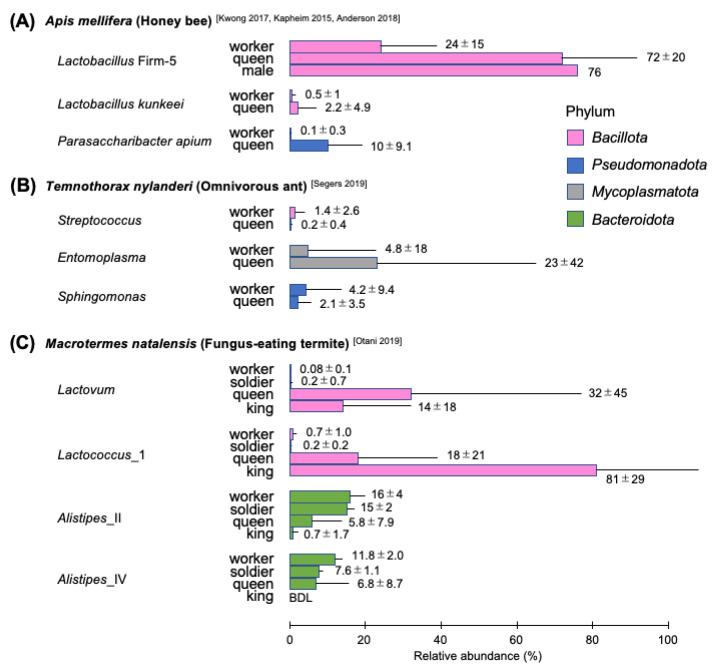
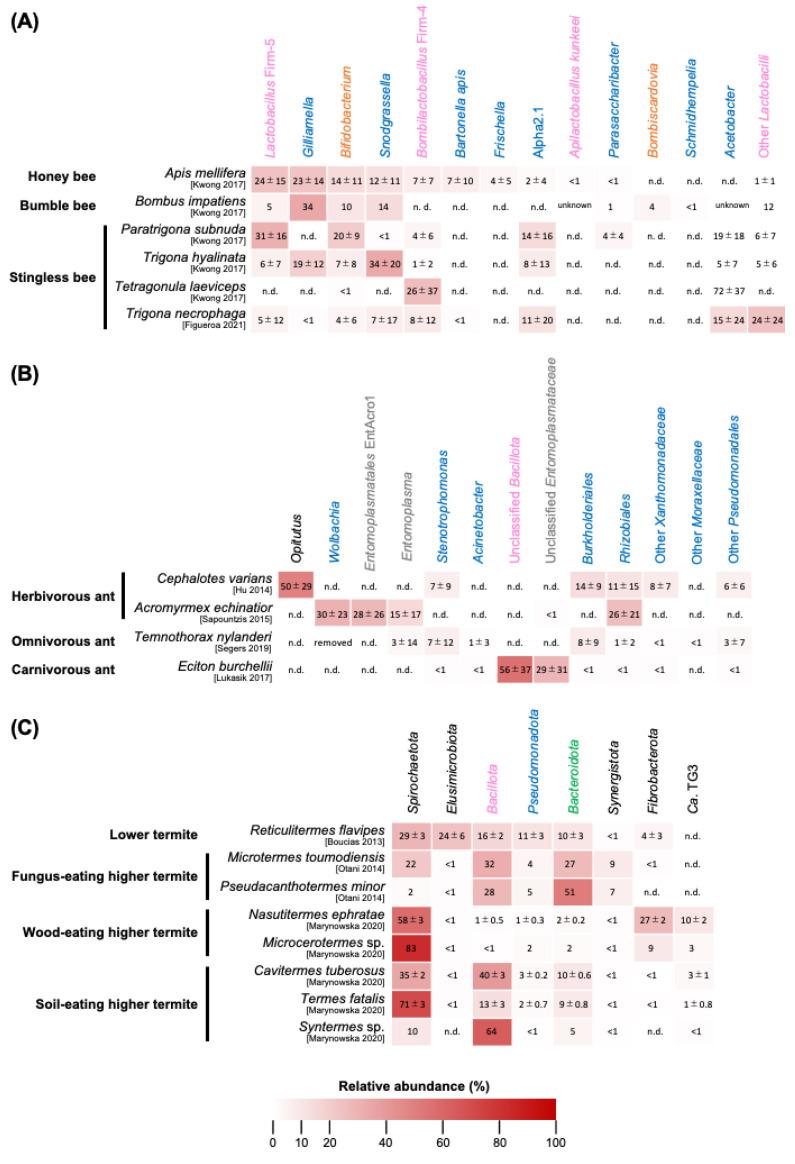
Gut bacterial communities assist host animals with numerous functions such as food digestion, nutritional provision, or immunity. Some social mammals and insects are unique in that their gut microbial communities are stable among individuals. In this review, we focus on the gut bacterial communities of eusocial insects, including bees, ants, and termites, to provide an overview of their community structures and to gain insights into any general aspects of their structural basis. and are prevalent bacterial phyla commonly detected in those three insect groups, but their compositions are distinct at lower taxonomic levels. Eusocial insects harbor unique gut bacterial communities that are shared within host species, while their stability varies depending on host physiology and ecology. Species with narrow dietary habits, such as eusocial bees, harbor highly stable and intraspecific microbial communities, while generalists, such as most ant species, exhibit relatively diverse community structures. Caste differences could influence the relative abundance of community members without significantly altering the taxonomic composition.
肠道细菌群落协助宿主动物完成众多功能,如食物消化、营养供应或免疫。一些社会性哺乳动物和昆虫的独特之处在于,它们的肠道微生物群落在个体之间是稳定的。在这篇综述中,我们聚焦于群居性昆虫的肠道细菌群落,包括蜜蜂、蚂蚁和白蚁,以概述它们的群落结构,并深入了解其结构基础的一般方面。厚壁菌门和拟杆菌门是在这三类昆虫群体中普遍检测到的细菌门类,但它们在较低分类水平上的组成有所不同。群居性昆虫拥有在宿主物种内共享的独特肠道细菌群落,而它们的稳定性因宿主生理和生态而异。饮食习惯狭窄的物种,如群居性蜜蜂,拥有高度稳定的种内微生物群落,而杂食性物种,如大多数蚂蚁物种,则表现出相对多样的群落结构。 caste差异可能会影响群落成员的相对丰度,而不会显著改变分类组成。 (注:原文中“and”前似乎有信息缺失,翻译中保留了这一情况;“caste”可能是“cast”的错误,暂且按“caste”翻译,具体需结合完整准确原文进一步确定)
 Zotero 插件