
解读成人肥胖、重度肥胖及身体质量指数:五十年的变迁
Explaining adult obesity, severe obesity, and BMI: Five decades of change.
作者信息
Kranjac Ashley W, Kranjac Dinko
机构信息
Department of Sociology, Wilkinson College, Chapman University, Orange, CA, USA.
Psychology Program, Institute of Mental Health and Psychological Well-Being, College of Health and Community Well-Being, University of La Verne, La Verne, CA, USA.
出版信息
Heliyon. 2023 May 19;9(5):e16210. doi: 10.1016/j.heliyon.2023.e16210. eCollection 2023 May.
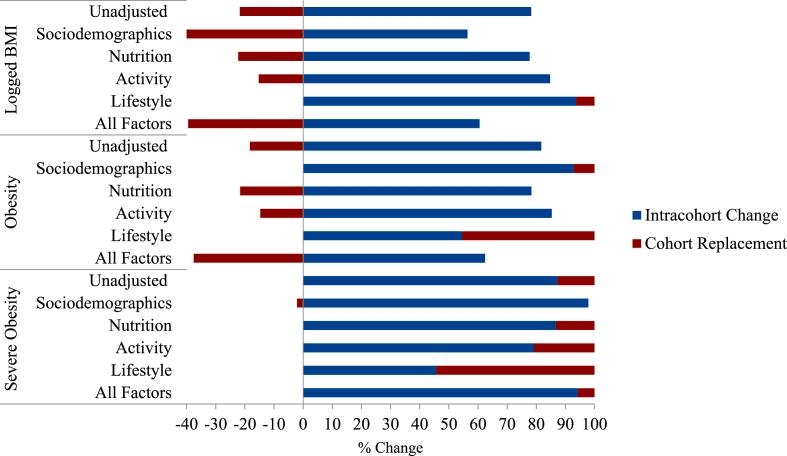
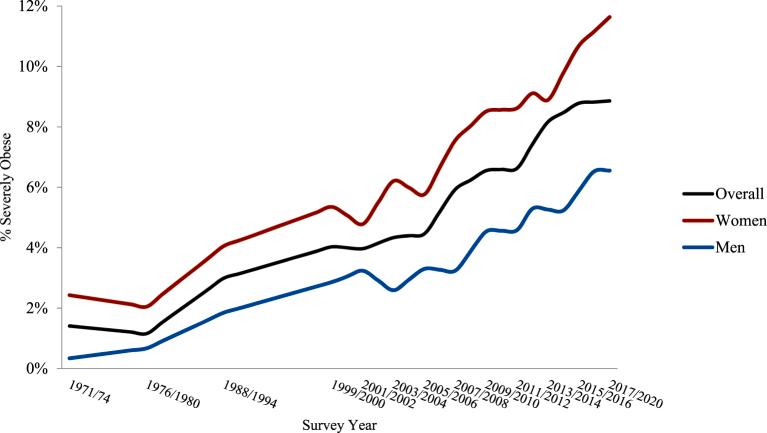
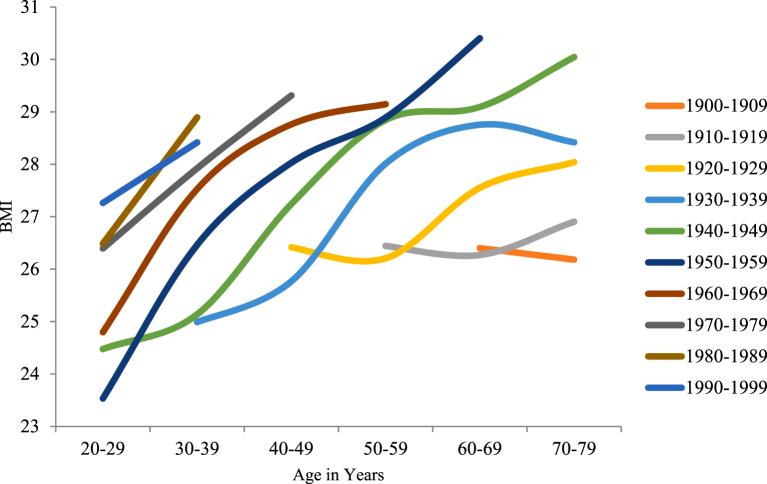
Obesity rates have increased across all segments of society since the late 1970s, but the reason behind population-level increases in body weight remains unclear. We used the 1971-2020 NHANES data to examine whether the observed trend in obesity prevalence is attributable to changing public health behaviors (i.e., intracohort change) changing publics (i.e., cohort replacement). We partitioned total change in mean BMI, and rates of obesity and severe obesity, into its IC and CR components using linear and algebraic decomposition methods. We found that the IC mechanism (i.e., broad sectors of individuals changing) plays a dominant role in the overall increase in mean BMI, and obesity and severe obesity prevalence. Birth cohort membership (i.e., the CR mechanism) is also influencing mean BMI, and rates of obesity and severe obesity, but in differing ways. Specifically, the large positive IC and the small positive CR effects are amplifying one another, thus creating a steep increase in the observed rates of severe obesity. Conversely, the large positive IC effect is offset by a small negative CR effect, which created a more gradual rise in mean BMI and rates of obesity. Furthermore, we computed total change for models that entered separately sociodemographic, lifestyle, nutritional, and physical activity measures to estimate differences in mean BMI, and rates of obesity and severe obesity, among cohorts and time periods. Adjustment for all the compositional differences among the cohorts during the study period indicate that a combination of a more pronounced IC and a less pronounced CR drove the observed increase in mean BMI, and rates of obesity and severe obesity. Thus, "universal prevention" (i.e., entire community) strategies for healthy weight promotion may need to be combined with "selective prevention" (i.e., at-risk groups) and/or "targeted prevention" (i.e., at-risk individuals) approaches in order to reverse the obesity epidemic.
自20世纪70年代末以来,肥胖率在社会各阶层都有所上升,但体重在人群层面增加背后的原因仍不清楚。我们使用1971 - 2020年美国国家健康与营养检查调查(NHANES)数据,来检验观察到的肥胖患病率趋势是否归因于不断变化的公共卫生行为(即队列内变化)或不断变化的人群(即队列更替)。我们使用线性和代数分解方法,将平均体重指数(BMI)、肥胖率和重度肥胖率的总变化,分解为其队列内变化(IC)和队列更替(CR)成分。我们发现,队列内变化机制(即广泛的个体群体发生变化)在平均BMI、肥胖率和重度肥胖患病率的总体增加中起主导作用。出生队列成员身份(即队列更替机制)也在影响平均BMI、肥胖率和重度肥胖率,但方式不同。具体而言,较大的正向队列内变化效应和较小的正向队列更替效应相互放大,从而导致观察到的重度肥胖率急剧上升。相反,较大的正向队列内变化效应被较小的负向队列更替效应抵消,这使得平均BMI和肥胖率上升更为平缓。此外,我们计算了分别纳入社会人口统计学、生活方式、营养和身体活动指标的模型的总变化,以估计不同队列和时间段之间平均BMI、肥胖率和重度肥胖率的差异。对研究期间队列之间所有构成差异进行调整后表明,更显著的队列内变化和不太显著的队列更替共同作用,推动了观察到的平均BMI、肥胖率和重度肥胖率的上升。因此,为促进健康体重而推行的“普遍预防”(即针对整个社区)策略,可能需要与“选择性预防”(即针对高危群体)和/或“针对性预防”(即针对高危个体)方法相结合,以扭转肥胖流行趋势。




 Zotero 插件