
系统文献回顾揭示了细胞生物医学研究中化学探针的使用不理想。
Systematic literature review reveals suboptimal use of chemical probes in cell-based biomedical research.
机构信息
Faculty of Medicine and Health, Charles Perkins Centre, The University of Sydney, Camperdown, NSW, 2006, Australia.
Discipline of Chemistry, School of Environmental and Life Sciences, The University of Newcastle, Callaghan, NSW, 2308, Australia.
出版信息
Nat Commun. 2023 Jun 3;14(1):3228. doi: 10.1038/s41467-023-38952-1.
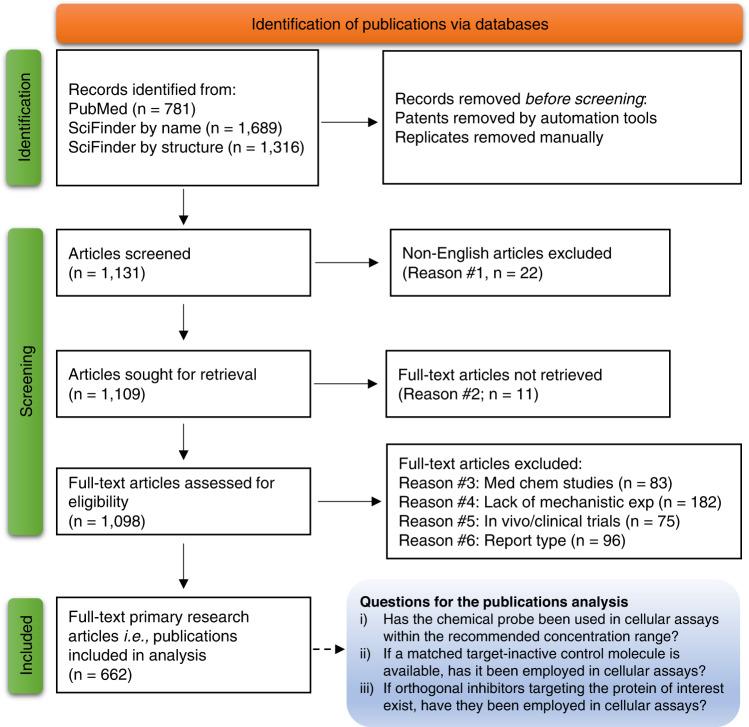
Chemical probes have reached a prominent role in biomedical research, but their impact is governed by experimental design. To gain insight into the use of chemical probes, we conducted a systematic review of 662 publications, understood here as primary research articles, employing eight different chemical probes in cell-based research. We summarised (i) concentration(s) at which chemical probes were used in cell-based assays, (ii) inclusion of structurally matched target-inactive control compounds and (iii) orthogonal chemical probes. Here, we show that only 4% of analysed eligible publications used chemical probes within the recommended concentration range and included inactive compounds as well as orthogonal chemical probes. These findings indicate that the best practice with chemical probes is yet to be implemented in biomedical research. To achieve this, we propose 'the rule of two': At least two chemical probes (either orthogonal target-engaging probes, and/or a pair of a chemical probe and matched target-inactive compound) to be employed at recommended concentrations in every study.
化学探针在生物医学研究中已经发挥了重要作用,但它们的影响受到实验设计的制约。为了深入了解化学探针的应用,我们对 662 篇采用了 8 种不同化学探针的基于细胞的研究的原始研究文章进行了系统回顾。我们总结了(i)在细胞实验中使用化学探针的浓度,(ii)包含结构匹配的靶无活性对照化合物,以及(iii)正交化学探针。研究结果表明,仅有 4%的分析合格出版物在细胞实验中使用了推荐浓度范围内的化学探针,并且包含了无活性化合物和正交化学探针。这些发现表明,化学探针的最佳实践尚未在生物医学研究中得到应用。为此,我们提出了“二原则”:即在每一项研究中,至少应使用两种化学探针(即正交的靶结合探针,和/或一对化学探针和匹配的靶无活性化合物),并在推荐的浓度下使用。


 Zotero 插件