
“多组学”数据整合:在益生菌研究中的应用
'Multi-omics' data integration: applications in probiotics studies.
作者信息
Kwoji Iliya Dauda, Aiyegoro Olayinka Ayobami, Okpeku Moses, Adeleke Matthew Adekunle
机构信息
Discipline of Genetics, School of Life Sciences, College of Agriculture, Engineering and Sciences, University of KwaZulu-Natal, 4090, Durban, South Africa.
Unit for Environmental Sciences and Management, North-West University, Potchefstroom, Northwest, South Africa.
出版信息
NPJ Sci Food. 2023 Jun 5;7(1):25. doi: 10.1038/s41538-023-00199-x.
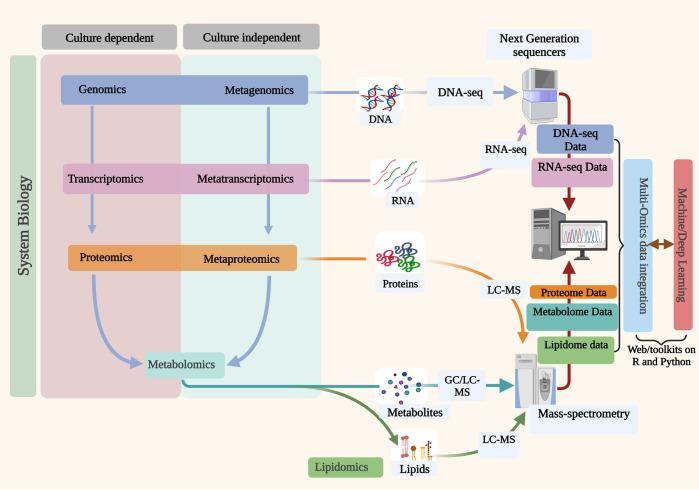
The concept of probiotics is witnessing increasing attention due to its benefits in influencing the host microbiome and the modulation of host immunity through the strengthening of the gut barrier and stimulation of antibodies. These benefits, combined with the need for improved nutraceuticals, have resulted in the extensive characterization of probiotics leading to an outburst of data generated using several 'omics' technologies. The recent development in system biology approaches to microbial science is paving the way for integrating data generated from different omics techniques for understanding the flow of molecular information from one 'omics' level to the other with clear information on regulatory features and phenotypes. The limitations and tendencies of a 'single omics' application to ignore the influence of other molecular processes justify the need for 'multi-omics' application in probiotics selections and understanding its action on the host. Different omics techniques, including genomics, transcriptomics, proteomics, metabolomics and lipidomics, used for studying probiotics and their influence on the host and the microbiome are discussed in this review. Furthermore, the rationale for 'multi-omics' and multi-omics data integration platforms supporting probiotics and microbiome analyses was also elucidated. This review showed that multi-omics application is useful in selecting probiotics and understanding their functions on the host microbiome. Hence, recommend a multi-omics approach for holistically understanding probiotics and the microbiome.
由于益生菌在影响宿主微生物群以及通过加强肠道屏障和刺激抗体来调节宿主免疫方面具有益处,其概念正受到越来越多的关注。这些益处,再加上对改良营养保健品的需求,促使人们对益生菌进行了广泛的表征,从而产生了大量使用多种“组学”技术的数据。微生物科学系统生物学方法的最新发展为整合不同组学技术产生的数据铺平了道路,以便理解分子信息从一个“组学”水平流向另一个水平,并清晰了解调控特征和表型。“单一组学”应用存在忽视其他分子过程影响的局限性和趋势,这证明了在益生菌选择及其对宿主作用的理解中需要应用“多组学”。本综述讨论了用于研究益生菌及其对宿主和微生物群影响的不同组学技术,包括基因组学、转录组学、蛋白质组学、代谢组学和脂质组学。此外,还阐明了支持益生菌和微生物群分析的“多组学”和多组学数据整合平台的基本原理。本综述表明,多组学应用有助于选择益生菌并理解它们对宿主微生物群的功能。因此,建议采用多组学方法来全面理解益生菌和微生物群。
 Zotero 插件