
二甲双胍联合低剂量替莫唑胺治疗复发或难治性胶质母细胞瘤患者的疗效与安全性:一项随机、前瞻性、多中心、双盲、对照的2期试验(KNOG-1501研究)。
Efficacy and safety of metformin plus low-dose temozolomide in patients with recurrent or refractory glioblastoma: a randomized, prospective, multicenter, double-blind, controlled, phase 2 trial (KNOG-1501 study).
作者信息
Yoon Wan-Soo, Chang Jong Hee, Kim Jeong Hoon, Kim Yu Jung, Jung Tae-Young, Yoo Heon, Kim Se-Hyuk, Ko Young-Cho, Nam Do-Hyun, Kim Tae Min, Kim Se Hoon, Park Sung-Hae, Lee Youn Soo, Yim Hyeon Woo, Hong Yong-Kil, Yang Seung Ho
机构信息
Department of Neurosurgery, Incheon St. Mary's Hospital, College of Medicine, The Catholic University of Korea, Seoul, Korea.
Department of Neurosurgery, Severance Hospital, Yonsei University College of Medicine, Seoul, Korea.
出版信息
Discov Oncol. 2023 Jun 6;14(1):90. doi: 10.1007/s12672-023-00678-3.
PURPOSE
Glioblastoma (GBM) has a poor prognosis after standard treatment. Recently, metformin has been shown to have an antitumor effect on glioma cells. We performed the first randomized prospective phase II clinical trial to investigate the clinical efficacy and safety of metformin in patients with recurrent or refractory GBM treated with low-dose temozolomide.
METHODS
Included patients were randomly assigned to a control group [placebo plus low-dose temozolomide (50 mg/m, daily)] or an experimental group [metformin (1000 mg, 1500 mg, and 2000 mg per day during the 1st, 2nd, and 3rd week until disease progression, respectively) plus low-dose temozolomide]. The primary endpoint was progression-free survival (PFS). Secondary endpoints were overall survival (OS), disease control rate, overall response rate, health-related quality of life, and safety.
RESULTS
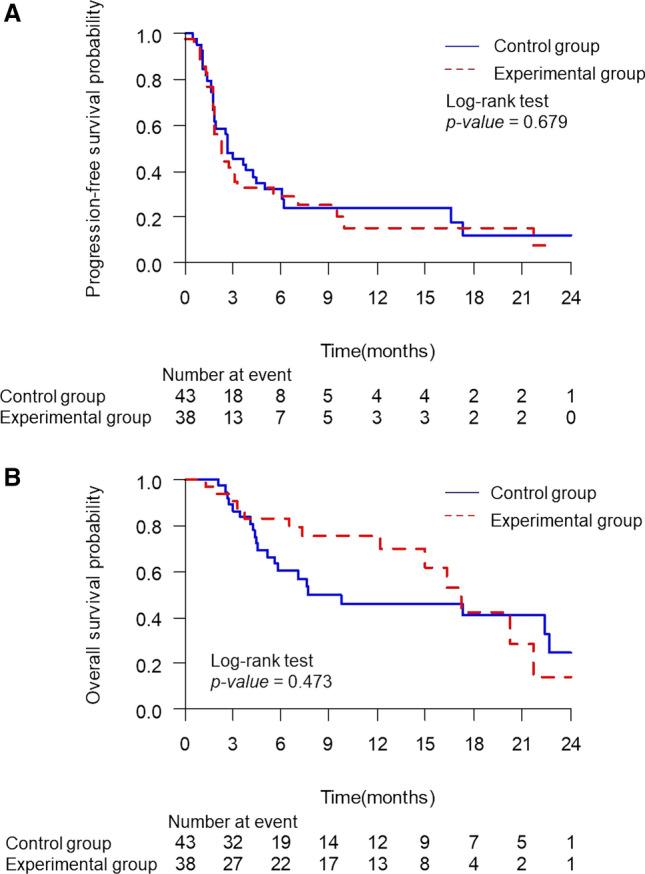
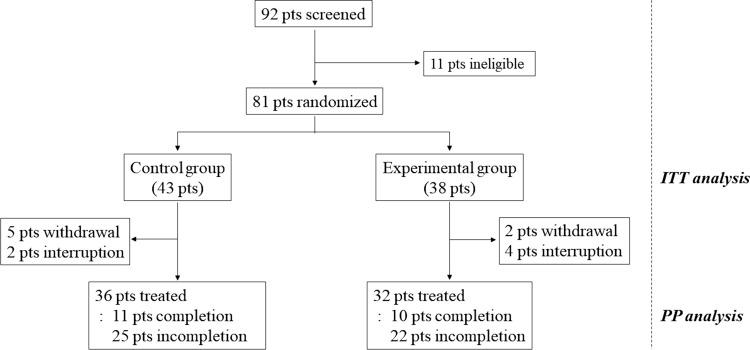
Among the 92 patients screened, 81 were randomly assigned to the control group (43 patients) or the experimental group (38 patients). Although the control group showed a longer median PFS, the difference between the two groups was not statistically significant (2.66 versus 2.3 months, p = 0.679). The median OS was 17.22 months (95% CI 12.19-21.68 months) in the experimental group and 7.69 months (95% CI 5.16-22.67 months) in the control group, showing no significant difference by the log-rank test (HR: 0.78; 95% CI 0.39-1.58; p = 0.473). The overall response rate and disease control rate were 9.3% and 46.5% in the control group and 5.3% and 47.4% in the experimental group, respectively.
CONCLUSIONS
Although the metformin plus temozolomide regimen was well tolerated, it did not confer a clinical benefit in patients with recurrent or refractory GBM. Trial registration NCT03243851, registered August 4, 2017.
目的
胶质母细胞瘤(GBM)在标准治疗后的预后较差。最近,二甲双胍已被证明对胶质瘤细胞具有抗肿瘤作用。我们开展了首个随机前瞻性II期临床试验,以研究二甲双胍在接受低剂量替莫唑胺治疗的复发或难治性GBM患者中的临床疗效和安全性。
方法
纳入的患者被随机分配至对照组[安慰剂加低剂量替莫唑胺(50mg/m²,每日)]或试验组[二甲双胍(第1、2、3周分别为1000mg、1500mg和2000mg,直至疾病进展)加低剂量替莫唑胺]。主要终点是无进展生存期(PFS)。次要终点包括总生存期(OS)、疾病控制率、总缓解率、健康相关生活质量和安全性。
结果
在92例筛查患者中,81例被随机分配至对照组(43例患者)或试验组(38例患者)。虽然对照组的中位PFS较长,但两组之间的差异无统计学意义(2.66个月对2.3个月,p = 0.679)。试验组的中位OS为17.22个月(95%CI 12.19 - 21.68个月),对照组为7.69个月(95%CI 5.16 - 22.67个月),对数秩检验显示无显著差异(HR:0.78;95%CI 0.39 - 1.58;p = 0.473)。对照组的总缓解率和疾病控制率分别为9.3%和46.5%,试验组分别为5.3%和47.4%。
结论
虽然二甲双胍加替莫唑胺方案耐受性良好,但在复发或难治性GBM患者中未显示出临床获益。试验注册号NCT03243851,于2017年8月4日注册。
 Zotero 插件