
精神和神经疾病患者感染的全球血清流行率:一项系统综述和荟萃分析。
Global seroprevalence of infection among patients with mental and neurological disorders: A systematic review and meta-analysis.
作者信息
Bisetegn Habtye, Debash Habtu, Ebrahim Hussen, Mahmood Naunian, Gedefie Alemu, Tilahun Mihret, Alemayehu Ermiyas, Mohammed Ousman, Feleke Daniel Getacher
机构信息
Department of Medical Laboratory Sciences, College of Medicine and Health Sciences Wollo University Dessie Ethiopia.
Department of Zoology University of Sargodha Sargodha Pakistan.
出版信息
Health Sci Rep. 2023 Jun 5;6(6):e1319. doi: 10.1002/hsr2.1319. eCollection 2023 Jun.
BACKGROUND AND AIM
Toxoplasmosis is the most widespread zoonotic disease that affects one-third of the world's population, and imposes a major public health problem worldwide. This study aimed to assess the prevalence of toxoplasmosis among patients with neuropsychiatric patients.
METHODS
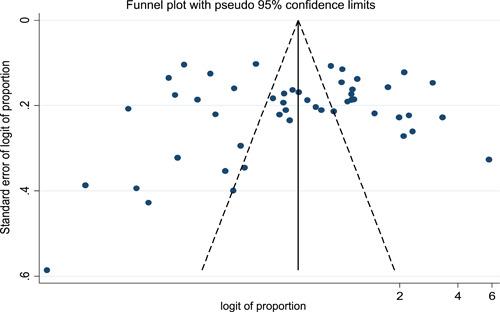
Electronic databases PubMed, Google Scholar, Web of Science, Research Gate, and Scopus were thoroughly searched from February to March 2022 to identify all relevant studies. The quality of studies was evaluated using the Newcastle-Ottawa quality scale for case-control and cross-sectional studies. Statistical analysis was done using STATA version 12 software. A random effect model was used to compute the global pooled seroprevalence of infection. Heterogeneity was quantified by using value. Subgroup analysis was done, and publication bias was assessed using a funnel plot and Egger's test.
RESULT
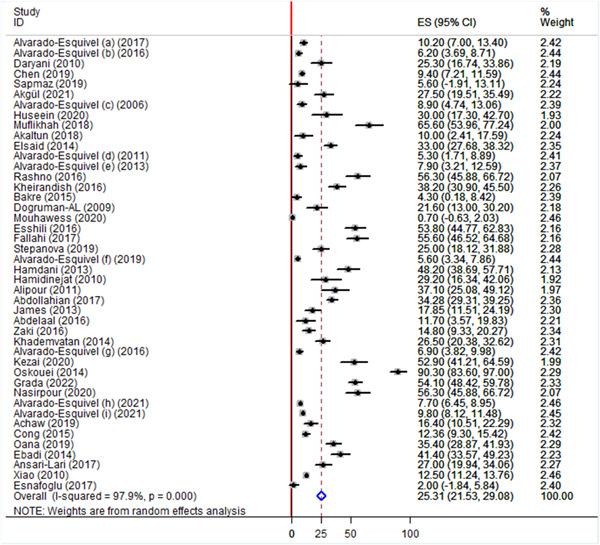
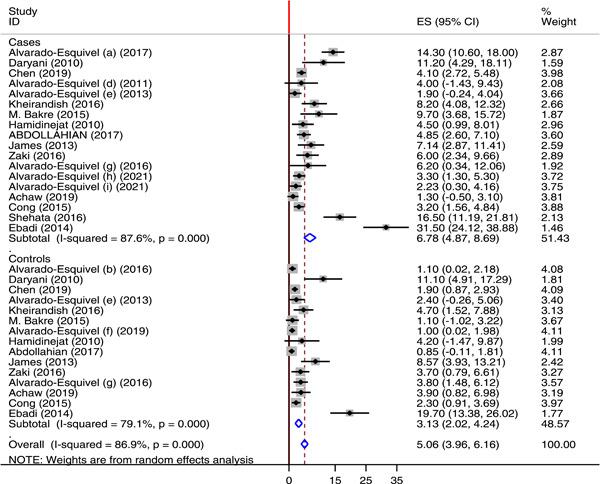
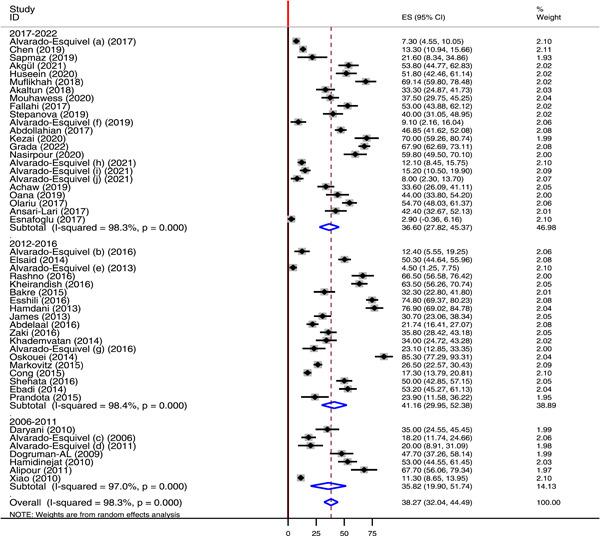
Of 1250 studies, 49 containing 21,093 participants and conducted in 18 countries were included. The global pooled seroprevalence of IgG antibody was 38.27% (95% CI: 32.04-44.9) among neuropsychiatric patients and 25.31% (95% CI: 21.53-29.08) in healthy controls with substantial heterogeneity of 98.3%. The prevalence of IgG antibody was higher in males (17.52%) than in females (12.35%) neuropsychiatric patients. The highest pooled prevalence of IgG antibody was in Europe (57%) followed by Africa (45.25%) and Asia (43%). Time based analysis showed the highest pooled prevalence of IgG antibody in 2012-2016 (41.16%).The global pooled seroprevalence IgM antibody among neuropsychiatric patients and healthy controls was 6.78% (95% CI: 4.87-8.69) and 3.13% (95% CI: 2.02-4.24), respectively.
CONCLUSION
The pooled prevalence of chronic and acute infection among neuropsychiatric patients was 38.27% and 6.78%, respectively. This showed a high burden of toxoplasmosis among neurological and psychiatric patients and urges routine screening of those patients and providing appropriate treatment. It also indicates the need for different stakeholders to develop targeted prevention and control strategies for infection.
背景与目的
弓形虫病是最广泛传播的人畜共患病,影响着全球三分之一的人口,是全球主要的公共卫生问题。本研究旨在评估神经精神疾病患者中弓形虫病的患病率。
方法
于2022年2月至3月全面检索电子数据库PubMed、谷歌学术、科学网、研究之门和Scopus,以识别所有相关研究。使用纽卡斯尔-渥太华病例对照和横断面研究质量量表评估研究质量。使用STATA 12版软件进行统计分析。采用随机效应模型计算感染的总体合并血清阳性率。通过I²值量化异质性。进行亚组分析,并使用漏斗图和埃格检验评估发表偏倚。
结果
在1250项研究中,纳入了49项研究,这些研究在18个国家开展,涉及21,093名参与者。神经精神疾病患者中IgG抗体的总体合并血清阳性率为38.27%(95%置信区间:32.04 - 44.9),健康对照者中为25.31%(95%置信区间:21.53 - 29.08),异质性高达98.3%。神经精神疾病患者中男性的IgG抗体患病率(17.52%)高于女性(12.35%)。IgG抗体总体合并患病率最高的是欧洲(57%),其次是非洲(45.25%)和亚洲(43%)。基于时间的分析显示,2012 - 2016年IgG抗体总体合并患病率最高(41.16%)。神经精神疾病患者和健康对照者中IgM抗体的总体合并血清阳性率分别为6.78%(95%置信区间:4.87 - 8.69)和3.13%(95%置信区间:2.02 - 4.24)。
结论
神经精神疾病患者中慢性和急性弓形虫感染的总体合并患病率分别为38.27%和6.78%。这表明神经和精神疾病患者中弓形虫病负担较重,促使对这些患者进行常规筛查并提供适当治疗。这也表明不同利益相关者需要制定针对性的弓形虫感染预防和控制策略。




 Zotero 插件