
诱导多能干细胞和 CD34+ 干细胞衍生的髓样细胞对颗粒物质和尘螨暴露的反应存在差异。
Induced pluripotent and CD34+ stem cell derived myeloid cells display differential responses to particle and dust mite exposure.
机构信息
Toxicology Department, Radiation, Chemical and Environmental Hazards Directorate, UK Health Security Agency, Chilton, Harwell Campus, Didcot, OX11 0RQ, UK.
出版信息
Sci Rep. 2023 Jun 9;13(1):9375. doi: 10.1038/s41598-023-36508-3.
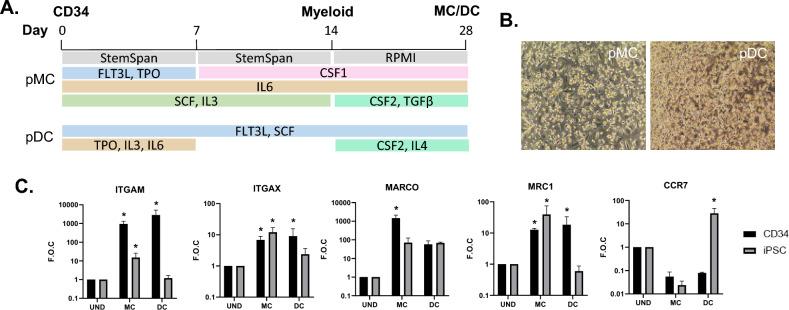
Myeloid cells form an essential component of initial responses to environmental hazards and toxic exposures. The ability to model these responses in vitro is central to efforts tasked with identifying hazardous materials and understanding mechanisms of injury and disease. Induced pluripotent stem cell (iPSC) derived cells have been suggested as alternatives to more established primary cell testing systems for these purposes. iPSC derived macrophage and dendritic like cells were compared to CD34+ haematopoietic stem cell derived populations using transcriptomic analysis. Using single cell sequencing-based characterisation of iPSC derived myeloid cells, we identified transitional, mature and M2 like macrophages as well as dendritic like antigen presenting cells and fibrocytes. Direct transcriptomic comparisons between iPSC and CD34+ cell derived populations revealed higher expression of myeloid differentiation genes such as MNDA, CSF1R and CSF2RB in CD34+ cells, while iPSC populations had higher fibroblastic and proliferative markers. Exposure of differentiated macrophage populations to nanoparticle alone or in combination with dust mite, resulted in differential gene expression on combination only, with responses markedly absent in iPSC compared to CD34+ derived cells. The lack of responsiveness in iPSC derived cells may be attributable to lower levels of dust mite component receptors CD14, TLR4, CLEC7A and CD36. In summary, iPSC derived myeloid cells display typical characteristics of immune cells but may lack a fully mature phenotype to adequately respond to environmental exposures.
髓样细胞是对环境危害和有毒暴露的初始反应的重要组成部分。能够在体外模拟这些反应对于识别危险材料和理解损伤和疾病机制的努力至关重要。诱导多能干细胞 (iPSC) 衍生的细胞已被提议作为这些目的的更成熟的原代细胞测试系统的替代品。使用转录组分析比较了 iPSC 衍生的巨噬细胞和树突状样细胞与 CD34+造血干细胞衍生的群体。使用基于单细胞测序的 iPSC 衍生髓样细胞特征分析,我们鉴定了过渡型、成熟型和 M2 样巨噬细胞以及树突状样抗原呈递细胞和纤维细胞。iPSC 和 CD34+细胞衍生群体之间的直接转录组比较显示,CD34+细胞中髓样分化基因如 MNDA、CSF1R 和 CSF2RB 的表达更高,而 iPSC 群体中具有更高的成纤维细胞和增殖标记物。将分化的巨噬细胞群体单独暴露于纳米颗粒或与尘螨联合暴露,仅在联合暴露时会导致基因表达的差异,与 CD34+细胞衍生的细胞相比,iPSC 中明显缺乏反应。iPSC 衍生细胞缺乏反应性可能归因于尘螨成分受体 CD14、TLR4、CLEC7A 和 CD36 的水平较低。总之,iPSC 衍生的髓样细胞显示出免疫细胞的典型特征,但可能缺乏完全成熟的表型,无法充分响应环境暴露。



 Zotero 插件