
来自北美和南美的杂草对生长素类似物以及 ALS 和 EPSPS 抑制剂的多种除草剂抗性的趋同适应
Convergent Adaptation of Multiple Herbicide Resistance to Auxin Mimics and ALS- and EPSPS-Inhibitors in from North and South America.
作者信息
Dominguez-Valenzuela José Alfredo, Palma-Bautista Candelario, Vazquez-Garcia José G, Yanniccari Marcos, Gigón Ramón, Alcántara-de la Cruz Ricardo, De Prado Rafael, Portugal João
机构信息
Department of Agricultural Parasitology, Chapingo Autonomous University, Texcoco 56230, Mexico.
Department Agroforestry, Biochemistry and Molecular Biology, University of Cordoba, 14014 Cordoba, Spain.
出版信息
Plants (Basel). 2023 May 26;12(11):2119. doi: 10.3390/plants12112119.
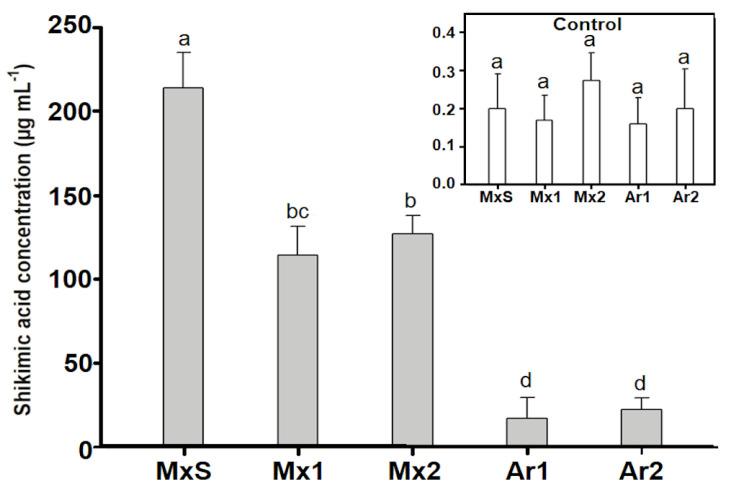
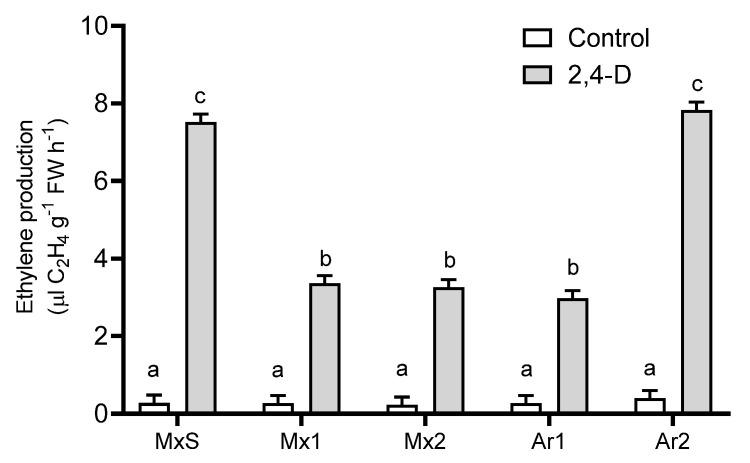
Herbicide-resistant weeds have been identified and recorded on every continent where croplands are available. Despite the diversity of weed communities, it is of interest how selection has led to the same consequences in distant regions. is a widespread naturalized weed that is found throughout temperate North and South America, and it is a frequent weed among winter cereal crops in Argentina and in Mexico. Broadleaf weed control is based on glyphosate that is used prior to sowing and sulfonylureas or mimic auxin herbicides that are used once the weeds have already emerged. This study was aimed at determining whether a convergent phenotypic adaptation to multiple herbicides had occurred in populations from Mexico and Argentina by comparing the herbicide sensitivity to inhibitors of the acetolactate synthase (ALS), 5-enolpyruvylshikimate-3-phosphate (EPSPS), and auxin mimics. Five populations were analyzed from seeds collected in wheat fields in Argentina (Ar1 and Ar2) and barley fields in Mexico (Mx1, Mx2 and MxS). Mx1, Mx2, and Ar1 populations presented multiple resistance to ALS- and EPSPS-inhibitors and to auxin mimics (2,4-D, MCPA, and fluroxypyr), while the Ar2 population showed resistance only to ALS-inhibitors and glyphosate. Resistance factors ranged from 947 to 4069 for tribenuron-methyl, from 1.5 to 9.4 for 2,4-D, and from 2.7 to 42 for glyphosate. These were consistent with ALS activity, ethylene production, and shikimate accumulation analyses in response to tribenuron-methyl, 2,4-D, and glyphosate, respectively. These results fully support the evolution of the multiple- and cross-herbicide resistance to glyphosate, ALS-inhibitors, and auxinic herbicides in populations from Mexico and Argentina.
在有农田的各大洲均已发现并记录了抗除草剂杂草。尽管杂草群落具有多样性,但令人感兴趣的是,选择作用如何在遥远地区导致了相同的结果。反枝苋是一种广泛分布的归化杂草,在北美洲和南美洲的温带地区均有发现,并且在阿根廷和墨西哥的冬季谷类作物田中是常见杂草。阔叶杂草防治基于播种前使用的草甘膦以及杂草出苗后使用的磺酰脲类或类生长素除草剂。本研究旨在通过比较对乙酰乳酸合成酶(ALS)抑制剂、5-烯醇丙酮酸莽草酸-3-磷酸(EPSPS)抑制剂和类生长素的除草剂敏感性,来确定墨西哥和阿根廷的反枝苋种群是否已发生对多种除草剂的趋同表型适应。从阿根廷麦田(Ar1和Ar2)以及墨西哥大麦田(Mx1、Mx2和MxS)采集的种子中分析了5个反枝苋种群。Mx1、Mx2和Ar1种群对ALS抑制剂、EPSPS抑制剂和类生长素(2,4-滴、灭草灵和氟草烟)表现出多重抗性,而Ar2种群仅对ALS抑制剂和草甘膦表现出抗性。甲基苯磺隆的抗性因子范围为947至4069, 2,4-滴的抗性因子范围为1.5至9.4,草甘膦的抗性因子范围为2.7至42。这些结果分别与针对甲基苯磺隆、2,4-滴和草甘膦的ALS活性、乙烯生成和莽草酸积累分析结果一致。这些结果充分支持了墨西哥和阿根廷的反枝苋种群对草甘膦、ALS抑制剂和生长素类除草剂产生多重和交叉抗性的进化过程。

 Zotero 插件