
严重急性呼吸综合征冠状病毒2(COVID-19)奥密克戎变异株致病性的增强
The Rise of SARS-CoV-2 (COVID-19) Omicron Subvariant Pathogenicity.
作者信息
DeGrasse David C, Black Shaun D
机构信息
Chemistry and Biochemistry, University of Texas at Tyler, Tyler, USA.
出版信息
Cureus. 2023 Jun 8;15(6):e40148. doi: 10.7759/cureus.40148. eCollection 2023 Jun.
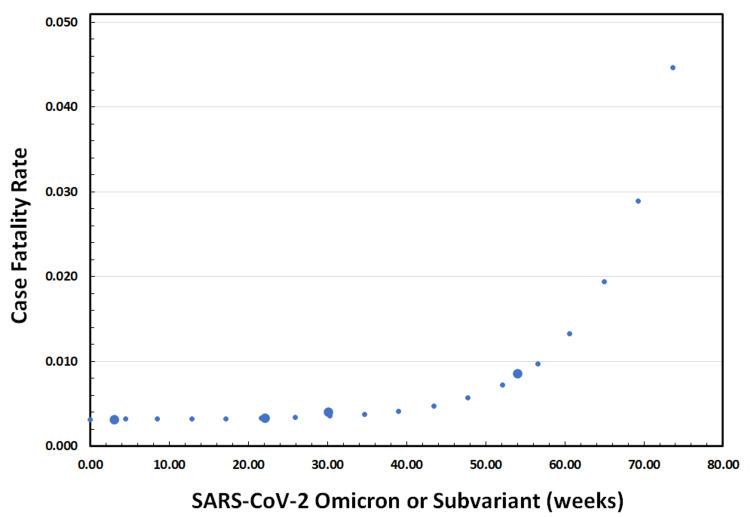
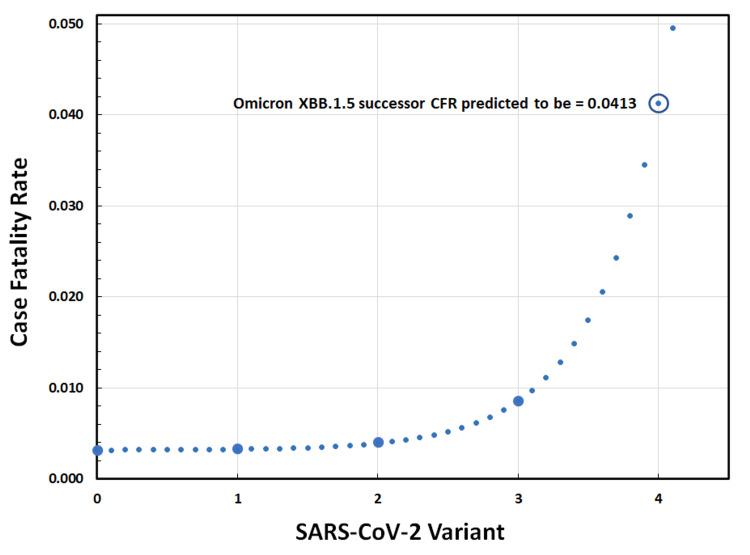
During the COVID-19 pandemic, variants of the SARS-CoV-2, the etiologic agent of COVID-19 disease, progressively decreased in pathogenicity up to the Omicron strain. However, the case fatality rate has increased from Omicron through each major Omicron subvariant (BA.2/BA.4, BA.5, XBB.1.5) in the United States of America. World data also mirror this trend. We show that the rise of Omicron pathogenicity is exponential, and we have modeled the case fatality rate of the next major subvariant as 0.0413, 2.5 times that of the Alpha strain and 60% of the original Wuhan strain which caused the greatest morbidity and mortality during the pandemic. Small-molecule therapeutics have been developed, and some of these, such as chlorpheniramine maleate, may be useful in the event of an Omicron subvariant of higher risk.
在新冠疫情期间,新冠病毒病的病原体严重急性呼吸综合征冠状病毒2(SARS-CoV-2)的变种,其致病性逐渐降低,直至奥密克戎毒株。然而,在美国,从奥密克戎毒株到每一个主要的奥密克戎亚变种(BA.2/BA.4、BA.5、XBB.1.5),病死率都有所上升。全球数据也反映了这一趋势。我们表明,奥密克戎毒株致病性的上升呈指数级,并且我们已经模拟出下一个主要亚变种的病死率为0.0413,是阿尔法毒株的2.5倍,是在疫情期间导致最高发病率和死亡率的原始武汉毒株的60%。小分子疗法已经研发出来,其中一些,如马来酸氯苯那敏,在出现更高风险的奥密克戎亚变种时可能会有用。

 Zotero 插件