
美国儿童的种族和民族、社会经济因素与龋齿分析。
Analysis of Race and Ethnicity, Socioeconomic Factors, and Tooth Decay Among US Children.
机构信息
Department of Oral Health Policy and Epidemiology, Harvard School of Dental Medicine, Boston, Massachusetts.
Department of Preventive and Restorative Dental Sciences, School of Dentistry, University of California, San Francisco.
出版信息
JAMA Netw Open. 2023 Jun 1;6(6):e2318425. doi: 10.1001/jamanetworkopen.2023.18425.
IMPORTANCE
While large oral health disparities remain by race and ethnicity among children, the associations of race, ethnicity, and mediating factors with oral health outcomes are poorly characterized. Identifying the pathways that explain these disparities would be critical to inform policies to effectively reduce them.
OBJECTIVE
To measure racial and ethnic disparities in the risk of developing tooth decay and quantify relative contributions of factors mediating the observed disparities among US children.
DESIGN, SETTING, AND PARTICIPANTS: This retrospective cohort study used electronic health records of US children from 2014 to 2020 to measure racial and ethnic disparities in the risk of tooth decay. Elastic net regularization was used to select variables to be included in the model among medical conditions, dental procedure types, and individual- and community-level socioeconomic factors. Data were analyzed from January 9 to April 28, 2023.
EXPOSURES
Race and ethnicity of children.
MAIN OUTCOMES AND MEASURES
The main outcome was diagnosis of tooth decay in either deciduous or permanent teeth, defined as at least 1 decayed, filled, or missing tooth due to caries. An Anderson-Gill model, a time-to-event model for recurrent tooth decay events with time-varying covariates, stratified by age groups (0-5, 6-10, and 11-18 years) was estimated. A nonlinear multiple additive regression tree-based mediation analysis quantified the relative contributions of factors underlying the observed racial and ethnic disparities.
RESULTS
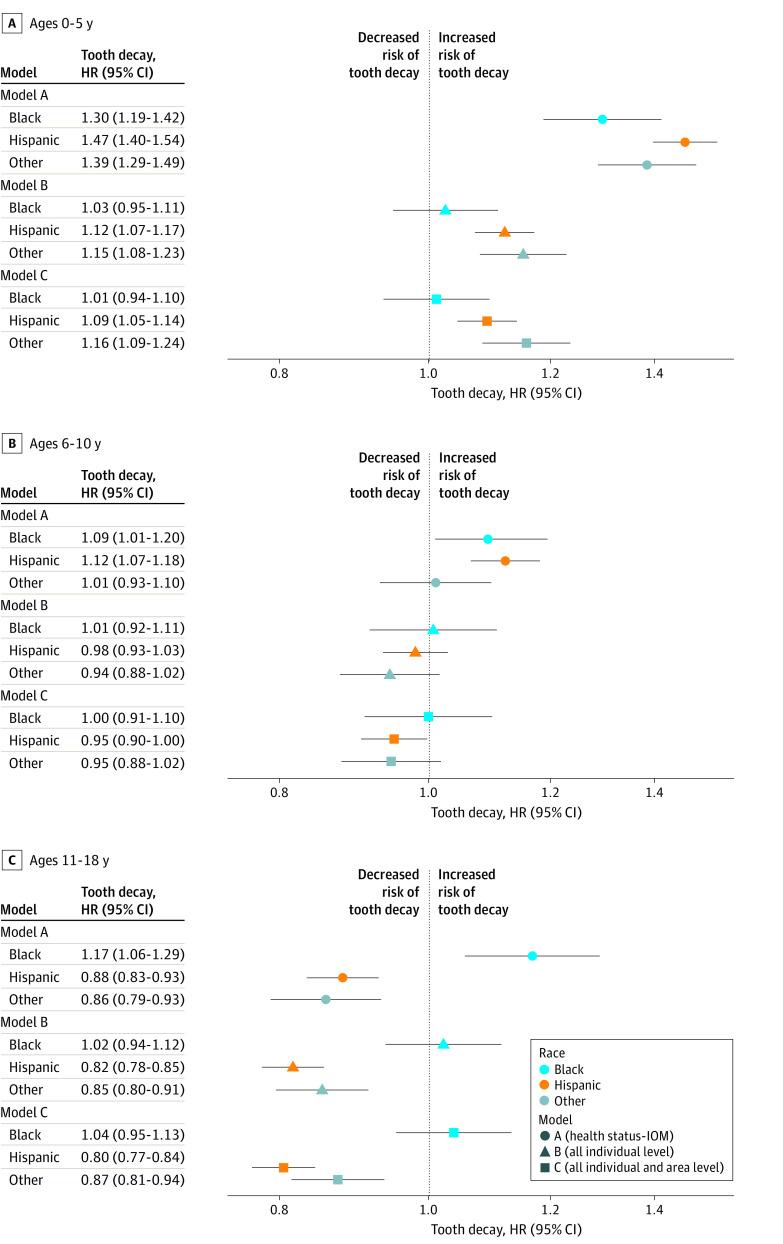
Among 61 083 children and adolescents aged 0 to 18 years at baseline (mean [SD] age, 9.9 [4.6] years; 30 773 [50.4%] female), 2654 Black individuals (4.3%), 11 213 Hispanic individuals (18.4%), 42 815 White individuals (70.1%), and 4401 individuals who identified as another race (eg, American Indian, Asian, and Hawaiian and Pacific Islander) (7.2%) were identified. Larger racial and ethnic disparities were observed among children aged 0 to 5 years compared with other age groups (Hispanic children: adjusted hazard ratio [aHR], 1.47; 95% CI, 1.40-1.54; Black children: aHR, 1.30; 95% CI, 1.19-1.42; other race children: aHR, 1.39; 95% CI, 1.29-1.49), compared with White children. For children aged 6 to 10 years, higher risk of tooth decay was observed for Black children (aHR, 1.09; 95% CI, 1.01-1.19) and Hispanic children (aHR, 1.12; 95% CI, 1.07-1.18) compared with White children. For adolescents aged 11 to 18 years, a higher risk of tooth decay was observed only in Black adolescents (aHR, 1.17; 95% CI, 1.06-1.30). A mediation analysis revealed that the association of race and ethnicity with time to first tooth decay became negligible, except for Hispanic and children of other race aged 0 to 5 years, suggesting that mediators explained most of the observed disparities. Insurance type explained the largest proportion of the disparity, ranging from 23.4% (95% CI, 19.8%-30.2%) to 78.9% (95% CI, 59.0%-114.1%), followed by dental procedures (receipt of topical fluoride and restorative procedures) and community-level factors (education attainment and Area Deprivation Index).
CONCLUSIONS
In this retrospective cohort study, large proportions of disparities in time to first tooth decay associated with race and ethnicity were explained by insurance type and dental procedure types among children and adolescents. These findings can be applied to develop targeted strategies to reduce oral health disparities.
重要性
尽管儿童的口腔健康差距仍然存在,但种族和民族之间存在较大差异,种族、民族以及中介因素与口腔健康结果的关联尚未得到充分描述。确定解释这些差异的途径对于制定有效减少这些差异的政策至关重要。
目的
衡量美国儿童中发生龋齿的风险方面的种族和民族差异,并量化影响这些差异的中介因素的相对贡献。
设计、地点和参与者:这是一项回顾性队列研究,使用了 2014 年至 2020 年美国儿童的电子健康记录,以衡量龋齿风险方面的种族和民族差异。使用弹性网络正则化选择医疗条件、牙科手术类型以及个体和社区层面的社会经济因素中的变量纳入模型。数据分析于 2023 年 1 月 9 日至 4 月 28 日进行。
暴露因素
儿童的种族和民族。
主要结局和测量指标
主要结局是在恒牙或乳牙中诊断出龋齿,定义为至少有 1 颗因龋齿而脱落、填充或缺失的牙齿。使用安德森-吉尔模型(一种用于具有时变协变量的复发性龋齿事件的时间到事件模型),根据年龄组(0-5 岁、6-10 岁和 11-18 岁)进行分层估计。基于非线性多重加法回归树的中介分析量化了观察到的种族和民族差异背后的因素的相对贡献。
结果
在基线时年龄为 0 至 18 岁的 61083 名儿童和青少年中(平均[标准差]年龄为 9.9[4.6]岁;30773[50.4%]为女性),发现 2654 名黑人个体(4.3%)、11213 名西班牙裔个体(18.4%)、42815 名白人个体(70.1%)和 4401 名认定为其他种族的个体(例如,美洲印第安人、亚洲人和夏威夷及太平洋岛民)(7.2%)。与其他年龄组相比,0 至 5 岁儿童的种族和民族差异更大(西班牙裔儿童:调整后的危险比[aHR],1.47;95%CI,1.40-1.54;黑人儿童:aHR,1.30;95%CI,1.19-1.42;其他种族儿童:aHR,1.39;95%CI,1.29-1.49)。对于 6 至 10 岁的儿童,黑人儿童(aHR,1.09;95%CI,1.01-1.19)和西班牙裔儿童(aHR,1.12;95%CI,1.07-1.18)的龋齿风险更高,而白人儿童。对于 11 至 18 岁的青少年,仅黑人青少年的龋齿风险更高(aHR,1.17;95%CI,1.06-1.30)。中介分析表明,种族和民族与首次发生龋齿的时间之间的关联几乎可以忽略不计,除了 0 至 5 岁的西班牙裔和其他种族儿童外,表明中介因素解释了大部分观察到的差异。保险类型解释了差异的最大比例,范围从 23.4%(95%CI,19.8%-30.2%)到 78.9%(95%CI,59.0%-114.1%),其次是牙科手术(接受局部氟化物和修复手术)和社区层面的因素(教育程度和区域贫困指数)。
结论
在这项回顾性队列研究中,种族和民族与首次发生龋齿的时间相关的差异很大程度上可以用儿童和青少年的保险类型和牙科手术类型来解释。这些发现可用于制定有针对性的策略来减少口腔健康差距。


 Zotero 插件