
评估白藜芦醇对几种物种增殖、培养物以及小鼠的抑制作用。
Evaluating the inhibitory effect of resveratrol on the multiplication of several species and on cultures, and in mice.
作者信息
El-Sayed Shimaa Abd El-Salam, El-Alfy El-Sayed, Sayed-Ahmed Mohamed Z, Mohanta Uday Kumar, Alqahtani Saad S, Alam Nawazish, Ahmad Sarfaraz, Ali Md Sajid, Igarashi Ikuo, Rizk Mohamed Abdo
机构信息
National Research Center for Protozoan Diseases, Obihiro University of Agriculture and Veterinary Medicine, Obihiro, Hokkaido, Japan.
Department of Biochemistry and Chemistry of Nutrition, Faculty of Veterinary Medicine, Mansoura University, Mansoura, Egypt.
出版信息
Front Pharmacol. 2023 May 30;14:1192999. doi: 10.3389/fphar.2023.1192999. eCollection 2023.
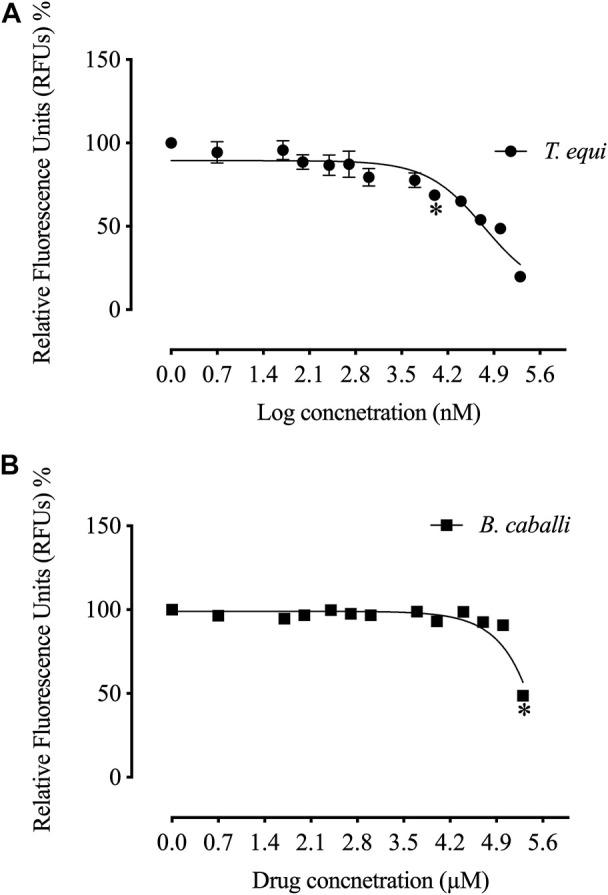
Histone post-translational modification is one of the most studied factors influencing epigenetic regulation of protozoan parasite gene expression, which is mediated by histone deacetylases (KDACs) and acetyltransferases (KATs). The present study investigated the role of resveratrol (RVT) as an activator of histone deacetylases in the control of various pathogenic Babesia sp. and Theileria equi , as well as infected mice using fluorescence assay. Its role in mitigating the side effects associated with the widely used antibabesial drugs diminazene aceturate (DA) and azithromycin (AZM) has also been investigated. The growth of , , , and Theileria equi () was significantly inhibited (P < 0.05) by RVT treatments. The estimated IC50 values revealed that RVT has the greatest inhibitory effects on growth , with an IC50 value of 29.51 ± 2.46 µM. Reverse transcription PCR assay showed that such inhibitory activity might be attributed to resveratrol's stimulatory effect on KDAC3 as well as its inhibitory effect on BbKATS. RVT causes a significant decrease (P < 0.05) in cardiac troponin T (cTnT) levels in heart tissue of - infected mice, thereby indicating that RVT may play a part in reducing the cardiotoxic effects of AZM. Resveratrol showed an additive effect with imidocarb dipropionate . Treatment of -infected mice with a combined 5 mg/kg RVT and 8.5 mg/kg ID resulted in an 81.55% inhibition at day 10 postinoculation (peak of parasitemia). Our data show that RVT is a promising antibabesial pharmacological candidate with therapeutic activities that could overcome the side effects of the currently used anti-Babesia medications.
组蛋白翻译后修饰是影响原生动物寄生虫基因表达表观遗传调控的研究最多的因素之一,其由组蛋白脱乙酰酶(KDACs)和乙酰转移酶(KATs)介导。本研究使用荧光测定法研究了白藜芦醇(RVT)作为组蛋白脱乙酰酶激活剂在控制各种致病性巴贝斯虫属和马泰勒虫以及感染小鼠方面的作用。还研究了其在减轻广泛使用的抗巴贝斯虫药物双脒苯脲(DA)和阿奇霉素(AZM)相关副作用方面的作用。RVT处理显著抑制了巴贝斯虫、马泰勒虫和驽巴贝斯虫的生长(P < 0.05)。估计的IC50值表明,RVT对驽巴贝斯虫生长的抑制作用最大,IC50值为29.51±2.46 μM。逆转录PCR分析表明,这种抑制活性可能归因于白藜芦醇对KDAC3的刺激作用及其对BbKATS的抑制作用。RVT导致感染驽巴贝斯虫的小鼠心脏组织中心肌肌钙蛋白T(cTnT)水平显著降低(P < 0.05),从而表明RVT可能在减轻AZM的心脏毒性作用中发挥作用。白藜芦醇与双丙酸咪唑苯脲显示出相加作用。用5 mg/kg RVT和8.5 mg/kg ID联合处理感染驽巴贝斯虫的小鼠,在接种后第10天(寄生虫血症高峰)产生了81.55%的抑制率。我们的数据表明,RVT是一种有前途的抗巴贝斯虫药理学候选药物,具有治疗活性,可以克服目前使用的抗巴贝斯虫药物的副作用。



 Zotero 插件