
菲律宾儿童系统性红斑狼疮的直接医疗费用。
Direct healthcare cost of pediatric systemic lupus erythematosus in the Philippines.
作者信息
Yee Maria Kathryn Ramirez, Collante Ma Theresa Moreno, Bernal Christine Bea
机构信息
Section of Pediatric Rheumatology, Department of Pediatrics, University of Santo Tomas Hospital, Manila, Philippines.
出版信息
Front Pediatr. 2023 May 30;11:1166974. doi: 10.3389/fped.2023.1166974. eCollection 2023.
BACKGROUND
Pediatric rheumatic diseases are chronic illnesses that pose a huge economic burden to children and their families; one of the most common is pediatric systemic lupus erythematosus (pSLE). The direct cost of pSLE has been studied in other countries. In the Philippines, this was only studied in the adult population. This study aimed to determine the direct cost of pSLE in the Philippines and its cost predictors.
METHODS
A total of 100 pSLE patients were seen from November 2017 to January 2018 at the University of Santo Tomas. Informed consent and assent forms were obtained. A total of 79 patients met the inclusion criteria and parents were asked to answer a questionnaire. Data were tabulated and were subjected to statistical analysis. Cost predictors were estimated using a stepwise log linear regression.
RESULTS
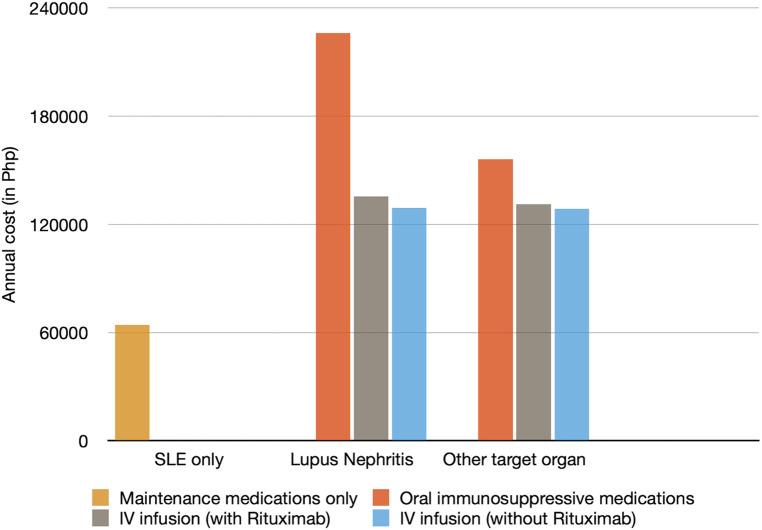
A total of 79 pediatric SLE patients, with a mean age of 14.68 ± 3.24 years, 89.9% of which were females, with a mean disease duration of 36.08 ± 23.54 months, were included in this study. A total of 65.82% had lupus nephritis and 49.37% were in flare. The mean annual direct cost for pediatric SLE patient was 162,764.81 PHP (USD 3,047.23). Majority of the expense was for medications. Regression analysis showed that the predictors of increased cost in doctor's fee in clinic visits (-value 0.000) and IV infusion (-value 0.01) were the higher combined income of the parents.
CONCLUSION
This is a preliminary study on the mean annual direct cost of pediatric SLE patients in a single center in the Philippines. Pediatric SLE patients with nephritis and other target organ damage were seen to increase the cost up to 2-3.5×. Patients in flare also had a higher cost of up to 1.6×. The overall cost driver of this study was the parent's or caregivers combined income. Further analysis showed that cost drivers in the subcategories include the age, sex and parent's/caregiver's educational attainment.
背景
儿童风湿性疾病是慢性疾病,给儿童及其家庭带来巨大经济负担;其中最常见的一种是儿童系统性红斑狼疮(pSLE)。pSLE的直接成本在其他国家已有研究。在菲律宾,仅对成年人群进行过此项研究。本研究旨在确定菲律宾pSLE的直接成本及其成本预测因素。
方法
2017年11月至2018年1月期间,圣托马斯大学共诊治了100例pSLE患者。获得了知情同意书和同意书。共有79例患者符合纳入标准,并要求其父母回答一份问卷。数据被制成表格并进行统计分析。使用逐步对数线性回归估计成本预测因素。
结果
本研究共纳入79例儿童SLE患者,平均年龄为14.68±3.24岁,其中89.9%为女性,平均病程为36.08±23.54个月。共有65.82%的患者患有狼疮性肾炎,49.37%的患者处于疾病活动期。儿童SLE患者的年平均直接成本为162,764.81菲律宾比索(3,047.23美元)。大部分费用用于药物治疗。回归分析表明,门诊就诊时医生费用增加(P值0.000)和静脉输液(P值0.01)的成本预测因素是父母较高的综合收入。
结论
这是对菲律宾一个单一中心儿童SLE患者年平均直接成本的初步研究。患有肾炎和其他靶器官损害的儿童SLE患者的成本增加了2至3.5倍。处于疾病活动期的患者成本也较高,高达1.6倍。本研究的总体成本驱动因素是父母或照顾者的综合收入。进一步分析表明,子类别中的成本驱动因素包括年龄、性别以及父母/照顾者的教育程度。
 Zotero 插件