
基线体表面积和瘙痒严重程度可定义 16 周时中重度特应性皮炎患者对巴瑞替尼的应答。
Baseline Body Surface Area and Itch Severity Define Response to Baricitinib in Patients with Moderate-to-Severe Atopic Dermatitis at Week 16.
机构信息
Department of Dermatology, Bispebjerg Hospital, University of Copenhagen, Copenhagen, Denmark.
Department of Dermatology and Allergology, National Expertise Center of Atopic Dermatitis, University Medical Center Utrecht, Utrecht, The Netherlands.
出版信息
Adv Ther. 2023 Aug;40(8):3574-3587. doi: 10.1007/s12325-023-02528-8. Epub 2023 Jun 19.
INTRODUCTION
Atopic dermatitis (AD) is a chronic, inflammatory skin disease characterized by heterogeneous clinical phenotypes and high symptom burden, especially through itch. Baricitinib (BARI), an oral Janus Kinase 1/2 inhibitor, is approved in Europe, Japan, and other countries, for treatment of adults with moderate-to-severe AD who are candidates for systemic therapy. This post hoc analysis of a Phase 3 topical corticosteroid (TCS) combination therapy trial (BREEZE-AD7) aims to characterize patients who might benefit most from BARI.
METHOD
Classification and regression tree (CART) analysis was used to identify baseline predictors for patients treated with BARI 4-mg, who achieved ≥ 75% improvement in Eczema Area and Severity Index (EASI75), or EASI75 or Itch Numerical Rating Scale (NRS) ≥ 4-point improvement at week 16 (responders), versus non-responders. Subgroup efficacy analyses were performed based on identified predictor variables, combined with Itch NRS < 7/ ≥ 7. Missing data were imputed as non-responder.
RESULTS
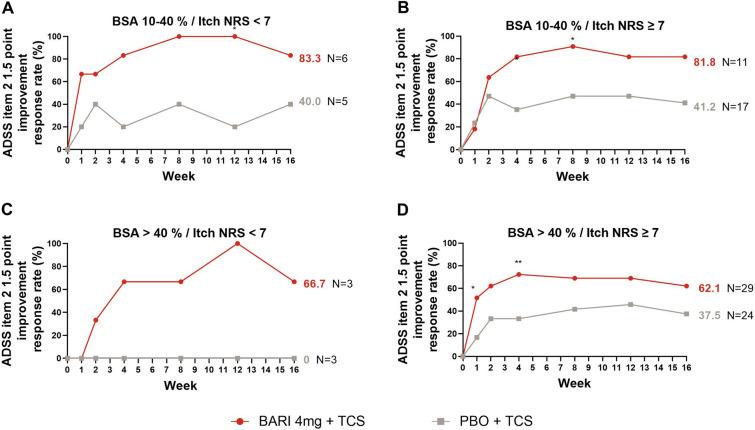
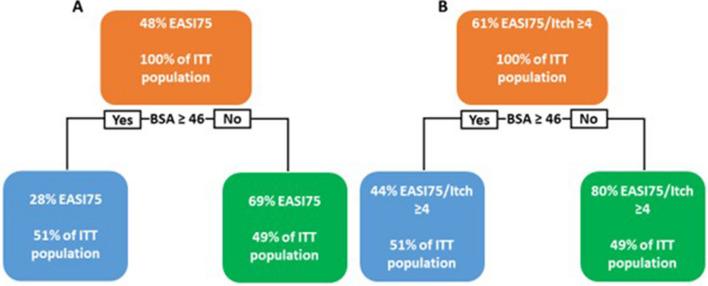
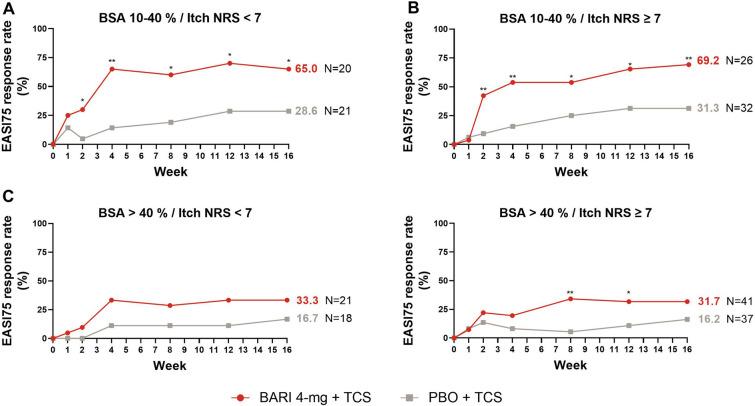
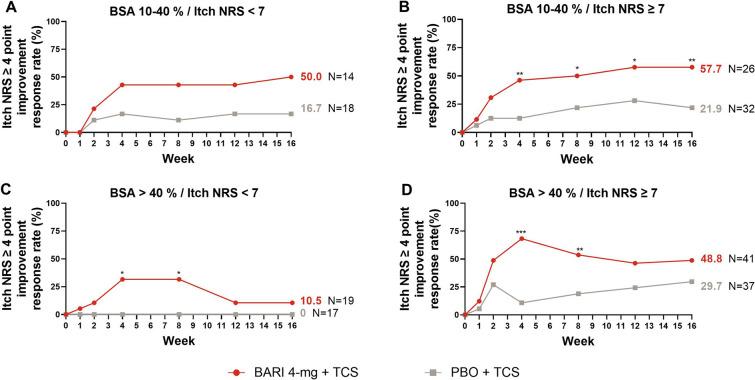
Baseline body surface area (BSA) was identified by CART as strongest variable predicting response to BARI at week 16, with a cut-off around 40% (BSA ≤ 40%). When combining BSA with itch severity, highest response rates were achieved by BARI patients with BSA ≤ 40%/Itch NRS ≥ 7 at baseline. In this subgroup, 69% and 58% of patients treated with BARI 4-mg achieved EASI75 and Itch NRS ≥ 4-point response at week 16, respectively. While these response rates were 65% and 50% for BARI 4-mg patients with baseline BSA ≤ 40%/Itch NRS < 7, they were 33% and 11% in BSA > 40%/Itch NRS < 7, and 32% and 49% in BSA > 40%/Itch NRS ≥ 7 subgroups, respectively.
CONCLUSION
Using a machine learning approach, patients with moderate-to-severe AD and a BSA affecting 10-40% and Itch NRS ≥ 7 were characterized as likely to benefit most from BARI 4-mg TCS combination therapy. This was confirmed by subgroup analyses, which showed that these patients are most likely to show favorable response rates in improving AD signs and symptoms, specifically itch, after 16 weeks of treatment.
简介
特应性皮炎(AD)是一种慢性炎症性皮肤病,其临床表型多样,症状负担重,尤其是瘙痒。巴瑞替尼(BARI)是一种口服 Janus 激酶 1/2 抑制剂,在欧洲、日本和其他国家被批准用于治疗候选全身治疗的中重度 AD 成人患者。本项 3 期局部皮质类固醇(TCS)联合治疗试验(BREEZE-AD7)的事后分析旨在确定最有可能从 BARI 治疗中获益的患者。
方法
使用分类回归树(CART)分析来确定接受 BARI 4mg 治疗、在第 16 周达到湿疹面积和严重程度指数(EASI75)≥75%改善或 EASI75 或瘙痒数字评分量表(NRS)≥4 点改善的患者的基线预测因子,与无应答者相比。根据确定的预测变量和瘙痒 NRS<7/≥7 进行亚组疗效分析。缺失数据采用非应答者填补。
结果
CART 确定基线体表面积(BSA)是预测 BARI 在第 16 周应答的最强变量,截断值约为 40%(BSA≤40%)。当 BSA 与瘙痒严重程度相结合时,BSA≤40%/瘙痒 NRS≥7 的 BARI 患者的应答率最高。在该亚组中,接受 BARI 4mg 治疗的患者中有 69%和 58%在第 16 周达到 EASI75 和瘙痒 NRS≥4 点应答,分别。对于基线 BSA≤40%/瘙痒 NRS<7 的 BARI 4mg 患者,这些应答率分别为 65%和 50%,而对于 BSA>40%/瘙痒 NRS<7 的患者,这些应答率分别为 33%和 11%,对于 BSA>40%/瘙痒 NRS≥7 的患者,这些应答率分别为 32%和 49%。
结论
使用机器学习方法,中重度 AD 患者的 BSA 影响 10-40%和瘙痒 NRS≥7 可确定为最有可能从 BARI 4mg TCS 联合治疗中获益。这一点在亚组分析中得到了证实,该分析表明,这些患者在改善 AD 体征和症状(尤其是瘙痒)方面最有可能在 16 周治疗后显示出良好的应答率。
 Zotero 插件