
全基因组测序和系统发育分析揭示了美国诊断动物样本中一种多重耐药性婴儿血清型克隆的出现。
Whole-genome sequencing and phylogenetic analysis capture the emergence of a multi-drug resistant serovar Infantis clone from diagnostic animal samples in the United States.
作者信息
Srednik Mariela E, Morningstar-Shaw Brenda R, Hicks Jessica A, Tong Christopher, Mackie Tonya A, Schlater Linda K
机构信息
National Veterinary Services Laboratories, Animal and Plant Health Inspection Service, U.S. Department of Agriculture, Ames, IA, United States.
Center for Veterinary Biologics, Animal and Plant Health Inspection Service, U.S. Department of Agriculture, Ames, IA, United States.
出版信息
Front Microbiol. 2023 Jun 2;14:1166908. doi: 10.3389/fmicb.2023.1166908. eCollection 2023.
INTRODUCTION
is a major cause of foodborne illness in the United States. A multi-drug resistant (MDR) emergent Infantis (ESI) with a megaplasmid (pESI) was first identified in Israel and Italy and subsequently reported worldwide. The ESI clone carrying an extended spectrum β-lactamase CTX-M-65 on a pESI-like plasmid and a mutation in the A gene has recently been found in the United States in poultry meat.
METHODS
We analyzed the phenotypic and genotypic antimicrobial resistance, genomics and phylogeny of 200 isolates from animal diagnostic samples.
RESULTS
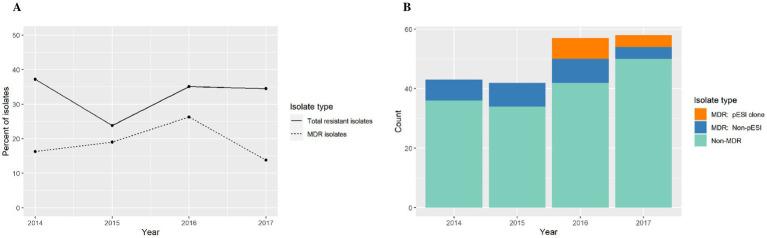
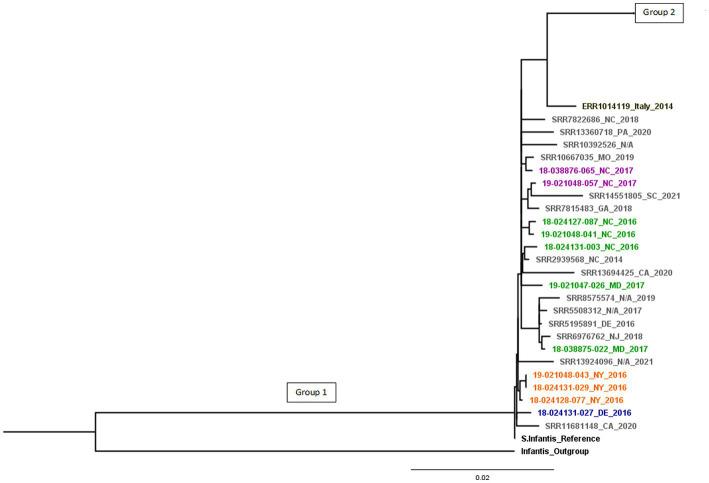
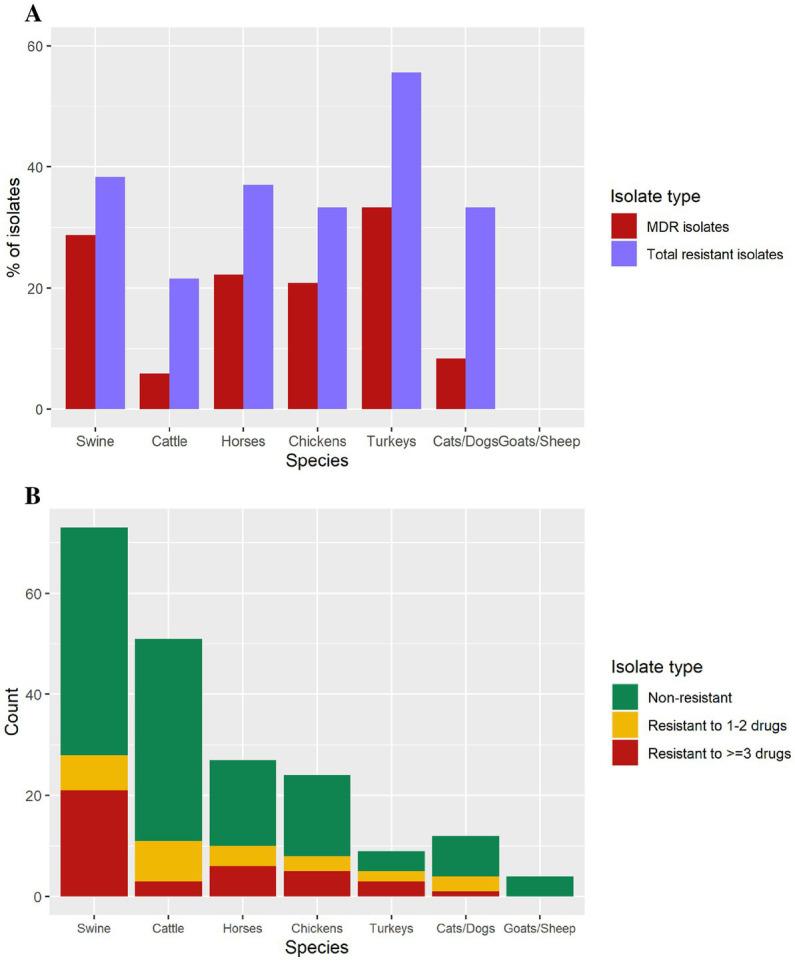
Of these, 33.5% were resistant to at least one antimicrobial and 19.5% were multi-drug resistant (MDR). Eleven isolates from different animal sources were phenotypically and genetically similar to the ESI clone. These isolates had a D87Y mutation in the A gene conferring reduced susceptibility to ciprofloxacin and harbored a combination of 6-10 resistance genes: CTX-M-65, (3)-IVa, A1, (4)-Ia, (3')-Ia, R, 1, A14, A, and A. These 11 isolates carried class I and class II integrons and three virulence genes: sinH, involved in adhesion and invasion, Q and P, associated with iron transport. These isolates were also closely related to each other (separated by 7 to 27 SNPs) and phylogenetically related to the ESI clone recently found in the U.S.
DISCUSSION
This dataset captured the emergence of the MDR ESI clone in multiple animal species and the first report of a pESI-like plasmid in isolates from horses in the U.S.
引言
在美国,[未提及具体病原体名称]是食源性疾病的主要病因。一种携带巨大质粒(pESI)的多重耐药性(MDR)新兴婴儿亚种(ESI)首次在以色列和意大利被鉴定出来,随后在全球范围内被报道。最近在美国的禽肉中发现了一种在类似pESI的质粒上携带超广谱β-内酰胺酶CTX-M-65且A基因发生突变的ESI克隆。
方法
我们分析了来自动物诊断样本的200株分离株的表型和基因型抗菌药物耐药性、基因组学和系统发育。
结果
其中,33.5%对至少一种抗菌药物耐药,19.5%为多重耐药(MDR)。来自不同动物来源的11株分离株在表型和基因上与ESI克隆相似。这些分离株的A基因发生了D87Y突变,使其对环丙沙星的敏感性降低,并携带6 - 10个耐药基因的组合:CTX-M-65、(3)-IVa、A1、(4)-Ia、(3')-Ia、R、1、A14、A和A。这11株分离株携带I类和II类整合子以及三个毒力基因:参与黏附和侵袭的sinH,与铁转运相关的Q和P。这些分离株彼此之间也密切相关(相隔7至27个单核苷酸多态性),并且在系统发育上与最近在美国发现的ESI克隆相关。
讨论
该数据集记录了多重耐药ESI克隆在多种动物物种中的出现以及在美国马匹分离株中首次报告的类似pESI的质粒。

 Zotero 插件