
亚临床动脉粥样硬化和炎症介导的表观遗传年龄加速:一项多组学研究。
Subclinical atherosclerosis and accelerated epigenetic age mediated by inflammation: a multi-omics study.
机构信息
Centro Nacional de Investigaciones Cardiovasculares (CNIC), Melchor Fernández Almagro, 3, 28029 Madrid, Spain.
Centro de Investigacion Biomedica en Red en Enfermedades Cardiovasculares (CIBERCV), Spain.
出版信息
Eur Heart J. 2023 Aug 1;44(29):2698-2709. doi: 10.1093/eurheartj/ehad361.
AIMS
Epigenetic age is emerging as a personalized and accurate predictor of biological age. The aim of this article is to assess the association of subclinical atherosclerosis with accelerated epigenetic age and to investigate the underlying mechanisms mediating this association.
METHODS AND RESULTS
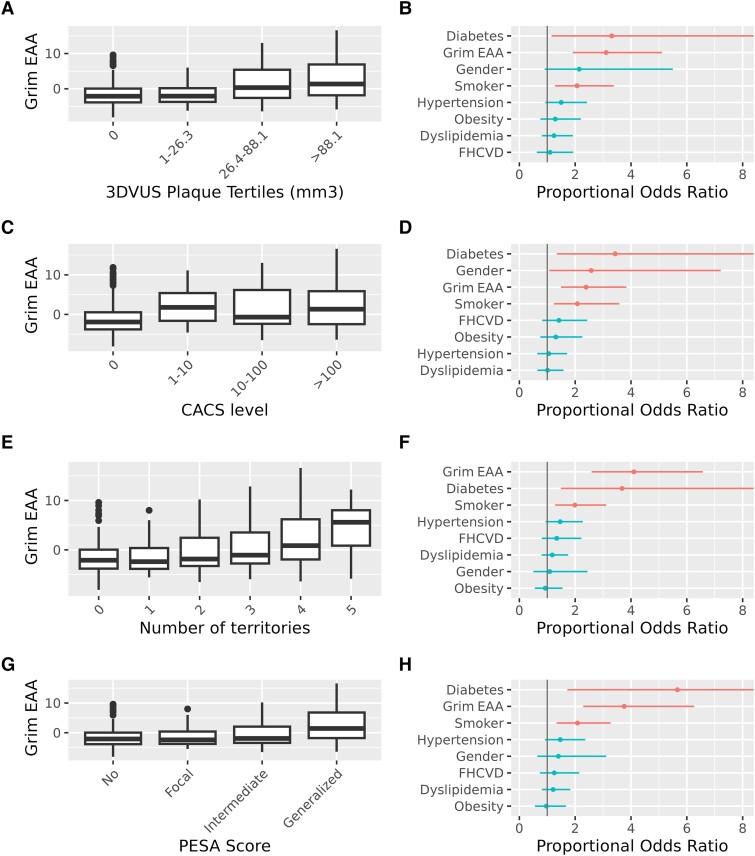
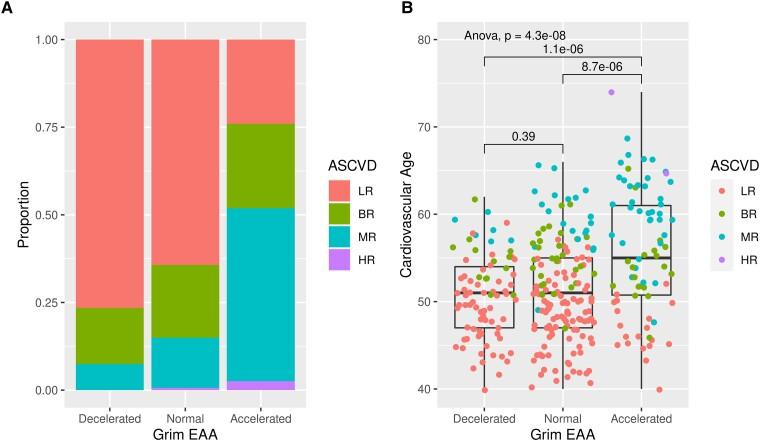
Whole blood methylomics, transcriptomics, and plasma proteomics were obtained for 391 participants of the Progression of Early Subclinical Atherosclerosis study. Epigenetic age was calculated from methylomics data for each participant. Its divergence from chronological age is termed epigenetic age acceleration. Subclinical atherosclerosis burden was estimated by multi-territory 2D/3D vascular ultrasound and by coronary artery calcification. In healthy individuals, the presence, extension, and progression of subclinical atherosclerosis were associated with a significant acceleration of the Grim epigenetic age, a predictor of health and lifespan, regardless of traditional cardiovascular risk factors. Individuals with an accelerated Grim epigenetic age were characterized by an increased systemic inflammation and associated with a score of low-grade, chronic inflammation. Mediation analysis using transcriptomics and proteomics data revealed key pro-inflammatory pathways (IL6, Inflammasome, and IL10) and genes (IL1B, OSM, TLR5, and CD14) mediating the association between subclinical atherosclerosis and epigenetic age acceleration.
CONCLUSION
The presence, extension, and progression of subclinical atherosclerosis in middle-aged asymptomatic individuals are associated with an acceleration in the Grim epigenetic age. Mediation analysis using transcriptomics and proteomics data suggests a key role of systemic inflammation in this association, reinforcing the relevance of interventions on inflammation to prevent cardiovascular disease.
目的
表观遗传年龄正在成为一种个性化且准确的生物年龄预测指标。本文旨在评估亚临床动脉粥样硬化与加速的表观遗传年龄之间的关联,并探讨介导这种关联的潜在机制。
方法和结果
对早期亚临床动脉粥样硬化进展研究中的 391 名参与者进行了全血甲基化组学、转录组学和血浆蛋白质组学检测。根据每位参与者的甲基化组学数据计算了表观遗传年龄。其与实际年龄的差异被称为表观遗传年龄加速。通过多区域 2D/3D 血管超声和冠状动脉钙化来评估亚临床动脉粥样硬化的负担。在健康个体中,亚临床动脉粥样硬化的存在、扩展和进展与 Grim 表观遗传年龄的显著加速相关,Grim 是健康和寿命的预测指标,与传统心血管危险因素无关。具有加速 Grim 表观遗传年龄的个体表现出全身性炎症增加,并与低度慢性炎症评分相关。使用转录组学和蛋白质组学数据进行的中介分析揭示了关键的促炎途径(IL6、Inflammasome 和 IL10)和基因(IL1B、OSM、TLR5 和 CD14),介导了亚临床动脉粥样硬化与表观遗传年龄加速之间的关联。
结论
在中年无症状个体中,亚临床动脉粥样硬化的存在、扩展和进展与 Grim 表观遗传年龄的加速有关。使用转录组学和蛋白质组学数据进行的中介分析表明,全身性炎症在这种关联中起着关键作用,这强化了干预炎症以预防心血管疾病的相关性。



 Zotero 插件