
在晚期胰腺导管腺癌中监测循环肿瘤 DNA 可预测临床结局,并比影像学更早地揭示疾病进展。
Monitoring of circulating tumour DNA in advanced pancreatic ductal adenocarcinoma predicts clinical outcome and reveals disease progression earlier than radiological imaging.
机构信息
Department of Hematology and Oncology, Stavanger University Hospital, Norway.
Section of Biostatistics, Department of Research, Stavanger University Hospital, Norway.
出版信息
Mol Oncol. 2023 Sep;17(9):1857-1870. doi: 10.1002/1878-0261.13472. Epub 2023 Jun 28.
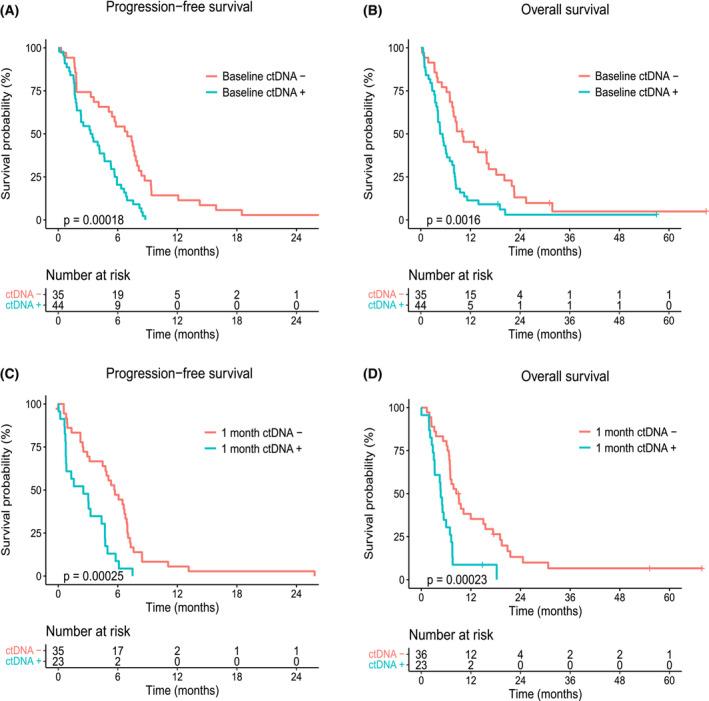
Pancreatic ductal adenocarcinoma (PDAC) is a lethal disease with a need for better tools to guide treatment selection and follow-up. The aim of this prospective study was to investigate the prognostic value and treatment monitoring potential of longitudinal circulating tumour DNA (ctDNA) measurements in patients with advanced PDAC undergoing palliative chemotherapy. Using KRAS peptide nucleic acid clamp-PCR, we measured ctDNA levels in plasma samples obtained at baseline and every 4 weeks during chemotherapy from 81 patients with locally advanced and metastatic PDAC. Cox proportional hazard regression showed that ctDNA detection at baseline was an independent predictor of progression-free and overall survival. Joint modelling demonstrated that the dynamic ctDNA level was a strong predictor of time to first disease progression. Longitudinal ctDNA measurements during chemotherapy successfully revealed disease progression in 20 (67%) of 30 patients with ctDNA detected at baseline, with a median lead time of 23 days (P = 0.01) over radiological imaging. Here, we confirmed the clinical relevance of ctDNA in advanced PDAC with regard to both the prediction of clinical outcome and disease monitoring during treatment.
胰腺导管腺癌(PDAC)是一种致命性疾病,需要更好的工具来指导治疗选择和随访。本前瞻性研究旨在探讨晚期 PDAC 患者接受姑息性化疗时纵向循环肿瘤 DNA(ctDNA)测量的预后价值和治疗监测潜力。我们使用 KRAS 肽核酸夹-PCR 方法,在 81 名局部晚期和转移性 PDAC 患者的化疗前和每 4 周的血浆样本中测量 ctDNA 水平。Cox 比例风险回归显示,基线时 ctDNA 的检测是无进展生存期和总生存期的独立预测因子。联合建模表明,动态 ctDNA 水平是疾病首次进展时间的强有力预测因子。在基线时检测到 ctDNA 的 30 名患者中,有 20 名(67%)的患者通过纵向 ctDNA 测量成功揭示了疾病进展,影像学检查的中位提前时间为 23 天(P=0.01)。在这里,我们证实了 ctDNA 在晚期 PDAC 中的临床相关性,涉及治疗期间临床结局的预测和疾病监测。



 Zotero 插件