
了解慢性肝病和肝癌中健康差距的变化态势。
Understanding the Changing Landscape of Health Disparities in Chronic Liver Diseases and Liver Cancer.
作者信息
Herren Olga M, Gillman Arielle S, Marshall Vanessa J, Das Rina
机构信息
Extramural Scientific Programs, Division of Integrative Biological and Behavioral Sciences.
Office of the Director National Institute on Minority Health and Health Disparities (NIMHD), Bethesda, MD.
出版信息
Gastro Hep Adv. 2023;2(4):505-520. doi: 10.1016/j.gastha.2022.12.001. Epub 2022 Dec 15.
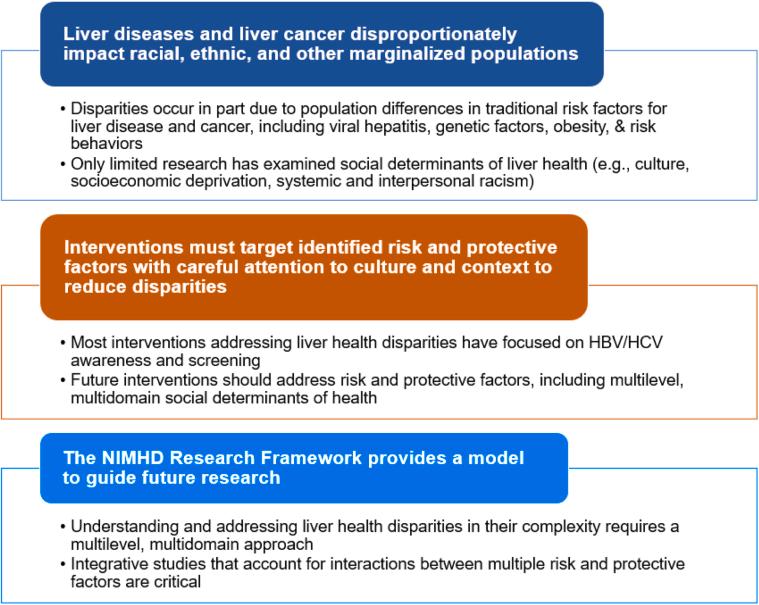
Liver disease and liver cancer disparities in the U.S. are reflective of complex multiple determinants of health. This review describes the disproportionate burden of liver disease and liver cancer among racial, ethnic, sexual, and gender minority, rural, low socioeconomic status (SES) populations, and place-based contexts. The contributions of traditional and lifestyle-related risk factors (e.g., alcohol consumption, evitable toxin exposure, nutrition quality) and comorbid conditions (e.g., viral hepatitis, obesity, type II diabetes) to disparities is also explored. Biopsychosocial mechanisms defining the physiological consequences of inequities underlying these health disparities, including inflammation, allostatic load, genetics, epigenetics, and social epigenomics are described. Guided by the National Institute on Minority Health and Health Disparities (NIMHD) framework, integrative research of unexplored social and biological mechanisms of health disparities, appropriate methods and measures for early screening, diagnosis, assessment, and strategies for timely treatment and maintaining multidisciplinary care should be actively pursued. We review emerging research on adverse social determinants of liver health, such as structural racism, discrimination, stigma, SES, rising care-related costs, food insecurity, healthcare access, health literacy, and environmental exposures to pollutants. Limited research on protective factors of liver health is also described. Research from effective, multilevel, community-based interventions indicate a need for further intervention efforts that target both risk and protective factors to address health disparities. Policy-level impacts are also needed to reduce disparities. These insights are important, as the social contexts and inequities that influence determinants of liver disease/cancer have been worsened by the coronavirus disease-2019 pandemic and are forecasted to amplify disparities.
美国肝病和肝癌的差异反映了健康的复杂多重决定因素。本综述描述了肝病和肝癌在种族、族裔、性取向和性别少数群体、农村、社会经济地位低下人群以及基于地域的环境中负担过重的情况。还探讨了传统和与生活方式相关的风险因素(如饮酒、可避免的毒素暴露、营养质量)以及合并症(如病毒性肝炎、肥胖症、II型糖尿病)对差异的影响。描述了定义这些健康差异背后不平等生理后果的生物心理社会机制,包括炎症、应激负荷、遗传学、表观遗传学和社会表观基因组学。以美国国立少数族裔健康与健康差异研究所(NIMHD)的框架为指导,应积极开展对健康差异尚未探索的社会和生物学机制的综合研究、早期筛查、诊断、评估的适当方法和措施,以及及时治疗和维持多学科护理的策略。我们综述了关于肝脏健康不良社会决定因素的新研究,如结构性种族主义、歧视、耻辱感、社会经济地位、与护理相关的成本上升、粮食不安全、医疗保健可及性、健康素养以及环境污染物暴露。还介绍了关于肝脏健康保护因素的有限研究。来自有效、多层次、基于社区的干预措施的研究表明,需要进一步开展针对风险和保护因素的干预工作,以解决健康差异问题。还需要政策层面的影响来减少差异。这些见解很重要,因为影响肝病/癌症决定因素的社会背景和不平等因2019年冠状病毒病大流行而恶化,预计还会加剧差异。


 Zotero 插件