
全球、地区和国家 1990 年至 2021 年糖尿病负担,以及对 2050 年患病率的预测:2021 年全球疾病负担研究的系统分析。
Global, regional, and national burden of diabetes from 1990 to 2021, with projections of prevalence to 2050: a systematic analysis for the Global Burden of Disease Study 2021.
出版信息
Lancet. 2023 Jul 15;402(10397):203-234. doi: 10.1016/S0140-6736(23)01301-6. Epub 2023 Jun 22.
BACKGROUND
Diabetes is one of the leading causes of death and disability worldwide, and affects people regardless of country, age group, or sex. Using the most recent evidentiary and analytical framework from the Global Burden of Diseases, Injuries, and Risk Factors Study (GBD), we produced location-specific, age-specific, and sex-specific estimates of diabetes prevalence and burden from 1990 to 2021, the proportion of type 1 and type 2 diabetes in 2021, the proportion of the type 2 diabetes burden attributable to selected risk factors, and projections of diabetes prevalence through 2050.
METHODS
Estimates of diabetes prevalence and burden were computed in 204 countries and territories, across 25 age groups, for males and females separately and combined; these estimates comprised lost years of healthy life, measured in disability-adjusted life-years (DALYs; defined as the sum of years of life lost [YLLs] and years lived with disability [YLDs]). We used the Cause of Death Ensemble model (CODEm) approach to estimate deaths due to diabetes, incorporating 25 666 location-years of data from vital registration and verbal autopsy reports in separate total (including both type 1 and type 2 diabetes) and type-specific models. Other forms of diabetes, including gestational and monogenic diabetes, were not explicitly modelled. Total and type 1 diabetes prevalence was estimated by use of a Bayesian meta-regression modelling tool, DisMod-MR 2.1, to analyse 1527 location-years of data from the scientific literature, survey microdata, and insurance claims; type 2 diabetes estimates were computed by subtracting type 1 diabetes from total estimates. Mortality and prevalence estimates, along with standard life expectancy and disability weights, were used to calculate YLLs, YLDs, and DALYs. When appropriate, we extrapolated estimates to a hypothetical population with a standardised age structure to allow comparison in populations with different age structures. We used the comparative risk assessment framework to estimate the risk-attributable type 2 diabetes burden for 16 risk factors falling under risk categories including environmental and occupational factors, tobacco use, high alcohol use, high body-mass index (BMI), dietary factors, and low physical activity. Using a regression framework, we forecast type 1 and type 2 diabetes prevalence through 2050 with Socio-demographic Index (SDI) and high BMI as predictors, respectively.
FINDINGS
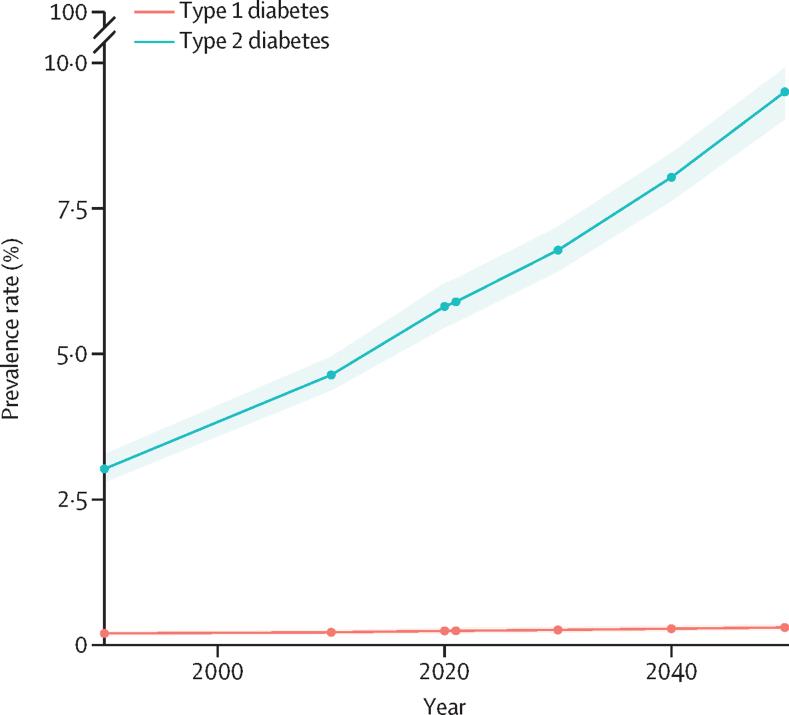
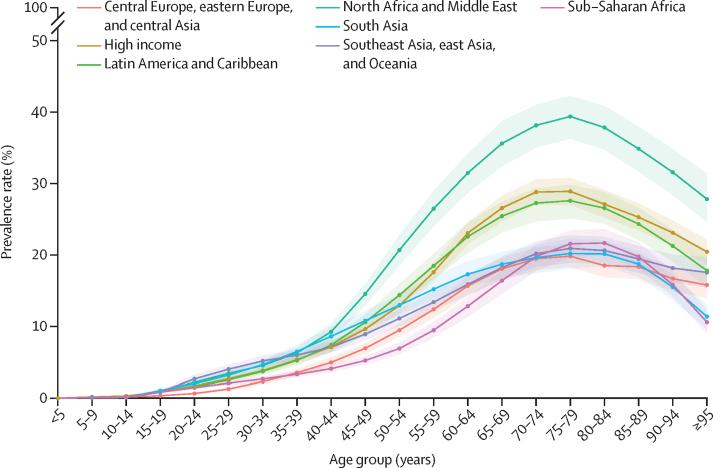
In 2021, there were 529 million (95% uncertainty interval [UI] 500-564) people living with diabetes worldwide, and the global age-standardised total diabetes prevalence was 6·1% (5·8-6·5). At the super-region level, the highest age-standardised rates were observed in north Africa and the Middle East (9·3% [8·7-9·9]) and, at the regional level, in Oceania (12·3% [11·5-13·0]). Nationally, Qatar had the world's highest age-specific prevalence of diabetes, at 76·1% (73·1-79·5) in individuals aged 75-79 years. Total diabetes prevalence-especially among older adults-primarily reflects type 2 diabetes, which in 2021 accounted for 96·0% (95·1-96·8) of diabetes cases and 95·4% (94·9-95·9) of diabetes DALYs worldwide. In 2021, 52·2% (25·5-71·8) of global type 2 diabetes DALYs were attributable to high BMI. The contribution of high BMI to type 2 diabetes DALYs rose by 24·3% (18·5-30·4) worldwide between 1990 and 2021. By 2050, more than 1·31 billion (1·22-1·39) people are projected to have diabetes, with expected age-standardised total diabetes prevalence rates greater than 10% in two super-regions: 16·8% (16·1-17·6) in north Africa and the Middle East and 11·3% (10·8-11·9) in Latin America and Caribbean. By 2050, 89 (43·6%) of 204 countries and territories will have an age-standardised rate greater than 10%.
INTERPRETATION
Diabetes remains a substantial public health issue. Type 2 diabetes, which makes up the bulk of diabetes cases, is largely preventable and, in some cases, potentially reversible if identified and managed early in the disease course. However, all evidence indicates that diabetes prevalence is increasing worldwide, primarily due to a rise in obesity caused by multiple factors. Preventing and controlling type 2 diabetes remains an ongoing challenge. It is essential to better understand disparities in risk factor profiles and diabetes burden across populations, to inform strategies to successfully control diabetes risk factors within the context of multiple and complex drivers.
FUNDING
Bill & Melinda Gates Foundation.
背景
糖尿病是全球范围内导致死亡和残疾的主要原因之一,无论国家、年龄组或性别如何,都会影响到人们。我们使用来自全球疾病、伤害和风险因素研究(GBD)的最新证据和分析框架,对 1990 年至 2021 年的糖尿病患病率和负担、2021 年 1 型和 2 型糖尿病的比例、特定风险因素导致的 2 型糖尿病负担比例以及 2050 年糖尿病患病率的预测进行了位置、年龄和性别特异性估计。
方法
我们在 204 个国家和地区,对男性和女性进行了 25 个年龄组的单独和组合的糖尿病患病率和负担估计;这些估计包括丧失的健康生命年,用残疾调整生命年(DALY;定义为生命损失年数[YLL]和残疾生命年数[YLD]之和)衡量。我们使用死因综合模型(CODEm)方法来估计糖尿病导致的死亡,纳入了 25666 个位置年的数据,来自生命登记和死因推断报告的单独的全(包括 1 型和 2 型糖尿病)和特定类型的模型。其他类型的糖尿病,包括妊娠和单基因糖尿病,没有明确建模。总糖尿病和 1 型糖尿病患病率是通过使用贝叶斯荟萃回归建模工具 DisMod-MR 2.1 来估计的,该工具分析了来自科学文献、调查微观数据和保险索赔的 1527 个位置年的数据;2 型糖尿病的估计值是通过从总估计值中减去 1 型糖尿病得出的。死亡率和患病率估计值,以及标准预期寿命和残疾权重,用于计算 YLL、YLD 和 DALY。在适当的情况下,我们将估计值外推到具有标准化年龄结构的假设人群中,以便在具有不同年龄结构的人群中进行比较。我们使用比较风险评估框架来估计 16 个风险因素导致的 2 型糖尿病负担风险,这些风险因素属于环境和职业因素、烟草使用、大量饮酒、高身体质量指数(BMI)、饮食因素和低体力活动等风险类别。我们使用回归框架,分别以社会人口指数(SDI)和高 BMI 为预测因子,预测 2050 年 1 型和 2 型糖尿病的患病率。
发现
2021 年,全球有 5.29 亿人(95%置信区间[UI]为 5.00-5.64)患有糖尿病,全球年龄标准化总糖尿病患病率为 6.1%(5.8-6.5)。在超级区域层面,北非和中东的年龄标准化率最高(9.3%[8.7-9.9]),在区域层面,大洋洲的年龄标准化率最高(12.3%[11.5-13.0])。在国家层面,卡塔尔的糖尿病年龄特异性患病率最高,75-79 岁人群的患病率为 76.1%(73.1-79.5)。糖尿病的总患病率,特别是在老年人中,主要反映了 2 型糖尿病,2021 年,2 型糖尿病占全球糖尿病病例的 96.0%(95.1-96.8),占全球糖尿病 DALY 的 95.4%(94.9-95.9)。2021 年,全球 2 型糖尿病 DALY 的 52.2%(25.5-71.8)归因于高 BMI。1990 年至 2021 年期间,全球范围内,高 BMI 对 2 型糖尿病 DALY 的贡献增加了 24.3%(18.5-30.4)。到 2050 年,预计全球将有超过 13.1 亿(1.22-1.39)人患有糖尿病,预计两个超级区域的年龄标准化总糖尿病患病率将超过 10%:北非和中东为 16.8%(16.1-17.6),拉丁美洲和加勒比为 11.3%(10.8-11.9)。到 2050 年,204 个国家和地区中,有 89 个(43.6%)的年龄标准化率将超过 10%。
解释
糖尿病仍然是一个重大的公共卫生问题。2 型糖尿病占糖尿病病例的大部分,它主要是可以预防的,在疾病早期发现并加以管理,在某些情况下是可以逆转的。然而,所有证据都表明,糖尿病的患病率在全球范围内正在上升,这主要是由于多种因素导致的肥胖症的上升。预防和控制 2 型糖尿病仍然是一个持续的挑战。必须更好地了解不同人群的风险因素特征和糖尿病负担的差异,为在多种复杂驱动因素的背景下成功控制糖尿病风险因素提供信息。
资金来源
比尔及梅琳达·盖茨基金会。


 Zotero 插件