
通过泰国罗勇府塑料包装废弃物管理的循环经济实现可持续发展。
Towards sustainability through the circular economy of plastic packaging waste management in Rayong Province, Thailand.
作者信息
Samitthiwetcharong Sutisa, Kullavanijaya Pratin, Suwanteep Kultip, Chavalparit Orathai
机构信息
Department of Environmental Engineering, Faculty of Engineering, Chulalongkorn University, Bangkok, 10330 Thailand.
Excellent Center of Waste Utilization and Management, Pilot Plant Development and Training Institute, King Mongkut's University of Technology Thonburi, Bangkok, 10150 Thailand.
出版信息
J Mater Cycles Waste Manag. 2023 Apr 24:1-17. doi: 10.1007/s10163-023-01657-0.
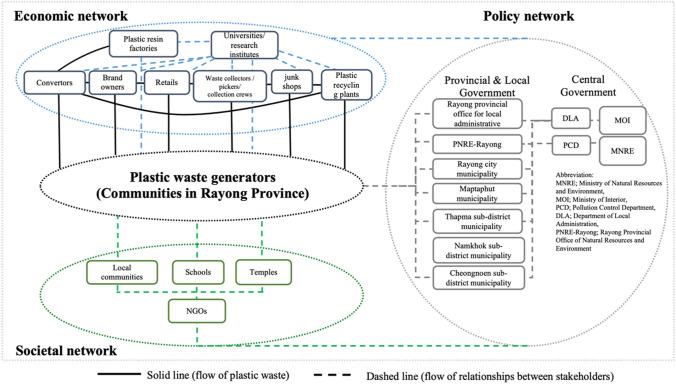
The circularity of plastic packaging waste (PPW) material via recycling is critical to its circular economy towards sustainability and carbon neutrality of society. The multi-stakeholders and complex waste recycling loop of Rayong Province, Thailand, is herein analysed using an actor-network theory to identify key actors, roles, and responsibilities in the recycling scheme. The results depict the relative function of three-actor networks, namely policy, economy, and societal networks, which play different roles in PPW handling from its generation through various separations from municipal solid wastes to recycling. The policy network comprises mainly national authorities and committees responsible for targeting and policymaking for local implementation, while economic networks are formal and informal actors acting for PPW collection with a recycling contribution of 11.3-64.1%. A societal network supports this collaboration for knowledge, technology, or funds. Two waste recycling models are classified as community-based and municipality-based management, which functions differently by coverage areas, capabilities, and process efficiency. The economic reliability of each informal sorting activity is a crucial factor for sustainability, while empowering people in environmental awareness and sorting ability at the household level is also essential, as well as law enforcement that is effective in the long-term circularity of the PPW economy.
通过回收利用实现塑料包装废弃物(PPW)材料的循环利用,对于实现其向可持续发展和社会碳中和的循环经济至关重要。本文运用行动者网络理论,对泰国罗勇府多利益相关者和复杂的废弃物回收循环进行了分析,以确定回收计划中的关键行动者、角色和责任。结果描绘了三个行动者网络的相对功能,即政策网络、经济网络和社会网络,它们在PPW从产生到通过从城市固体废物中进行各种分离再到回收利用的处理过程中发挥着不同的作用。政策网络主要由负责制定目标和政策以在地方实施的国家当局和委员会组成,而经济网络是为PPW收集而行动的正式和非正式行动者,其回收贡献率为11.3%-64.1%。社会网络为这种合作提供知识、技术或资金支持。两种废弃物回收模式被归类为基于社区和基于市政当局的管理,它们在覆盖区域、能力和处理效率方面发挥着不同的作用。每项非正式分类活动的经济可靠性是可持续性的关键因素,同时增强家庭层面人们的环境意识和分类能力也至关重要,以及在PPW经济的长期循环中有效的执法也很关键。



 Zotero 插件