
加强循环塑料垃圾管理:减少泰国罗勇府的温室气体排放并提高经济价值。
Enhancing circular plastic waste management: Reducing GHG emissions and increasing economic value in Rayong province, Thailand.
作者信息
Samitthiwetcharong Sutisa, Chavalparit Orathai, Suwanteep Kultip, Murayama Takehiko, Kullavanijaya Pratin
机构信息
Department of Environmental and Sustainable Engineering, Faculty of Engineering, Chulalongkorn University, Bangkok, 10330, Thailand.
Research Unit of Environmental Management and Sustainable Industry, Faculty of Engineering, Chulalongkorn University, Bangkok, 10330, Thailand.
出版信息
Heliyon. 2024 Sep 7;10(18):e37611. doi: 10.1016/j.heliyon.2024.e37611. eCollection 2024 Sep 30.
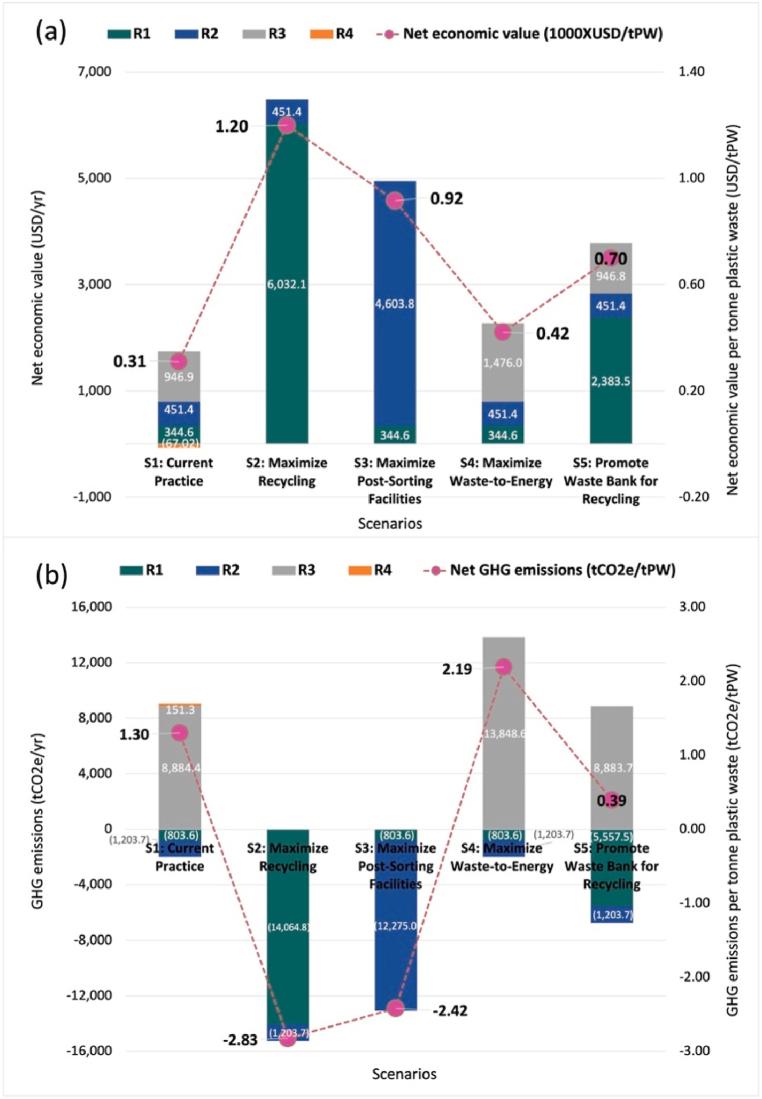
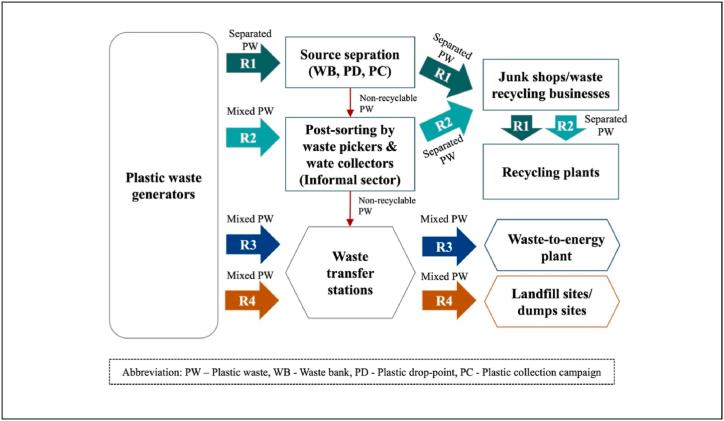
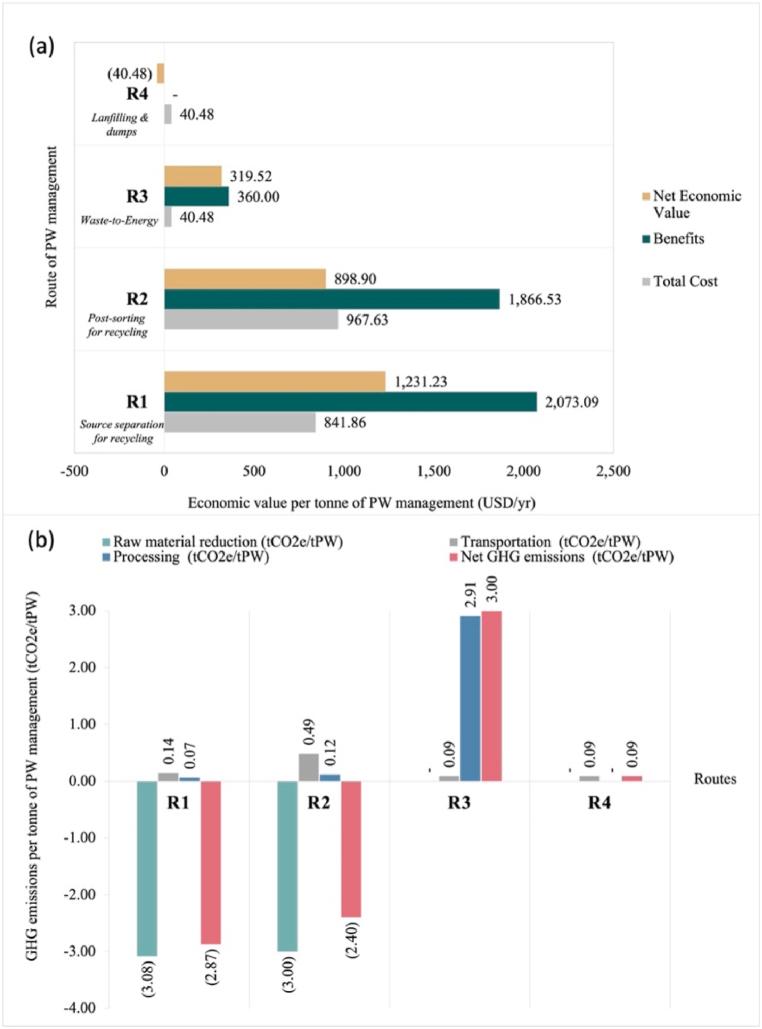
This study evaluates the greenhouse gas (GHG) emissions and economic value creation of plastic waste (PW) management in Rayong, Thailand, a city on the eastern Gulf Coast with a significant amount of generated and leaked PW. By analyzing current practices, and developing and evaluating improvement scenarios, the study explores strategies for reducing GHG and enhancing economic benefits across the PW management chain. Four primary routes with varying capacities handle approximately 5,445.55 tonnes of PW via source separation recycling (5.18 %), post-sorting recycling (9.30 %), energy recovery (54.86 %), and landfills or opened dump disposal (30.66 %). About 83.21 % of the 16 ± 6.9 % PW in municipal solid waste (MSW) is recyclable, primarily consisting of high-density polyethylene (HDPE), polypropylene (PP), low-density polyethylene (LDPE), linear low-density polyethylene (LLDPE), and polyethylene terephthalate (PET). The current management practice generates an economic benefit of approximately 1.68 million USD/yr or 310 USD/t of PW, compared to the proposed scenarios, which enhances recycling efficiency and reduces landfill and energy recovery waste, yielding 2.27-6.48 million USD/yr or 420.64-1200.33 USD/t of PW. The practice emits about 7,028.47 tCOe annually, while improved source and post-sorting efficiencies reduce GHG emissions by 2.86-3.17 times or -2.83 to -2.42 tCOe/t of PW or a total of over 13,078.60-15,268.44 tCOe. Burning PW increases approximately 1.6 times or 11,841.36 tCOe/yr. Enhancing recycling efficiency, particularly through source separation, is key to promoting more productive and valuable PW separation, increasing economic value and GHG mitigation by approximately 3.87 and 3.17 times, respectively. These findings provide valuable insights for local authorities and policymakers to develop strategic interventions and policies that align with the improved scenario by enhancing source separation and recycling. The results demonstrate that improving the efficiency of separation at the source is critical for transitioning from a linear PW management strategy to a circular economy, significantly reducing landfill waste and mitigating environmental threats.
本研究评估了泰国罗勇府塑料垃圾(PW)管理的温室气体(GHG)排放及经济价值创造情况。罗勇府位于泰国湾东海岸,产生并泄漏了大量塑料垃圾。通过分析当前做法、制定并评估改进方案,本研究探索了在整个塑料垃圾管理链中减少温室气体排放及提高经济效益的策略。四条不同处理能力的主要路线通过源头分类回收(5.18%)、分拣后回收(9.30%)、能源回收(54.86%)以及填埋或露天倾倒处置(30.66%)处理约5445.55吨塑料垃圾。城市固体废弃物(MSW)中16±6.9%的塑料垃圾约83.21%可回收利用,主要包括高密度聚乙烯(HDPE)、聚丙烯(PP)、低密度聚乙烯(LDPE)、线性低密度聚乙烯(LLDPE)和聚对苯二甲酸乙二酯(PET)。与提议的方案相比,当前管理做法产生的经济效益约为每年168万美元或每吨塑料垃圾310美元,提议方案提高了回收效率,减少了填埋和能源回收废弃物,产生的经济效益为每年227万至648万美元或每吨塑料垃圾420.64至1200.33美元。当前做法每年排放约7028.47吨二氧化碳当量,而提高源头和分拣后效率可将温室气体排放量减少2.86至3.17倍,即每吨塑料垃圾减少2.83至2.42吨二氧化碳当量,或总共减少超过13078.60至15268.44吨二氧化碳当量。焚烧塑料垃圾会使排放量增加约1.6倍,即每年增加11841.36吨二氧化碳当量。提高回收效率,特别是通过源头分类,是促进更高效和有价值的塑料垃圾分类、分别将经济价值和温室气体减排提高约3.87倍和3.17倍的关键。这些发现为地方当局和政策制定者提供了宝贵见解,有助于他们制定与改进方案相一致的战略干预措施和政策,通过加强源头分类和回收利用来实现。结果表明,提高源头分类效率对于从线性塑料垃圾管理战略向循环经济转型、大幅减少填埋废弃物以及减轻环境威胁至关重要。


 Zotero 插件