
预测环境浓度下的磺酸盐改性聚苯乙烯纳米颗粒诱导与种系Notch信号增加相关的跨代毒性。
Sulfonate-Modified Polystyrene Nanoparticle at Precited Environmental Concentrations Induces Transgenerational Toxicity Associated with Increase in Germline Notch Signal of .
作者信息
He Wenmiao, Gu Aihua, Wang Dayong
机构信息
Key Laboratory of Environmental Medicine Engineering of Ministry of Education, Medical School, Southeast University, Nanjing 210009, China.
School of Public Health, Nanjing Medical University, Nanjing 211166, China.
出版信息
Toxics. 2023 Jun 6;11(6):511. doi: 10.3390/toxics11060511.
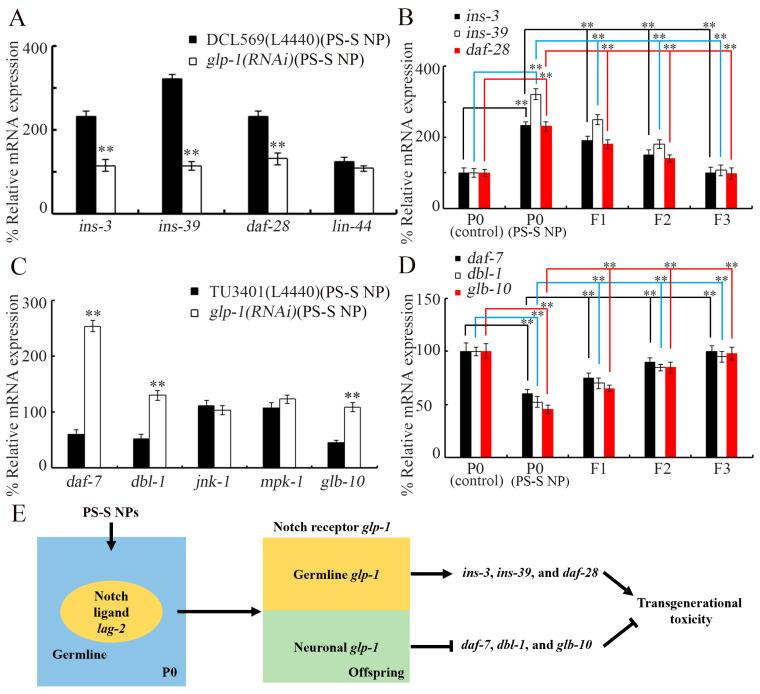
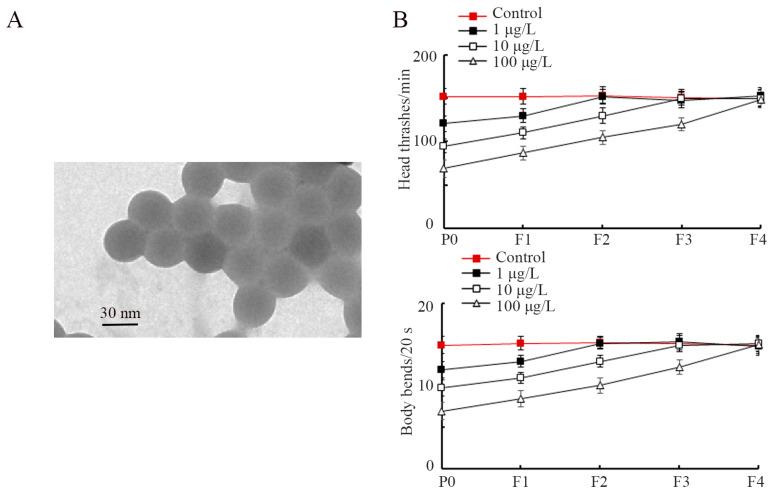
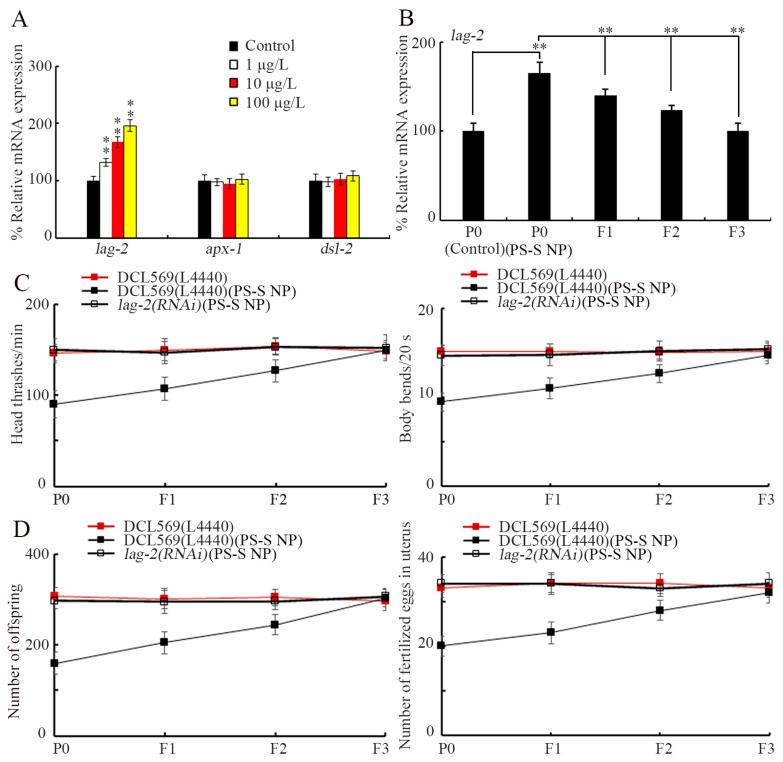
Recently, the transgenerational toxicity of nanoplastics has received increasing attention. is a useful model to assess the transgenerational toxicity of different pollutants. In nematodes, the possibility of early-life exposure to sulfonate-modified polystyrene nanoparticle (PS-S NP) causing transgenerational toxicity and its underlying mechanisms were investigated. After exposure at the L1-larval stage, transgenerational inhibition in both locomotion behavior (body bend and head thrash) and reproductive capacity (number of offspring and fertilized egg number in uterus) was induced by 1-100 μg/L PS-S NP. Meanwhile, after exposure to 1-100 μg/L PS-S NP, the expression of germline encoding Notch ligand was increased not only at the parental generation (P0-G) but also in the offspring, and the transgenerational toxicity was inhibited by the germline RNA interference (RNAi) of . During the transgenerational toxicity formation, the parental LAG-2 activated the corresponding Notch receptor GLP-1 in the offspring, and transgenerational toxicity was also suppressed by RNAi. GLP-1 functioned in the germline and the neurons to mediate the PS-S NP toxicity. In PS-S NP-exposed nematodes, germline GLP-1 activated the insulin peptides of INS-39, INS-3, and DAF-28, and neuronal GLP-1 inhibited the DAF-7, DBL-1, and GLB-10. Therefore, the exposure risk in inducing transgenerational toxicity through PS-S NP was suggested, and this transgenerational toxicity was mediated by the activation of germline Notch signal in organisms.
近年来,纳米塑料的跨代毒性受到越来越多的关注。秀丽隐杆线虫是评估不同污染物跨代毒性的有用模型。在线虫中,研究了早期暴露于磺酸盐修饰的聚苯乙烯纳米颗粒(PS-S NP)导致跨代毒性的可能性及其潜在机制。在L1幼虫阶段暴露后,1-100μg/L的PS-S NP诱导了运动行为(身体弯曲和头部摆动)和生殖能力(后代数量和子宫内受精卵数量)的跨代抑制。同时,在暴露于1-100μg/L的PS-S NP后,编码Notch配体的种系基因的表达不仅在亲代(P0-G)中增加,在后代中也增加,并且种系RNA干扰(RNAi)抑制了跨代毒性。在跨代毒性形成过程中,亲代的LAG-2激活了后代中相应的Notch受体GLP-1,RNAi也抑制了跨代毒性。GLP-1在种系和神经元中发挥作用,介导PS-S NP的毒性。在暴露于PS-S NP的线虫中,种系GLP-1激活了INS-39、INS-3和DAF-28的胰岛素肽,神经元GLP-1抑制了DAF-7、DBL-1和GLB-10。因此,提示了通过PS-S NP诱导跨代毒性的暴露风险,并且这种跨代毒性是由生物体内种系Notch信号的激活介导的。



 Zotero 插件