
FAPI PET/CT成像——最新综述
FAPI PET/CT Imaging-An Updated Review.
作者信息
Chandekar Kunal Ramesh, Prashanth Arun, Vinjamuri Sobhan, Kumar Rakesh
机构信息
Department of Nuclear Medicine, All India Institute of Medical Sciences, New Delhi 110029, India.
Department of Nuclear Medicine, MIOT International Hospital, Chennai 600089, India.
出版信息
Diagnostics (Basel). 2023 Jun 9;13(12):2018. doi: 10.3390/diagnostics13122018.
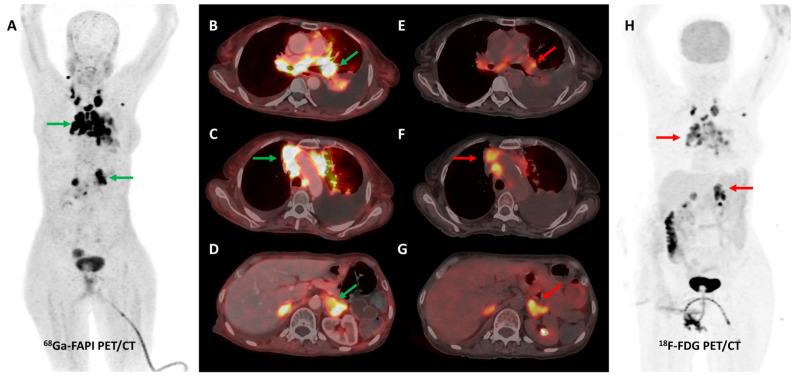
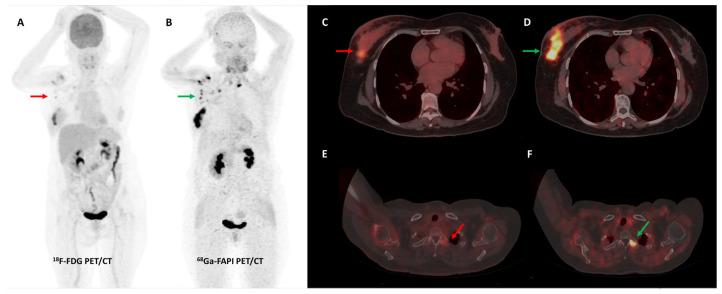
Despite revolutionizing the field of oncological imaging, Positron Emission Tomography (PET) with [F]Fluorodeoxyglucose (FDG) as its workhorse is limited by a lack of specificity and low sensitivity in certain tumor subtypes. Fibroblast activation protein (FAP), a type II transmembrane glycoprotein, is expressed by cancer-associated fibroblasts (CAFs) that form a major component of the tumor stroma. FAP holds the promise to be a pan-cancer target, owing to its selective over-expression in a vast majority of neoplasms, particularly epithelial cancers. Several radiolabeled FAP inhibitors (FAPI) have been developed for molecular imaging and potential theranostic applications. Preliminary data on FAPI PET/CT remains encouraging, with extensive multi-disciplinary clinical research currently underway. This review summarizes the existing literature on FAPI PET/CT imaging with an emphasis on diagnostic applications, comparison with FDG, pitfalls, and future directions.
尽管正电子发射断层扫描(PET)以[F]氟脱氧葡萄糖(FDG)作为其主要显像剂,彻底改变了肿瘤影像学领域,但在某些肿瘤亚型中,它存在特异性不足和灵敏度较低的局限性。成纤维细胞活化蛋白(FAP)是一种II型跨膜糖蛋白,由构成肿瘤基质主要成分的癌症相关成纤维细胞(CAF)表达。由于FAP在绝大多数肿瘤,尤其是上皮癌中选择性过度表达,它有望成为一种泛癌靶点。已经开发了几种放射性标记的FAP抑制剂(FAPI)用于分子成像和潜在的诊疗应用。FAPI PET/CT的初步数据仍然令人鼓舞,目前正在进行广泛的多学科临床研究。这篇综述总结了关于FAPI PET/CT成像的现有文献,重点是诊断应用、与FDG的比较、陷阱和未来方向。





 Zotero 插件