
哺乳动物体内DNA G-四链体结构的动力学与调控
In vivo dynamics and regulation of DNA G-quadruplex structures in mammals.
作者信息
Zhang Ze-Hao, Qian Sheng Hu, Wei Dengguo, Chen Zhen-Xia
机构信息
Hubei Hongshan Laboratory, College of Life Science and Technology, College of Biomedicine and Health, Interdisciplinary Sciences Institute, Huazhong Agricultural University, Wuhan, 430070, China.
College of Science, Huazhong Agricultural University, Wuhan, 430070, China.
出版信息
Cell Biosci. 2023 Jun 28;13(1):117. doi: 10.1186/s13578-023-01074-8.
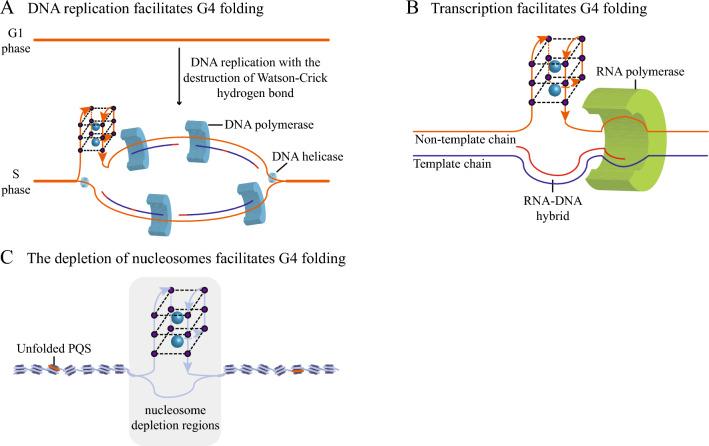
G-quadruplex (G4) is a four-stranded helical DNA secondary structure formed by guanine-rich sequence folding, and G4 has been computationally predicted to exist in a wide range of species. Substantial evidence has supported the formation of endogenous G4 (eG4) in living cells and revealed its regulatory dynamics and critical roles in several important biological processes, making eG4 a regulator of gene expression perturbation and a promising therapeutic target in disease biology. Here, we reviewed the methods for prediction of potential G4 sequences (PQS) and detection of eG4s. We also highlighted the factors affecting the dynamics of eG4s and the effects of eG4 dynamics. Finally, we discussed the future applications of eG4 dynamics in disease therapy.
G-四链体(G4)是由富含鸟嘌呤的序列折叠形成的四链螺旋DNA二级结构,并且通过计算预测G4存在于广泛的物种中。大量证据支持活细胞内源性G4(eG4)的形成,并揭示了其调控动态以及在几个重要生物学过程中的关键作用,使得eG4成为基因表达扰动的调节因子以及疾病生物学中有前景的治疗靶点。在此,我们综述了潜在G4序列(PQS)的预测方法和eG4的检测方法。我们还强调了影响eG4动态变化的因素以及eG4动态变化的影响。最后,我们讨论了eG4动态变化在疾病治疗中的未来应用。




 Zotero 插件