
CD169、HLA-DR和CD64表达动力学作为新冠病毒感染结果的预测生物标志物
Kinetics of CD169, HLA-DR, and CD64 expression as predictive biomarkers of SARS-CoV2 outcome.
作者信息
Gatti Arianna, Fassini Paola, Mazzone Antonino, Rusconi Stefano, Brando Bruno, Mistraletti Giovanni
机构信息
Hematology Laboratory and Transfusion Center, New Hospital of Legnano: Ospedale Nuovo di Legnano, 20025, Legnano, Milano, Italy.
Department of Intensive Care, New Hospital of Legnano: Ospedale Nuovo di Legnano, 20025, Legnano, Milano, Italy.
出版信息
J Anesth Analg Crit Care. 2023 Mar 27;3(1):6. doi: 10.1186/s44158-023-00090-x.
INTRODUCTION
Discriminating between virus-induced fever from superimposed bacterial infections is a common challenge in intensive care units. Superimposed bacterial infections can be detected in severe SARS-CoV2-infected patients, suggesting the important role of the bacteria in COVID-19 evolution. However, indicators of patients' immune status may be of help in the management of critically ill subjects. Monocyte CD169 is a type I interferon-inducible receptor that is up-regulated during viral infections, including COVID-19. Monocyte HLA-DR expression is an immunologic status marker, that decreases during immune exhaustion. This condition is an unfavorable prognostic biomarker in septic patients. Neutrophil CD64 upregulation is an established indicator of sepsis.
METHODS
In this study, we evaluated by flow cytometry the expression of cellular markers monocyte CD169, neutrophil CD64, and monocyte HLA-DR in 36 hospitalized patients with severe COVID-19, as possible indicators of ongoing progression of disease and of patients' immune status. Blood testings started at ICU admission and were carried on throughout the ICU stay and extended in case of transfer to other units, when applicable. The marker expression in mean fluorescence intensity (MFI) and their kinetics with time were correlated to the clinical outcome.
RESULTS
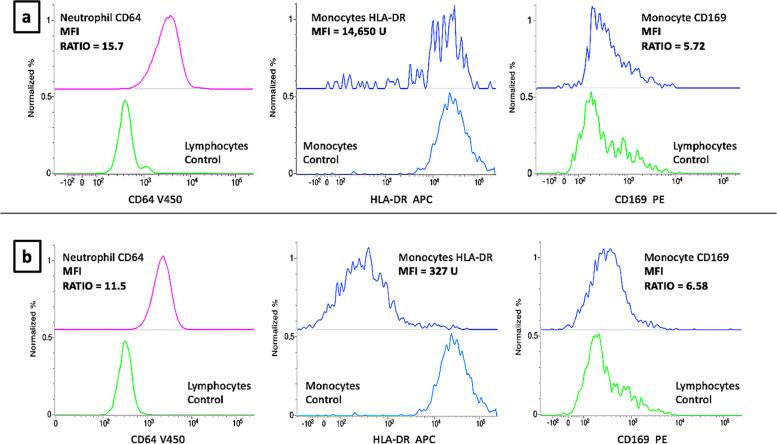
Patients with short hospital stay (≤15 days) and good outcome showed higher values of monocyte HLA-DR (median 17,478 MFI) than long hospital stay patients (>15 days, median 9590 MFI, p= 0.04) and than patients who died (median 5437 MFI, p= 0.05). In most cases, the recovery of the SARS-CoV2 infection-related signs was associated with the downregulation of monocyte CD169 within 17 days from disease onset. However in three surviving long hospital stay patients, a persistent upregulation of monocyte CD169 was observed. An increased neutrophil CD64 expression was found in two cases with a superimposed bacterial sepsis.
CONCLUSION
Monocyte CD169, neutrophil CD64, and monocyte HLA-DR expression can be used as predictive biomarkers of SARS-CoV2 outcome in acutely infected patients. The combined analysis of these indicators can offer a real-time evaluation of patients' immune status and of viral disease progression versus superimposed bacterial infections. This approach allows to better define the patients' clinical status and outcome and may be useful to guide clinicians' decisions. Our study focused on the discrimination between the activity of viral and bacterial infections and on the detection of the development of anergic states that may correlate with an unfavorable prognosis.
引言
区分病毒引起的发热与叠加的细菌感染是重症监护病房常见的挑战。在重症SARS-CoV2感染患者中可检测到叠加的细菌感染,这表明细菌在COVID-19病情发展中起重要作用。然而,患者免疫状态指标可能有助于危重症患者的管理。单核细胞CD169是一种I型干扰素诱导受体,在包括COVID-19在内的病毒感染期间上调。单核细胞HLA-DR表达是一种免疫状态标志物,在免疫耗竭时会降低。这种情况是脓毒症患者不良预后的生物标志物。中性粒细胞CD64上调是脓毒症的既定指标。
方法
在本研究中,我们通过流式细胞术评估了36例住院的重症COVID-19患者的细胞标志物单核细胞CD169、中性粒细胞CD64和单核细胞HLA-DR的表达,作为疾病持续进展和患者免疫状态的可能指标。血液检测在入住重症监护病房时开始,在整个重症监护病房住院期间持续进行,并在转至其他科室(如适用)时延长检测时间。标志物的平均荧光强度(MFI)表达及其随时间的变化动力学与临床结局相关。
结果
住院时间短(≤15天)且预后良好的患者单核细胞HLA-DR值(中位数17478 MFI)高于住院时间长的患者(>15天,中位数9590 MFI,p = 0.04)和死亡患者(中位数5437 MFI,p = 0.05)。在大多数情况下,SARS-CoV2感染相关体征的恢复与发病后17天内单核细胞CD169的下调有关。然而,在三名存活的住院时间长的患者中,观察到单核细胞CD169持续上调。在两例叠加细菌性脓毒症的病例中发现中性粒细胞CD64表达增加。
结论
单核细胞CD169、中性粒细胞CD64和单核细胞HLA-DR表达可作为急性感染患者SARS-CoV2预后的预测生物标志物。对这些指标的综合分析可以实时评估患者的免疫状态以及病毒疾病进展与叠加细菌感染的情况。这种方法有助于更好地确定患者的临床状态和结局,可能有助于指导临床医生的决策。我们的研究集中在区分病毒和细菌感染的活动以及检测可能与不良预后相关的无反应状态的发展。


 Zotero 插件