
CD169/SIGLEC1在新冠病毒疾病(COVID-19)的循环单核细胞上表达,其表达水平与疾病严重程度相关。
CD169/SIGLEC1 is expressed on circulating monocytes in COVID-19 and expression levels are associated with disease severity.
作者信息
Doehn Jan-Moritz, Tabeling Christoph, Biesen Robert, Saccomanno Jacopo, Madlung Elena, Pappe Eva, Gabriel Frieder, Kurth Florian, Meisel Christian, Corman Victor M, Hanitsch Leif G, Treskatsch Sascha, Heim Kathrin, Stegemann Miriam S, Ruwwe-Glösenkamp Christoph, Müller-Redetzky Holger C, Uhrig Alexander, Somasundaram Rajan, Spies Claudia, von Bernuth Horst, Hofmann Jörg, Drosten Christian, Suttorp Norbert, Witzenrath Martin, Sander Leif E, Hübner Ralf-Harto
机构信息
Department of Infectious Diseases and Respiratory Medicine, Charité-Universitätsmedizin Berlin, corporate member of Freie Universität Berlin, Humboldt-Universität zu Berlin, and Berlin Institute of Health, 10117, Berlin, Germany.
Division of Pulmonary Inflammation, Charité-Universitätsmedizin Berlin, corporate member of Freie Universität Berlin, Humboldt-Universität zu Berlin, and Berlin Institute of Health, Berlin, Germany.
出版信息
Infection. 2021 Aug;49(4):757-762. doi: 10.1007/s15010-021-01606-9. Epub 2021 Apr 6.
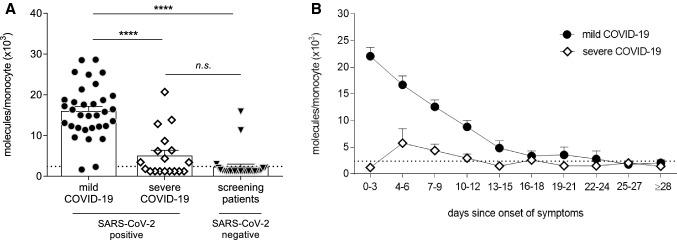
Coronavirus disease 2019 (COVID-19) is caused by infection with severe acute respiratory syndrome coronavirus 2 (SARS-CoV-2). Type I interferons are important in the defense of viral infections. Recently, neutralizing IgG auto-antibodies against type I interferons were found in patients with severe COVID-19 infection. Here, we analyzed expression of CD169/SIGLEC1, a well described downstream molecule in interferon signaling, and found increased monocytic CD169/SIGLEC1 expression levels in patients with mild, acute COVID-19, compared to patients with severe disease. We recommend further clinical studies to evaluate the value of CD169/SIGLEC1 expression in patients with COVID-19 with or without auto-antibodies against type I interferons.
2019冠状病毒病(COVID-19)由严重急性呼吸综合征冠状病毒2(SARS-CoV-2)感染引起。I型干扰素在抵御病毒感染中起重要作用。最近,在重症COVID-19感染患者中发现了针对I型干扰素的中和性IgG自身抗体。在此,我们分析了干扰素信号通路中一个广为人知的下游分子CD169/SIGLEC1的表达情况,发现与重症患者相比,轻症急性COVID-19患者单核细胞CD169/SIGLEC1表达水平升高。我们建议开展进一步的临床研究,以评估CD169/SIGLEC1表达在有或没有针对I型干扰素自身抗体的COVID-19患者中的价值。


 Zotero 插件