
审视肯尼亚国家医疗保险基金对高血压和糖尿病患者的反应能力:一项定性研究。
Examining the responsiveness of the National Health Insurance Fund to people living with hypertension and diabetes in Kenya: a qualitative study.
机构信息
Health Economics Research Unit (HERU), KEMRI-Wellcome Trust Research Programme, Nairobi, Kenya
Health Economics Research Unit (HERU), KEMRI-Wellcome Trust Research Programme, Nairobi, Kenya.
出版信息
BMJ Open. 2023 Jul 4;13(7):e069330. doi: 10.1136/bmjopen-2022-069330.
OBJECTIVES
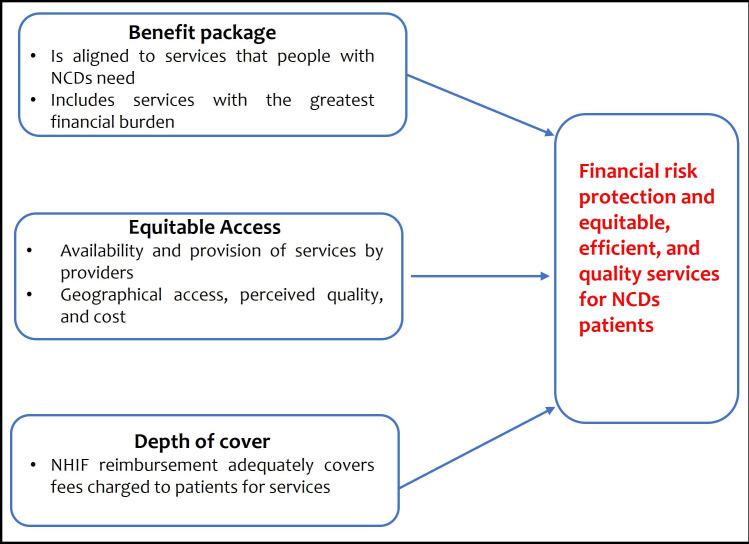
To assess the responsiveness of the National Health Insurance Fund (NHIF) Supa Cover benefit package to the needs of individuals with diabetes and hypertension in Kenya.
DESIGN, SETTING AND PARTICIPANTS: We carried out a qualitative study and collected data using key informant interviews (n=39) and focus group discussions (n=4) in two purposively selected counties in Western Kenya. Study participants were drawn from NHIF officials, county government officials, health facility managers, healthcare workers and individuals with hypertension and diabetes who were enrolled in NHIF. We analysed data using a thematic approach.
RESULTS
Study participants reported that the NHIF Supa Cover benefit package expanded access to services for people living with hypertension and diabetes. However, the NHIF members and healthcare workers had inadequate awareness of the NHIF service entitlements. The NHIF benefit package inadequately covered the range of services needed by people living with hypertension and diabetes and the benefits package did not prioritise preventive and promotive services. Sometimes patients were discriminated against by healthcare providers who preferred cash-paying patients, and some NHIF-empanelled health facilities had inadequate structural inputs essential for quality of care. Study participants felt that the NHIF premium for the general scheme was unaffordable, and NHIF members faced additional out-of-pocket costs because of additional payments for services not available or covered.
CONCLUSION
Whereas NHIF has reduced financial barriers for hypertension and diabetes patients, to enhance its responsiveness to patient needs, NHIF should implement mechanisms to increase benefit package awareness among members and providers. In addition, preventive and promotive services should be included in NHIF's benefits package and mechanisms to monitor and hold contracted providers accountable should be strengthened.
目的
评估肯尼亚国家健康保险基金 (NHIF) Supa 保险套餐对糖尿病和高血压患者需求的响应能力。
设计、地点和参与者:我们进行了一项定性研究,在肯尼亚西部两个有针对性选择的县使用关键知情人访谈(n=39)和焦点小组讨论(n=4)收集数据。研究参与者来自 NHIF 官员、县政府官员、医疗机构管理人员、医疗保健工作者以及参加 NHIF 的高血压和糖尿病患者。我们使用主题方法分析数据。
结果
研究参与者报告称,NHIF Supa 保险套餐扩大了高血压和糖尿病患者获得服务的机会。然而,NHIF 成员和医疗保健工作者对 NHIF 的服务权益认识不足。NHIF 福利套餐不能充分涵盖高血压和糖尿病患者所需的服务范围,福利套餐也没有优先考虑预防和促进性服务。有时,医疗保健提供者会歧视那些需要现金支付的患者,而一些 NHIF 注册的医疗机构缺乏提供优质护理所必需的结构性投入。研究参与者认为,NHIF 一般计划的保费负担不起,而且 NHIF 成员由于需要支付额外的未涵盖或未提供的服务费用而面临额外的自付费用。
结论
尽管 NHIF 已经为高血压和糖尿病患者减少了财务障碍,但为了增强其对患者需求的响应能力,NHIF 应实施机制,提高成员和提供者对福利套餐的认识。此外,应将预防和促进性服务纳入 NHIF 的福利套餐,并加强监测和追究签约提供者责任的机制。
 Zotero 插件