
依伐卡托,一种 CFTR 增效剂,在 COPD 中的应用:一项多中心、平行分组、双盲临床试验。
Icenticaftor, a CFTR Potentiator, in COPD: A Multicenter, Parallel-Group, Double-Blind Clinical Trial.
机构信息
Division of Pulmonary and Critical Care Medicine, Weill Cornell Medicine/NewYork-Presbyterian Hospital, New York, New York.
Department of Thoracic Medicine and Surgery, Lewis Katz School of Medicine, Temple University, Philadelphia, Pennsylvania.
出版信息
Am J Respir Crit Care Med. 2023 Aug 15;208(4):417-427. doi: 10.1164/rccm.202303-0458OC.
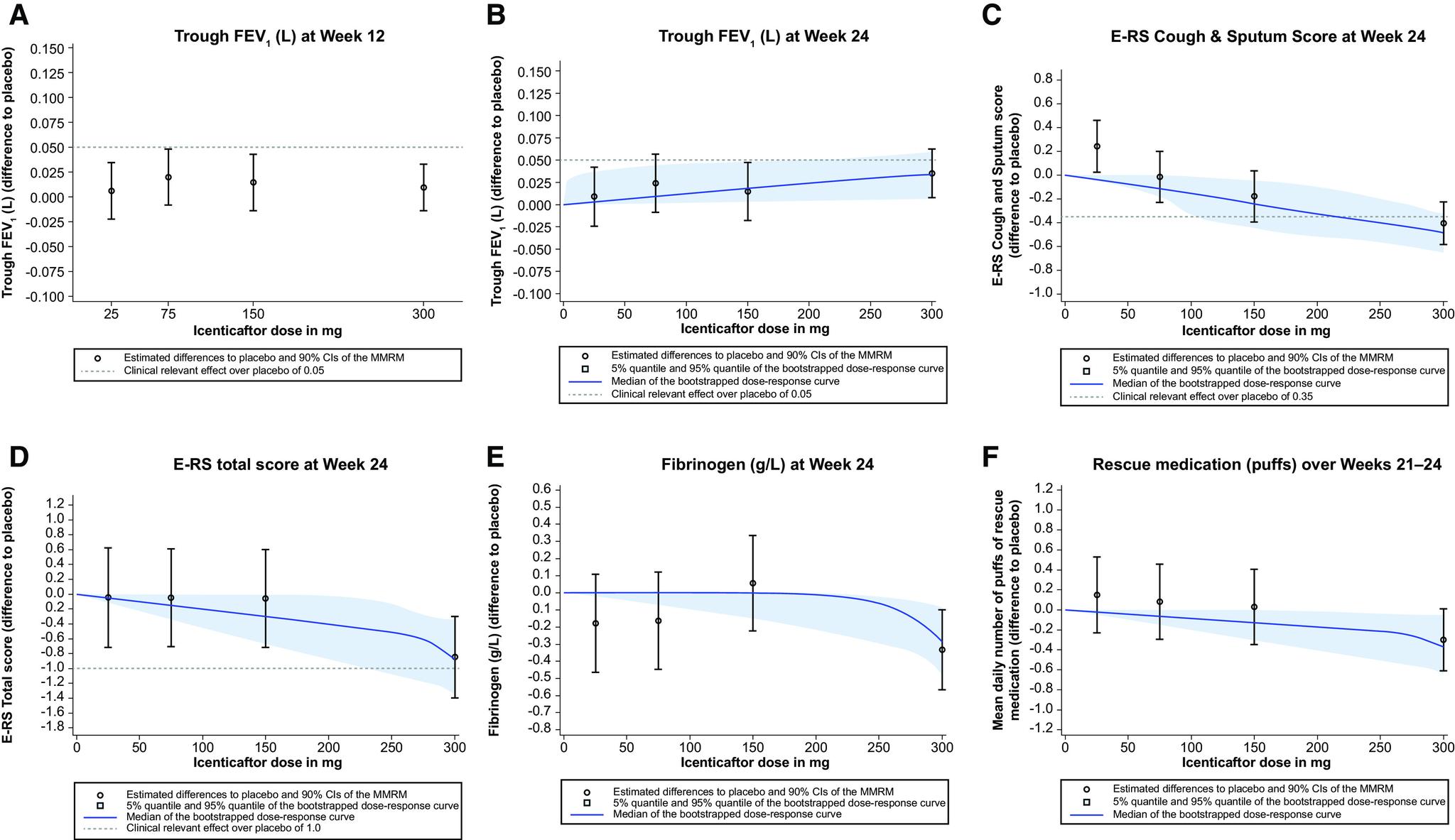
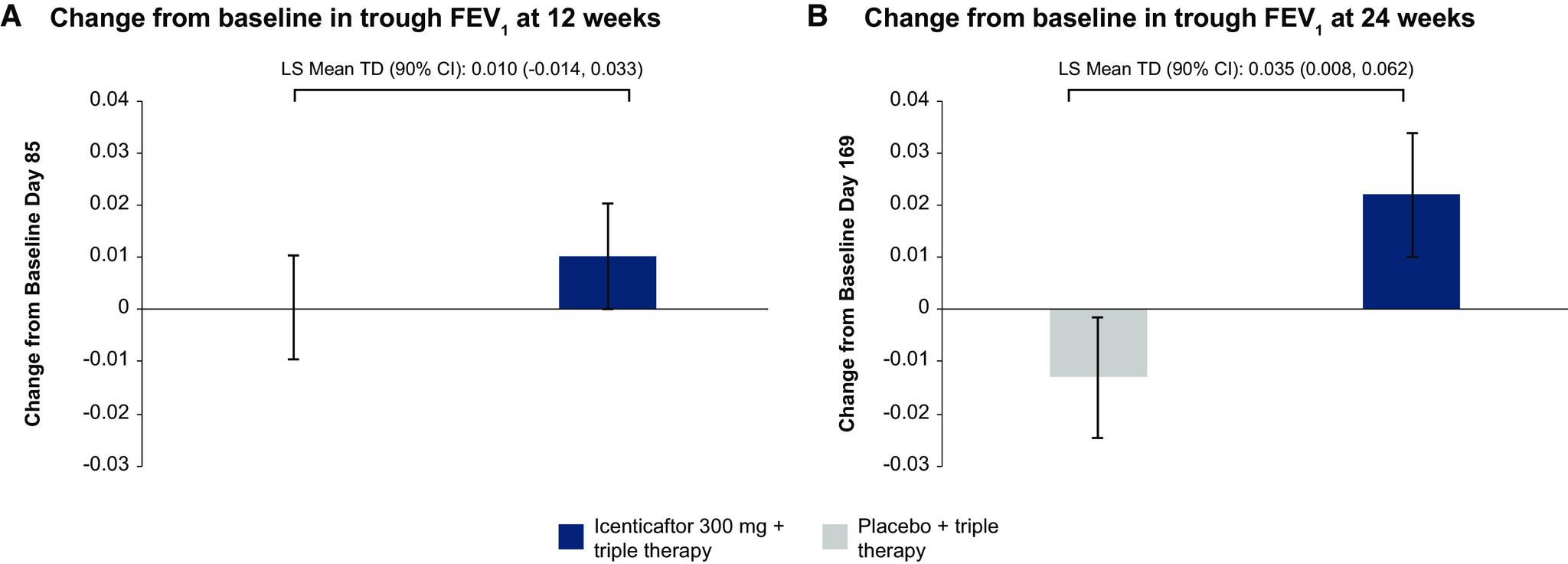
CFTR (cystic fibrosis transmembrane conductance regulator) dysfunction is associated with mucus accumulation and worsening chronic obstructive pulmonary disease (COPD) symptoms. The aim of this phase IIb dose-finding study was to compare a CFTR potentiator, icenticaftor (QBW251), with placebo in patients with COPD and chronic bronchitis. Patients with COPD on triple therapy for at least three months were randomized to six treatment arms (icenticaftor 450, 300, 150, 75, or 25 mg or placebo twice daily [b.i.d.]) in a 24-week, multicenter, parallel-group, double-blind study. The primary endpoint was change from baseline in trough FEV after 12 weeks. Secondary endpoints included change from baseline in trough FEV and Evaluating Respiratory Symptoms in COPD (E-RS) total and cough and sputum scores after 24 weeks. Multiple comparison procedure-modeling was conducted to characterize dose-response relationship. Rescue medication use, exacerbations, and change in serum fibrinogen concentration after 24 weeks were assessed in exploratory and analyses, respectively. Nine hundred seventy-four patients were randomized. After 12 weeks of icenticaftor treatment, no dose-response relationship for change from baseline in trough FEV was observed; however, it was observed for E-RS cough and sputum score. A dose-response relationship was observed after 24 weeks for trough FEV, E-RS cough and sputum and total scores, rescue medication use, and fibrinogen. A dose of 300 mg b.i.d. was consistently the most effective. Improvements for 300 mg b.i.d. versus placebo were also seen in pairwise comparisons of these endpoints. All treatments were well tolerated. The primary endpoint was negative, as icenticaftor did not improve trough FEV over 12 weeks. Although the findings must be interpreted with caution, icenticaftor improved trough FEV; reduced cough, sputum, and rescue medication use; and lowered fibrinogen concentrations at 24 weeks. Clinical trial registered with www.clinicaltrials.gov (NCT04072887).
CFTR(囊性纤维化跨膜电导调节因子)功能障碍与黏液积聚和慢性阻塞性肺疾病(COPD)症状恶化有关。本 IIb 期剂量探索研究的目的是比较 CFTR 增效剂伊替卡托(QBW251)与安慰剂在 COPD 和慢性支气管炎患者中的疗效。接受三联疗法至少三个月的 COPD 患者被随机分为六组治疗(伊替卡托 450、300、150、75 或 25mg 或安慰剂每日两次[bid]),共 24 周,多中心、平行组、双盲研究。主要终点是 12 周时的谷值 FEV 从基线的变化。次要终点包括 24 周时的谷值 FEV 和 COPD 评估呼吸症状(E-RS)总分以及咳嗽和痰评分的变化。采用多比较程序建模来描述剂量反应关系。在探索性和 分析中分别评估了 24 周时的救急药物使用、加重情况和血清纤维蛋白原浓度的变化。974 名患者被随机分组。在接受伊替卡托治疗 12 周后,未观察到谷值 FEV 从基线的变化与剂量之间存在剂量反应关系;然而,E-RS 咳嗽和痰评分则存在这种关系。24 周时,观察到谷值 FEV、E-RS 咳嗽和痰以及总分、救急药物使用和纤维蛋白原与剂量之间存在剂量反应关系。300mg bid 的剂量始终最有效。300mg bid 与安慰剂相比,在这些终点的两两比较中也观察到了改善。所有治疗均耐受良好。主要终点为阴性,因为伊替卡托在 12 周内并未改善谷值 FEV。尽管这些发现必须谨慎解释,但伊替卡托在 24 周时改善了谷值 FEV;减少了咳嗽、痰和救急药物的使用;并降低了纤维蛋白原浓度。该临床试验已在 www.clinicaltrials.gov 上注册(NCT04072887)。



 Zotero 插件