
在炎症条件下,花生四烯酸乙醇胺前体20:4-NAPE对突触传递的抑制作用是由TRPV1受体介导的。
Inhibition of synaptic transmission by anandamide precursor 20:4-NAPE is mediated by TRPV1 receptors under inflammatory conditions.
作者信息
Spicarova Diana, Nerandzic Vladimir, Muzik David, Pontearso Monica, Bhattacharyya Anirban, Nagy Istvan, Palecek Jiri
机构信息
Laboratory of Pain Research, Institute of Physiology of the Czech Academy of Sciences, Prague, Czechia.
Section of Anaesthetics, Pain Medicine and Intensive Care, Department of Surgery and Cancer, Imperial College London, Faculty of Medicine, Chelsea and Westminster Hospital, London, United Kingdom.
出版信息
Front Mol Neurosci. 2023 Jun 22;16:1188503. doi: 10.3389/fnmol.2023.1188503. eCollection 2023.
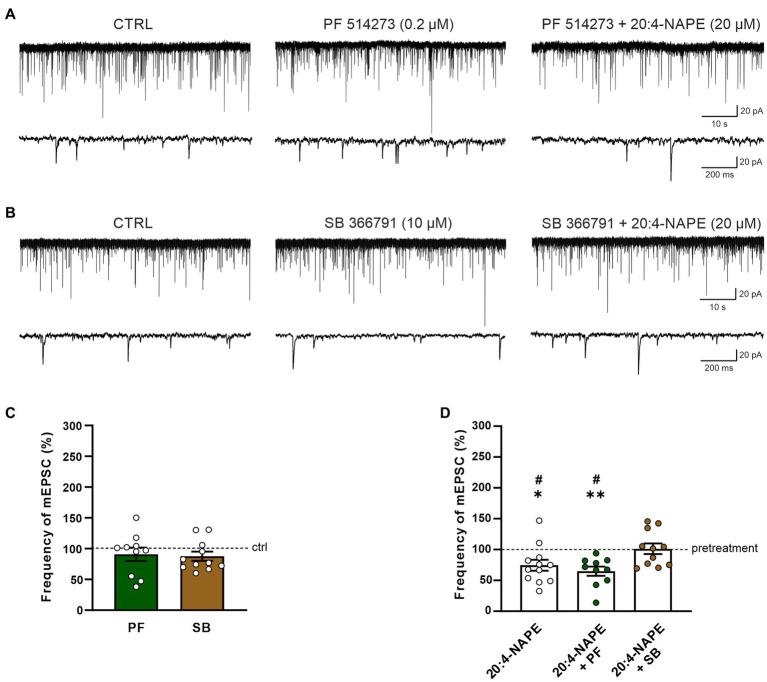
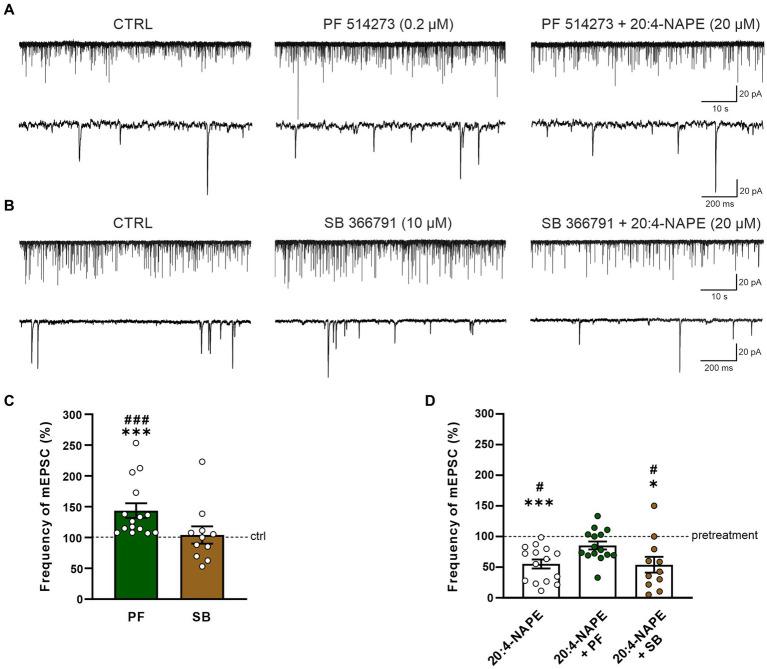
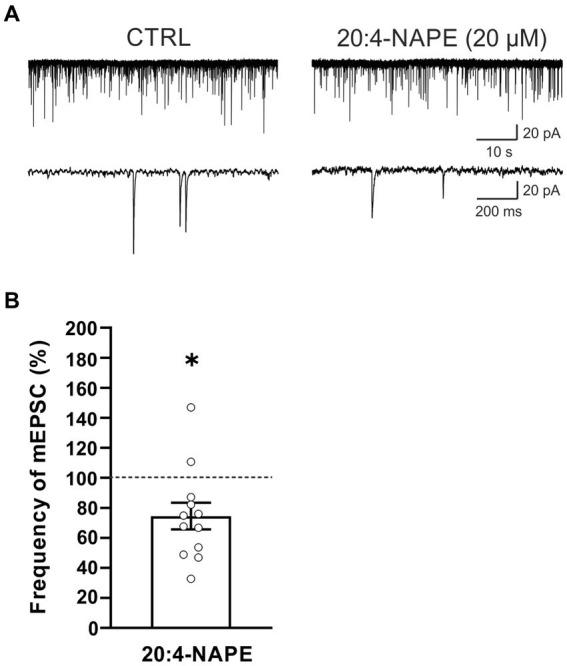
Transient receptor potential ion channel, vanilloid subfamily, type 1 (TRPV1) cation channel, and cannabinoid receptor 1 (CB) are essential in the modulation of nociceptive signaling in the spinal cord dorsal horn that underlies different pathological pain states. TRPV1 and CB receptors share the endogenous agonist anandamide (AEA), produced from N-arachidonoylphosphatidylethanolamine (20:4-NAPE). We investigated the effect of the anandamide precursor 20:4-NAPE on synaptic activity in naive and inflammatory conditions. Patch-clamp recordings of miniature excitatory postsynaptic currents (mEPSCs) from superficial dorsal horn neurons in rat acute spinal cord slices were used. Peripheral inflammation was induced by subcutaneous injection of carrageenan. Under naive conditions, mEPSCs frequency (0.96 ± 0.11 Hz) was significantly decreased after 20 μM 20:4-NAPE application (55.3 ± 7.4%). This 20:4-NAPE-induced inhibition was blocked by anandamide-synthesizing enzyme N-acyl phosphatidylethanolamine phospholipase D (NAPE-PLD) inhibitor LEI-401. In addition, the inhibition was prevented by the CB receptor antagonist PF 514273 (0.2 μM) but not by the TRPV1 receptor antagonist SB 366791 (10 μM). Under inflammatory conditions, 20:4-NAPE (20 μM) also exhibited a significant inhibitory effect (74.5 ± 8.9%) on the mEPSCs frequency that was prevented by the TRPV1 receptor antagonist SB 366791 but not by PF 514273 application. Our results show that 20:4-NAPE application has a significant modulatory effect on spinal cord nociceptive signaling that is mediated by both TRPV1 and CB presynaptic receptors, whereas peripheral inflammation changes the underlying mechanism. The switch between TRPV1 and CB receptor activation by the AEA precursor 20:4-NAPE during inflammation may play an important role in nociceptive processing, hence the development of pathological pain.
瞬时受体电位离子通道香草酸亚家族1型(TRPV1)阳离子通道和大麻素受体1(CB1)在脊髓背角伤害性信号传导的调节中起着至关重要的作用,而脊髓背角伤害性信号传导是不同病理性疼痛状态的基础。TRPV1和CB1受体共享内源性激动剂花生四烯酸乙醇胺(AEA),它由N-花生四烯酰磷脂酰乙醇胺(20:4-NAPE)产生。我们研究了花生四烯酸乙醇胺前体20:4-NAPE在正常和炎症条件下对突触活动的影响。采用膜片钳记录大鼠急性脊髓切片中浅表背角神经元的微小兴奋性突触后电流(mEPSCs)。通过皮下注射角叉菜胶诱导外周炎症。在正常条件下,应用20μM 20:4-NAPE后,mEPSCs频率(0.96±0.11Hz)显著降低(55.3±7.4%)。这种20:4-NAPE诱导的抑制作用可被花生四烯酸乙醇胺合成酶N-酰基磷脂酰乙醇胺磷脂酶D(NAPE-PLD)抑制剂LEI-401阻断。此外,CB1受体拮抗剂PF 514273(0.2μM)可预防这种抑制作用,而TRPV1受体拮抗剂SB 366791(10μM)则不能。在炎症条件下,20:4-NAPE(20μM)对mEPSCs频率也表现出显著的抑制作用(74.5±8.9%),这种抑制作用可被TRPV1受体拮抗剂SB 366791预防,但PF 514273不能。我们的结果表明,应用20:4-NAPE对脊髓伤害性信号传导具有显著的调节作用,该作用由TRPV1和CB1突触前受体介导,而外周炎症改变了其潜在机制。在炎症过程中,AEA前体20:4-NAPE激活TRPV1和CB1受体之间的转换可能在伤害性处理中起重要作用,从而导致病理性疼痛的发生。

 Zotero 插件