
右美托咪定对肺癌胸腔镜手术后炎症和肺功能的影响:一项系统评价和荟萃分析。
Effects of dexmedetomidine on inflammation and pulmonary function after thoracoscopic surgery for lung cancer: a systematic review and meta-analysis.
作者信息
Xu Yu, Zhou Yi, Maloney James D, Shan Guofa
机构信息
Department of Anesthesiology, Suzhou Xiangcheng People's Hospital, Suzhou, China.
Department of Oncology, Funing County People's Hospital, Yancheng, China.
出版信息
J Thorac Dis. 2023 Jun 30;15(6):3397-3408. doi: 10.21037/jtd-23-651. Epub 2023 Jun 16.
BACKGROUND
Surgical resection is the most effective treatment for lung cancer, but it can also lead to adverse stress reactions in the body. The minimization of lung function damage caused by one-lung ventilation and inflammatory reactions caused by surgery are new challenges faced by the field of anesthesiology. Dexmedetomidine (Dex) has been found to be effective in improving perioperative lung function. In this study, we aimed to conduct a systematic review and meta-analysis to examine the effect of Dex on inflammation and pulmonary function after thoracoscopic surgery for lung cancer.
METHODS
A computer-based search was performed to retrieve controlled trials (CTs) about the effects of Dex on inflammation and lung function after thoracoscopic surgery for lung cancer from the databases of PubMed, Embase, Cochrane Library, and Web of Science. The time period for retrieval was set from inception to 1 August 2022. The articles were strictly screened according to the inclusion and exclusion criteria, and data analysis was conducted using the software Stata 15.0.
RESULTS
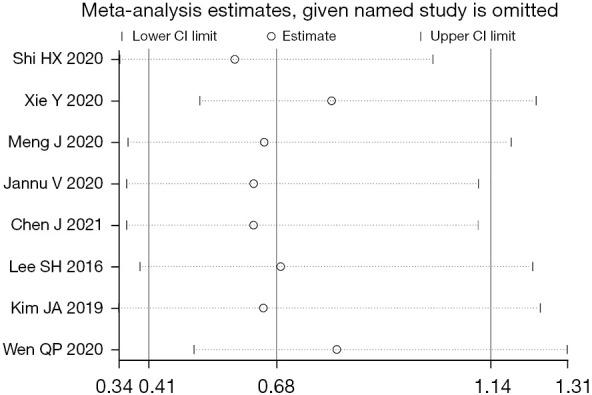
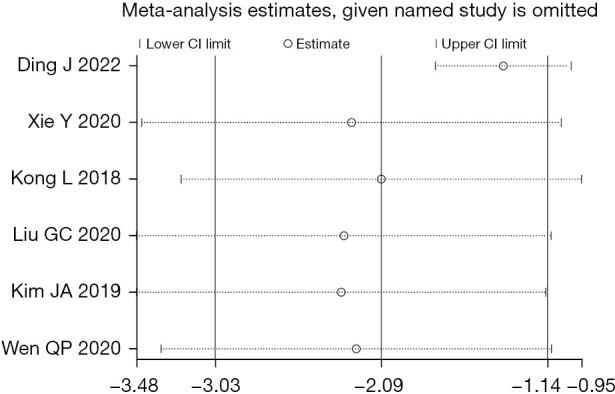
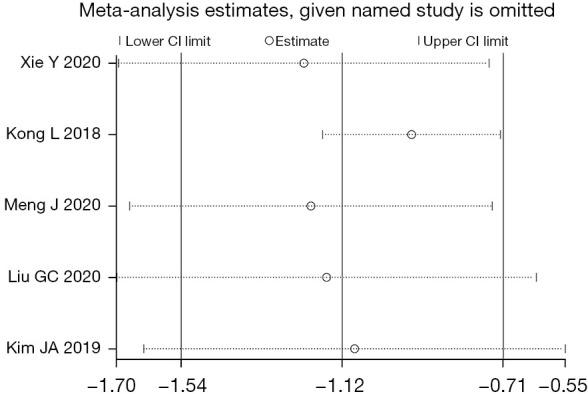
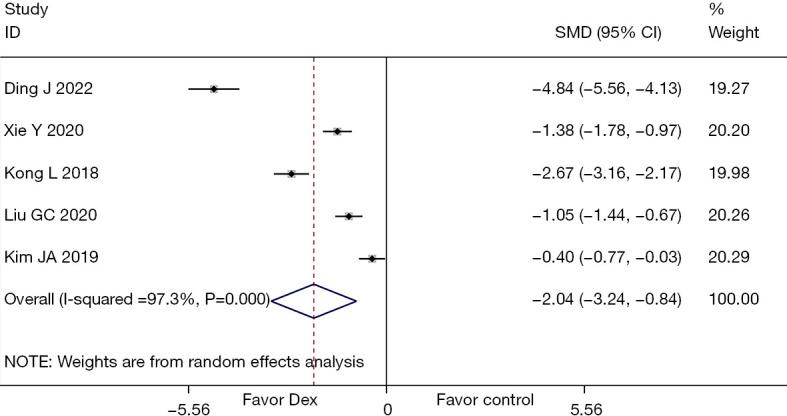
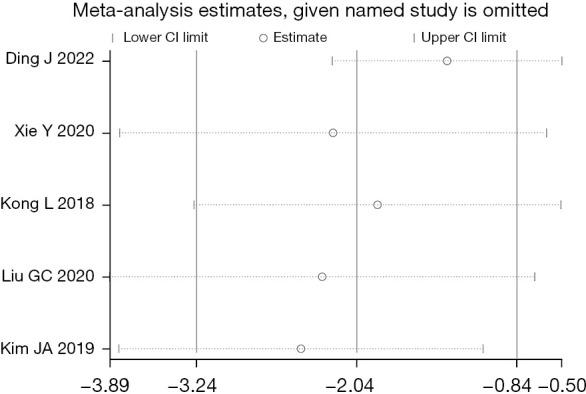
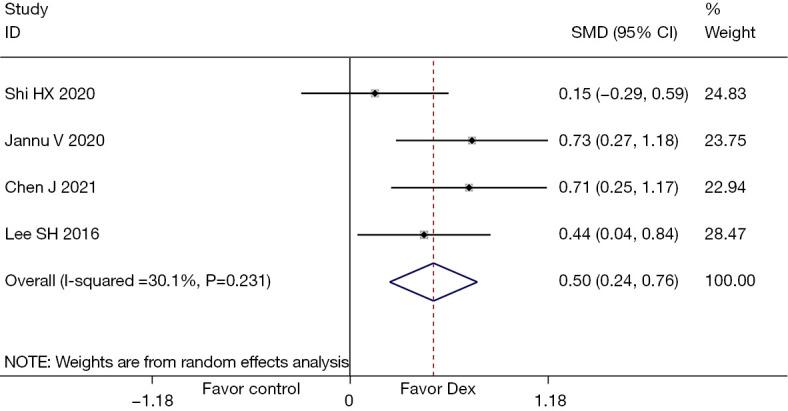
A total of 11 CTs were included, involving 1,026 patients overall, with 512 assigned to the Dex group and 514 to the control group. The meta-analysis showed that after Dex treatment, the inflammatory factors of patients with lung cancer who underwent radical resection were all decreased: interleukin-6 (IL-6) [standardized mean difference (SMD) =-2.09; 95% confidence interval (CI): -3.03, -1.14; P=0.003], interleukin-8 (IL-8) (SMD =-1.12; 95% CI: -1.54, -0.71; P=0.001), and tumor necrosis factor-α (TNF-α) (SMD =-2.04; 95% CI: -3.24, 0.84; P=0.001). The pulmonary function of the patients was also improved: forced expiratory volume in the first second (FEV1) (SMD =0.50; 95% CI: 0.24, 0.76; P=0.003), and partial pressure of oxygen (PaO) (SMD =1.00; 95% CI: 0.40, 1.59; P=0.001). However, there was no significant difference between the two groups regarding adverse reactions [relative risk (RR) =0.68; 95% CI: 0.41, 1.14; P=0.27].
CONCLUSIONS
In summary, the use of Dex in lung cancer patients after radical surgery can reduce serum inflammatory factors, and this may play an important role in postoperative inflammatory reaction and improving lung function.
背景
手术切除是肺癌最有效的治疗方法,但它也会导致机体产生不良应激反应。单肺通气引起的肺功能损害最小化以及手术引起的炎症反应是麻醉学领域面临的新挑战。已发现右美托咪定(Dex)在改善围手术期肺功能方面有效。在本研究中,我们旨在进行系统评价和荟萃分析,以检验Dex对肺癌胸腔镜手术后炎症和肺功能的影响。
方法
通过计算机检索从PubMed、Embase、Cochrane图书馆和Web of Science数据库中获取关于Dex对肺癌胸腔镜手术后炎症和肺功能影响的对照试验(CTs)。检索时间段设定为从数据库建立至2022年8月1日。根据纳入和排除标准对文章进行严格筛选,并使用Stata 15.0软件进行数据分析。
结果
共纳入11项CTs,总共涉及1026例患者,其中512例被分配到Dex组,514例被分配到对照组。荟萃分析表明,Dex治疗后,接受根治性切除的肺癌患者的炎症因子均降低:白细胞介素-6(IL-6)[标准化均数差(SMD)=-2.09;95%置信区间(CI):-3.03,-1.14;P=0.003]、白细胞介素-8(IL-8)(SMD=-1.12;95%CI:-1.54,-0.71;P=0.001)和肿瘤坏死因子-α(TNF-α)(SMD=-2.04;95%CI:-3.24,-0.84;P=0.001)。患者的肺功能也得到改善:第1秒用力呼气量(FEV1)(SMD=0.50;95%CI:0.24,0.76;P=0.003)和氧分压(PaO)(SMD=1.00;95%CI:0.40,1.59;P=0.001)。然而,两组之间不良反应无显著差异[相对危险度(RR)=0.68;95%CI:0.41,1.14;P=0.27]。
结论
总之,在肺癌根治术后患者中使用Dex可降低血清炎症因子,这可能在术后炎症反应和改善肺功能中起重要作用。






 Zotero 插件