
小儿躯干导管的局部麻醉剂剂量和毒性:已发表实践的叙述性综述。
Local anesthetic dosing and toxicity of pediatric truncal catheters: a narrative review of published practice.
机构信息
Department of Anesthesia, Critical Care and Pain Medicine, Massachusetts General Hospital, Boston, Massachusetts, USA
Department of Anaesthesia, Harvard Medical School, Boston, Massachusetts, USA.
出版信息
Reg Anesth Pain Med. 2024 Jan 11;49(1):59-66. doi: 10.1136/rapm-2023-104666.
BACKGROUND/IMPORTANCE: Despite over 30 years of use by pediatric anesthesiologists, standardized dosing rates, dosing characteristics, and cases of toxicity of truncal nerve catheters are poorly described.
OBJECTIVE
We reviewed the literature to characterize dosing and toxicity of paravertebral and transversus abdominis plane catheters in children (less than 18 years).
EVIDENCE REVIEW
We searched for reports of ropivacaine or bupivacaine infusions in the paravertebral and transversus abdominis space intended for 24 hours or more of use in pediatric patients. We evaluated bolus dosing, infusion dosing, and cumulative 24-hour dosing in patients over and under 6 months. We also identified cases of local anesthetic systemic toxicity and toxic blood levels.
FINDINGS
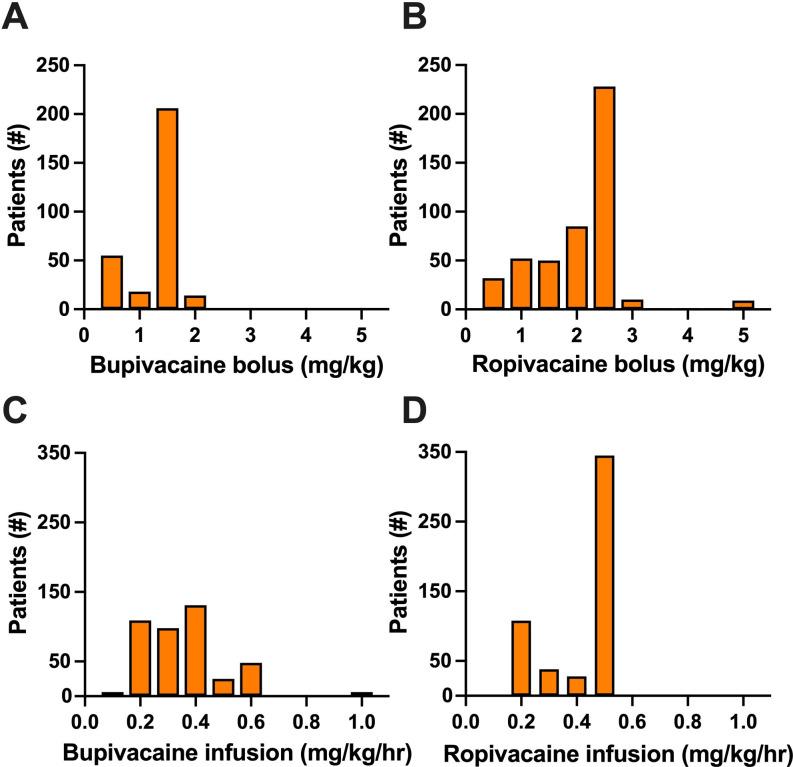
Following screening, we extracted data from 46 papers with 945 patients.Bolus dosing was 2.5 mg/kg (median, range 0.6-5.0; n=466) and 1.25 mg/kg (median, range 0.5-2.5; n=294) for ropivacaine and bupivacaine, respectively. Infusion dosing was 0.5 mg/kg/hour (median, range 0.2-0.68; n=521) and 0.33 mg/kg/hour (median, range 0.1-1.0; n=423) for ropivacaine and bupivacaine, respectively, consistent with a dose equivalence of 1.5:1.0. A single case of toxicity was reported, and pharmacokinetic studies reported at least five cases with serum levels above the toxic threshold.
CONCLUSIONS
Bolus doses of bupivacaine and ropivacaine frequently comport with expert recommendations. Infusions in patients under 6 months used doses associated with toxicity and toxicity occurred at a rate consistent with single-shot blocks. Pediatric patients would benefit from specific recommendations about ropivacaine and bupivacaine dosing, including age-based dosing, breakthrough dosing, and intermittent bolus dosing.
背景/重要性:尽管小儿麻醉医师已经使用了 30 多年,但对躯干神经导管的标准化给药率、给药特点和中毒病例仍描述甚少。
目的
我们回顾了文献,以描述小儿(<18 岁)应用椎旁和腹横平面导管的给药和毒性。
证据回顾
我们检索了罗哌卡因或布比卡因在小儿椎旁和腹横平面空间输注超过 24 小时的报告,用于 24 小时或更长时间的使用。我们评估了 6 个月以上和以下患者的推注剂量、输注剂量和 24 小时累积剂量。我们还确定了局部麻醉药全身毒性和毒性血药水平的病例。
发现
经过筛选,我们从 46 篇论文中提取了 945 例患者的数据。罗哌卡因和布比卡因的推注剂量分别为 2.5mg/kg(中位数,范围 0.6-5.0;n=466)和 1.25mg/kg(中位数,范围 0.5-2.5;n=294)。罗哌卡因和布比卡因的输注剂量分别为 0.5mg/kg/h(中位数,范围 0.2-0.68;n=521)和 0.33mg/kg/h(中位数,范围 0.1-1.0;n=423),与剂量等效比 1.5:1.0 一致。报告了一例毒性病例,药代动力学研究报告了至少五例血清水平超过毒性阈值的病例。
结论
布比卡因和罗哌卡因的单次推注剂量通常符合专家建议。6 个月以下患者的输注剂量与毒性相关,且毒性发生率与单次阻滞一致。小儿患者将受益于罗哌卡因和布比卡因剂量的具体建议,包括基于年龄的剂量、突破剂量和间歇性推注剂量。
 Zotero 插件