
BPF-低剂量暴露后哺乳期大鼠肝脏氧化应激增加:对子代的围产期影响。
Oxidative stress increases in liver of lactating rats after BPF-low-dose exposure: perinatal effects in the offspring.
机构信息
Department of Biochemistry and Molecular Biology, School of Medicine, Complutense University of Madrid, Madrid, Spain.
GREEN Tox and Institute of Veterinary Pharmacology and Toxicology, University of Zurich, Zurich, Switzerland.
出版信息
Sci Rep. 2023 Jul 11;13(1):11229. doi: 10.1038/s41598-023-38434-w.
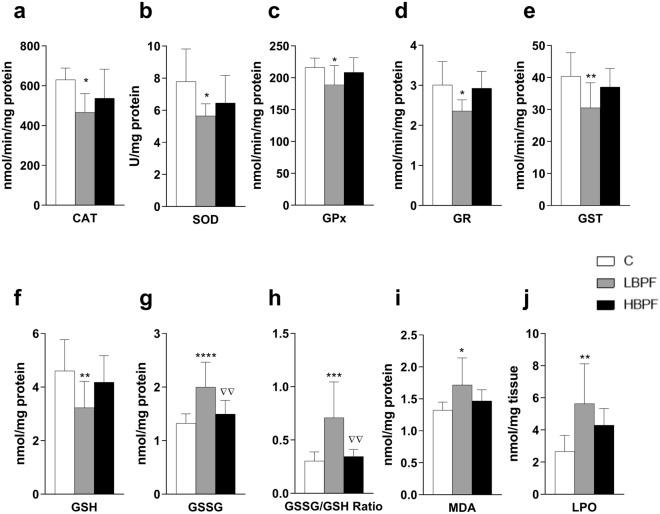
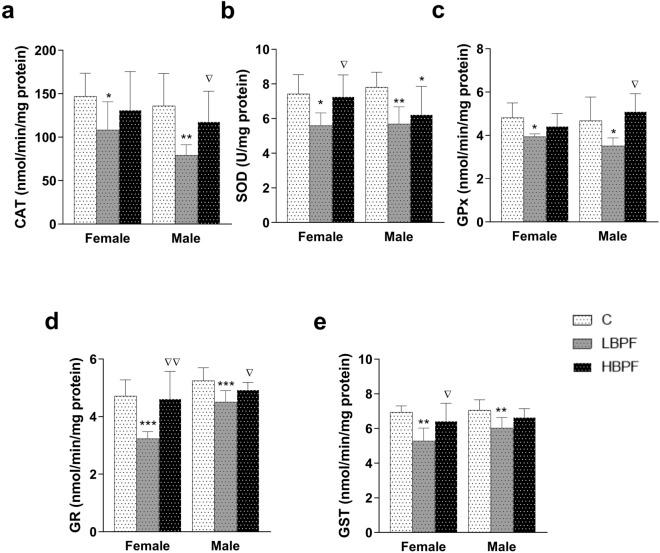
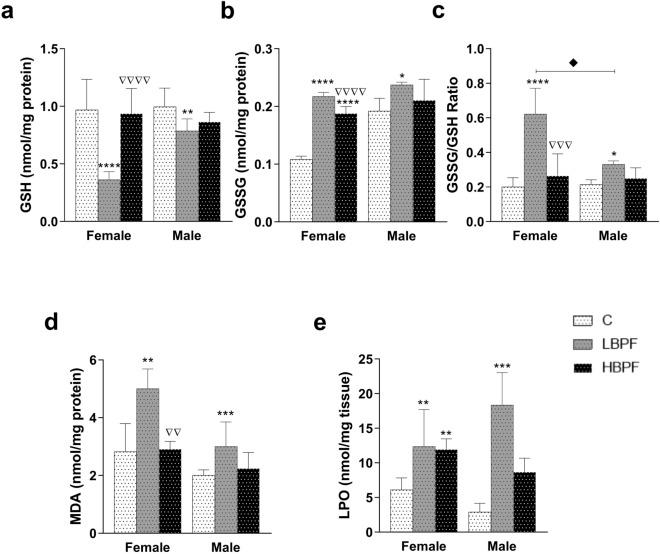
Bisphenol F (BPF) is replacing Bisphenol A (BPA) in the manufacture of products due to endocrine-disrupting effects. BPF monomers can also be released into the environment and enter the food chain, resulting in human exposure to low doses. Since bisphenols are primarily metabolized by the liver, this organ is more vulnerable to lower doses of bisphenols than others. Exposure during prenatal development may increase the risk of diseases in adulthood. The aim was to evaluate whether BPF administration could generate oxidative stress in liver of lactating rats, and whether these effects may be also observed in female and male postnatal day 6 (PND6) offspring. Long Evans rats received oral treatment: Control, BPF-low-dose (LBPF) 0.0365 mg/kg b.w./day, and BPF-high-dose (HBPF) 3.65 mg/kg b.w./day. The levels of antioxidant enzymes (CAT, SOD, GR, GPx and GST), glutathione system (GSH, GSSG) and lipid damage markers (MDA, LPO) were measured using colorimetric methods in liver of both lactating dams and in PND6 offspring. Mean values were analyzed using Prism-7. LBPF affected liver defense mechanisms (antioxidant enzymes and glutathione system), increasing ROS levels and producing lipid peroxidation in lactating dams. Similar effects were found in female and male PND6 offspring as a consequence of perinatal exposure.
双酚 F(BPF)由于其内分泌干扰作用,正在取代双酚 A(BPA),用于制造产品。BPF 单体也可能释放到环境中并进入食物链,导致人类接触低剂量的 BPF。由于双酚类物质主要在肝脏中代谢,因此与其他器官相比,肝脏更容易受到低剂量双酚类物质的影响。在产前发育过程中的暴露可能会增加成年后患疾病的风险。本研究旨在评估 BPF 给药是否会在哺乳期大鼠的肝脏中产生氧化应激,以及这些影响是否也会在出生后第 6 天(PND6)的雌性和雄性后代中观察到。长爪沙鼠接受口服治疗:对照组、BPF 低剂量组(LBPF)0.0365mg/kg b.w./天和 BPF 高剂量组(HBPF)3.65mg/kg b.w./天。使用比色法测定哺乳期母鼠和 PND6 后代肝脏中的抗氧化酶(CAT、SOD、GR、GPx 和 GST)、谷胱甘肽系统(GSH、GSSG)和脂质损伤标志物(MDA、LPO)的水平。使用 Prism-7 分析平均值。LBPF 影响了哺乳期母鼠的肝脏防御机制(抗氧化酶和谷胱甘肽系统),增加了 ROS 水平,并产生了脂质过氧化。由于围产期暴露,在雌性和雄性 PND6 后代中也发现了类似的影响。

 Zotero 插件