
前列腺癌患者端粒长度与核质桥及疾病严重程度之间的关系
The Relationship between Telomere Length and Nucleoplasmic Bridges and Severity of Disease in Prostate Cancer Patients.
作者信息
Dhillon Varinderpal S, Deo Permal, Fenech Michael
机构信息
Health and Biomedical Innovation, Clinical and Health Sciences, University of South Australia, Adelaide 5000, Australia.
Genome Health Foundation, North Brighton 5048, Australia.
出版信息
Cancers (Basel). 2023 Jun 26;15(13):3351. doi: 10.3390/cancers15133351.
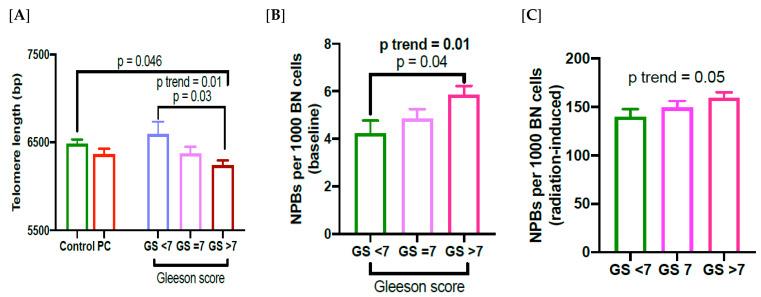
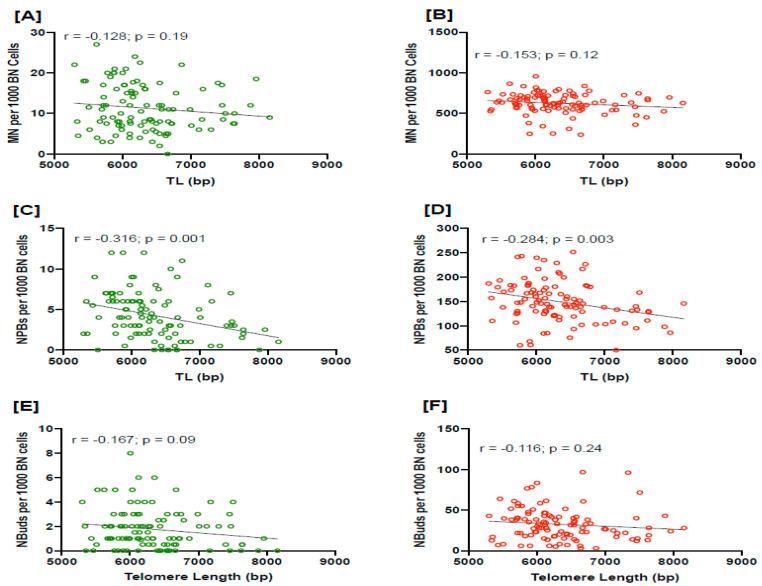
Telomeres are repetitive nucleotide (TTAGGG) sequences that stabilize the chromosome ends and play an important role in the prevention of cancer initiation and progression. Nucleoplasmic bridges (NPBs) are formed when chromatids remain joined together during mitotic anaphase either due to mis-repair of DNA breaks or due to chromatid end fusion as a result of telomere loss or telomere dysfunction. We tested the hypotheses that (i) telomere length (TL) is shorter in prostate cancer (PC) patients relative to healthy age-matched individuals, (ii) TL differs in different stages of PC and (iii) shorter TL is significantly correlated with NPBs formation in PC cases. TL was measured in whole blood by well-established quantitative PCR method and the frequency of NPBs was measured in lymphocytes using cytokinesis-block micronucleus cytome (CBMNcyt) assay. Our results indicate that TL is shorter and NPBs are increased in PC patients relative to age-matched healthy controls. Furthermore, TL was significantly shorter ( = 0.03) in patients with a Gleason score more than 7 and there was also a significant trend of decreasing TL across all three stages ( trend = 0.01; Gleason score <7, 7 and >7). Furthermore, TL was significantly inversely correlated with NPB frequency in PC patients (r = -0.316; = 0.001) but not in controls (r = 0.163; = 0.06) and their relationships became stronger with higher Gleason scores. More studies are required that can confirm our observations and explore mechanistic differences in the role of telomeres in NPB formation in PC cases relative to non-cancer cases.
端粒是重复的核苷酸(TTAGGG)序列,可稳定染色体末端,并在预防癌症发生和发展中发挥重要作用。当染色单体在有丝分裂后期由于DNA断裂修复错误或由于端粒丢失或端粒功能障碍导致染色单体末端融合而仍连接在一起时,就会形成核质桥(NPB)。我们检验了以下假设:(i)前列腺癌(PC)患者的端粒长度(TL)相对于年龄匹配的健康个体更短;(ii)PC不同阶段的TL有所不同;(iii)较短的TL与PC病例中NPB的形成显著相关。通过成熟的定量PCR方法测量全血中的TL,并使用胞质分裂阻断微核细胞组学(CBMNcyt)检测法测量淋巴细胞中NPB的频率。我们的结果表明,与年龄匹配的健康对照相比,PC患者的TL更短且NPB增加。此外,Gleason评分大于7的患者的TL显著更短(P = 0.03),并且在所有三个阶段中TL也有显著下降趋势(趋势P = 0.01;Gleason评分<7、7和>7)。此外,PC患者的TL与NPB频率显著负相关(r = -0.316;P = 0.001),但在对照组中无相关性(r = 0.163;P = 0.06),并且随着Gleason评分升高,它们之间的关系变得更强。需要更多的研究来证实我们的观察结果,并探索端粒在PC病例与非癌症病例中NPB形成作用的机制差异。
 Zotero 插件