
RH 野生型与四个 SRS29B(SAG1)敲除克隆的比较蛋白质组学分析揭示了不同菌株之间的显著差异。
Comparative Proteomic Analysis of RH Wild-Type and Four SRS29B (SAG1) Knock-Out Clones Reveals Significant Differences between Individual Strains.
机构信息
Department of Infectious Diseases and Pathobiology, Institute of Parasitology, University of Bern, 3012 Bern, Switzerland.
Graduate School for Cellular and Biomedical Sciences, University of Bern, 3012 Bern, Switzerland.
出版信息
Int J Mol Sci. 2023 Jun 21;24(13):10454. doi: 10.3390/ijms241310454.
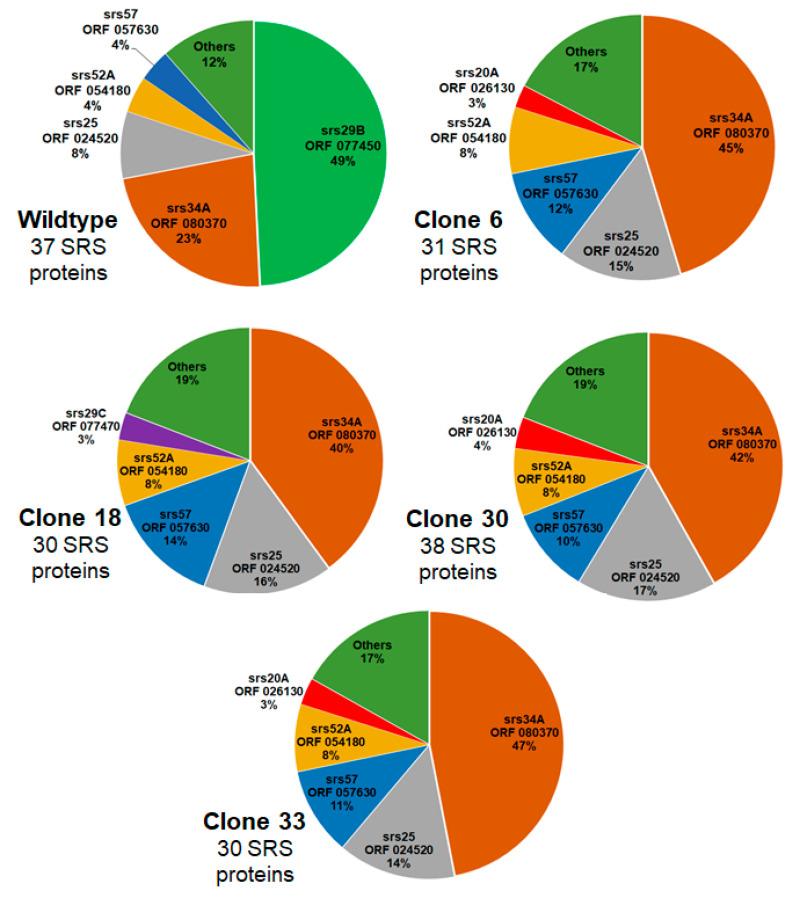
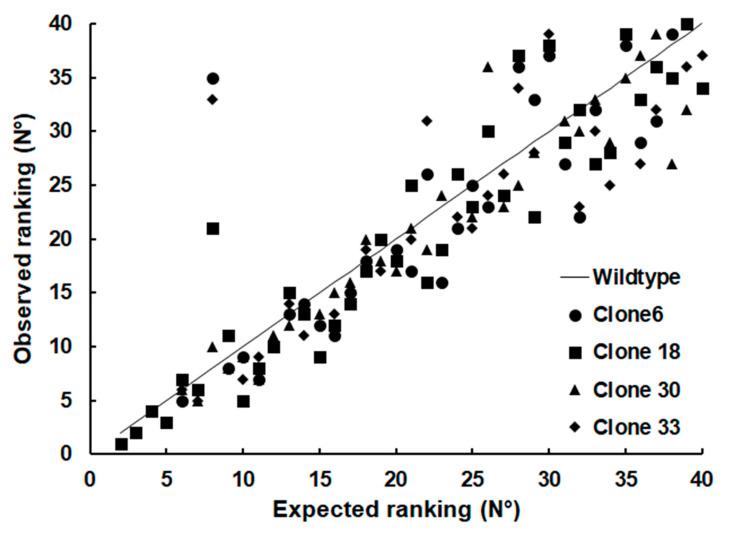
In , as well as in other model organisms, gene knock-out using CRISPR-Cas9 is a suitable tool to identify the role of specific genes. The general consensus implies that only the gene of interest is affected by the knock-out. Is this really the case? In a previous study, we generated knock-out (KO) clones of TgRH88_077450 (SRS29B; SAG1) which differed in the numbers of the integrated dihydrofolate-reductase-thymidylate-synthase (MDHFR-TS) drug-selectable marker. Clones 18 and 33 had a single insertion of MDHFR-TS within SRS29B. Clone 6 was disrupted by the insertion of a short unrelated DNA-sequence, but the marker was integrated elsewhere. In clone 30, the marker was inserted into SRS29B, and several other MDHFR-TS copies were found in the genome. KO and wild-type (WT) tachyzoites had similar shapes, dimensions, and vitality. This prompted us to investigate the impact of genetic engineering on the overall proteome patterns of the four clones as compared to the respective WT. Comparative shotgun proteomics of the five strains was performed. Overall, 3236 proteins were identified. Principal component analysis of the proteomes revealed five distinct clusters corresponding to the five strains by both iTop3 and iLFQ algorithms. Detailed analysis of the differentially expressed proteins revealed that the target of the KO, srs29B, was lacking in all KO clones. In addition to this protein, 20 other proteins were differentially expressed between KO clones and WT or between different KO clones. The protein exhibiting the highest variation between the five strains was srs36D encoded by TgRH_016110. The deregulated expression of SRS36D was further validated by quantitative PCR. Moreover, the transcript levels of three other selected SRS genes, namely SRS36B, SRS46, and SRS57, exhibited significant differences between individual strains. These results indicate that knocking out a given gene may affect the expression of other genes. Therefore, care must be taken when specific phenotypes are regarded as a direct consequence of the KO of a given gene.
在其他模式生物中,利用 CRISPR-Cas9 进行基因敲除是鉴定特定基因功能的一种合适工具。人们普遍认为,只有目的基因受到敲除的影响。情况真的是这样吗?在之前的一项研究中,我们生成了 TgRH88_077450(SRS29B;SAG1)的敲除(KO)克隆,这些克隆在整合的二氢叶酸还原酶-胸苷酸合成酶(MDHFR-TS)药物选择标记的数量上有所不同。克隆 18 和 33 只有一个 MDHFR-TS 插入 SRS29B 中。克隆 6 被一个短的不相关的 DNA 序列插入所破坏,但标记被整合到其他地方。在克隆 30 中,标记插入到 SRS29B 中,并且在基因组中发现了几个其他的 MDHFR-TS 拷贝。KO 和野生型(WT)速殖子具有相似的形状、大小和活力。这促使我们研究基因工程对这四个克隆与各自的 WT 相比对整个蛋白质组模式的影响。对五个菌株进行了比较shotgun 蛋白质组学研究。总共鉴定到 3236 种蛋白质。通过 iTop3 和 iLFQ 算法对蛋白质组进行主成分分析,发现五个簇分别对应于五个菌株。对差异表达蛋白的详细分析表明,KO 的靶标 srs29B 在所有 KO 克隆中均缺失。除了这种蛋白质外,KO 克隆和 WT 之间或不同 KO 克隆之间还存在 20 种其他差异表达的蛋白质。五个菌株之间变化最大的蛋白质是 TgRH_016110 编码的 srs36D。通过定量 PCR 进一步验证了 SRS36D 的表达失调。此外,三个其他选定的 SRS 基因,即 SRS36B、SRS46 和 SRS57 的转录水平在各个菌株之间也表现出显著差异。这些结果表明,敲除一个特定基因可能会影响其他基因的表达。因此,在将特定表型视为特定基因 KO 的直接后果时,必须谨慎行事。



 Zotero 插件