
解析应激下的代谢组学:啮齿动物模型的新见解。
Deciphering the Metabolome under Stress: Insights from Rodent Models.
机构信息
Laboratory of Biochemistry, Department of Biological Applications and Technology, School of Health Sciences, University of Ioannina, Greece.
Biomedical Research Institute, Foundation for Research and Technology-Hellas (BRI-FORTH), Ioannina, Greece.
出版信息
Curr Neuropharmacol. 2024;22(5):884-903. doi: 10.2174/1570159X21666230713094843.
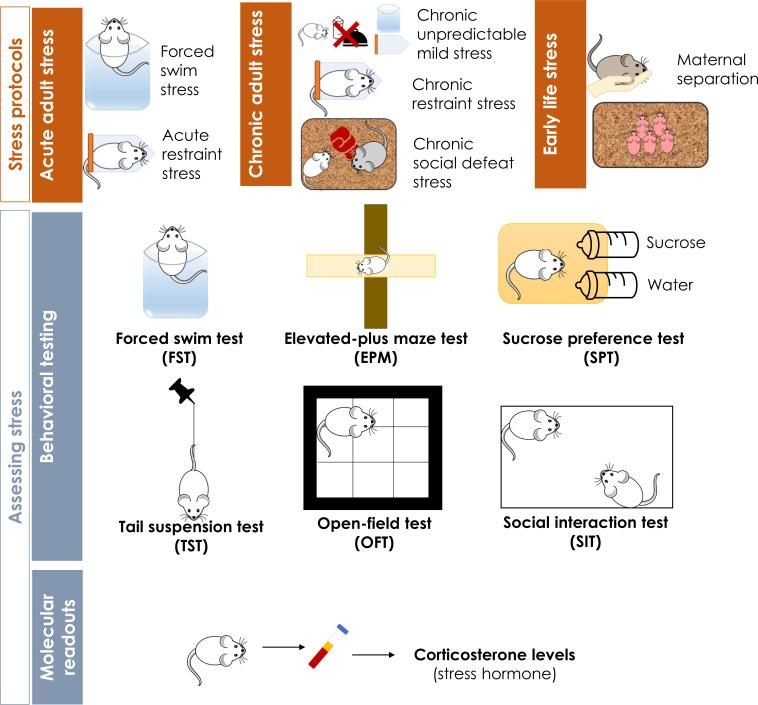
Despite intensive research efforts to understand the molecular underpinnings of psychological stress and stress responses, the underlying molecular mechanisms remain largely elusive. Towards this direction, a plethora of stress rodent models have been established to investigate the effects of exposure to different stressors. To decipher affected molecular pathways in a holistic manner in these models, metabolomics approaches addressing altered, small molecule signatures upon stress exposure in a high-throughput, quantitative manner provide insightful information on stress-induced systemic changes in the brain. In this review, we discuss stress models in mice and rats, followed by mass spectrometry (MS) and nuclear magnetic resonance (NMR) metabolomics studies. We particularly focus on acute, chronic and early life stress paradigms, highlight how stress is assessed at the behavioral and molecular levels and focus on metabolomic outcomes in the brain and peripheral material such as plasma and serum. We then comment on common metabolomics patterns across different stress models and underline the need for unbiased -omics methodologies and follow-up studies of metabolomics outcomes to disentangle the complex pathobiology of stress and pertinent psychopathologies.
尽管人们进行了大量的研究来了解心理压力和应激反应的分子基础,但潜在的分子机制在很大程度上仍难以捉摸。为此,建立了大量的应激啮齿动物模型来研究暴露于不同应激源的影响。为了全面揭示这些模型中受影响的分子途径,代谢组学方法以高通量、定量的方式研究应激暴露后小分子特征的变化,提供了关于应激引起的大脑系统变化的有见地的信息。在这篇综述中,我们讨论了小鼠和大鼠的应激模型,以及随后的质谱 (MS) 和核磁共振 (NMR) 代谢组学研究。我们特别关注急性、慢性和早期生活应激范式,强调如何在行为和分子水平上评估应激,并关注大脑和外周物质(如血浆和血清)中的代谢组学结果。然后,我们评论了不同应激模型的常见代谢组学模式,并强调需要使用无偏的组学方法和代谢组学结果的后续研究来阐明应激的复杂病理生物学和相关的精神病理学。
 Zotero 插件