
中低收入国家学龄前儿童呼吸道合胞病毒负担的年龄分布:半参数、荟萃回归方法。
The age profile of respiratory syncytial virus burden in preschool children of low- and middle-income countries: A semi-parametric, meta-regression approach.
机构信息
Center for Health Economics and Modeling of Infectious Diseases, University of Antwerp, Antwerp, Belgium.
Swiss Tropical and Public Health Institute, Allschwil, Switzerland.
出版信息
PLoS Med. 2023 Jul 17;20(7):e1004250. doi: 10.1371/journal.pmed.1004250. eCollection 2023 Jul.
BACKGROUND
Respiratory syncytial virus (RSV) infections are among the primary causes of death for children under 5 years of age worldwide. A notable challenge with many of the upcoming prophylactic interventions against RSV is their short duration of protection, making the age profile of key interest to the design of prevention strategies.
METHODS AND FINDINGS
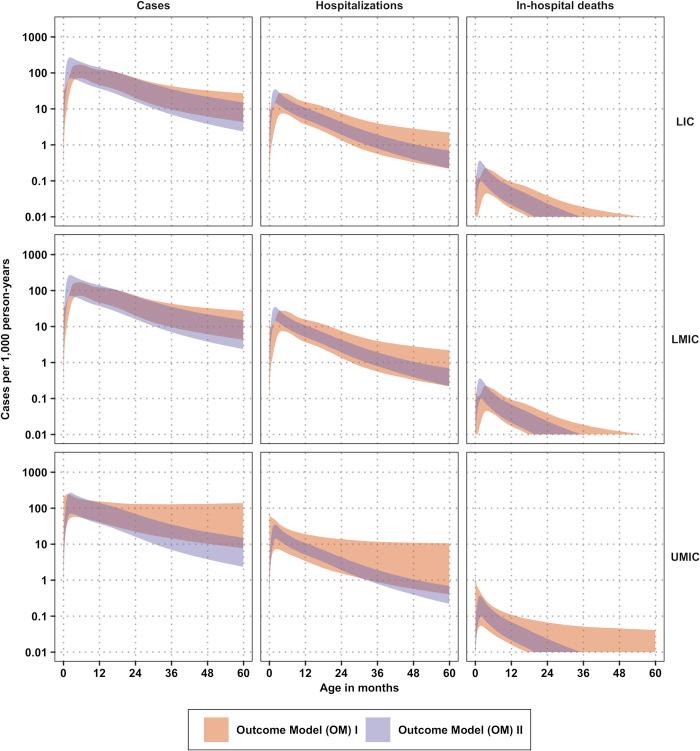
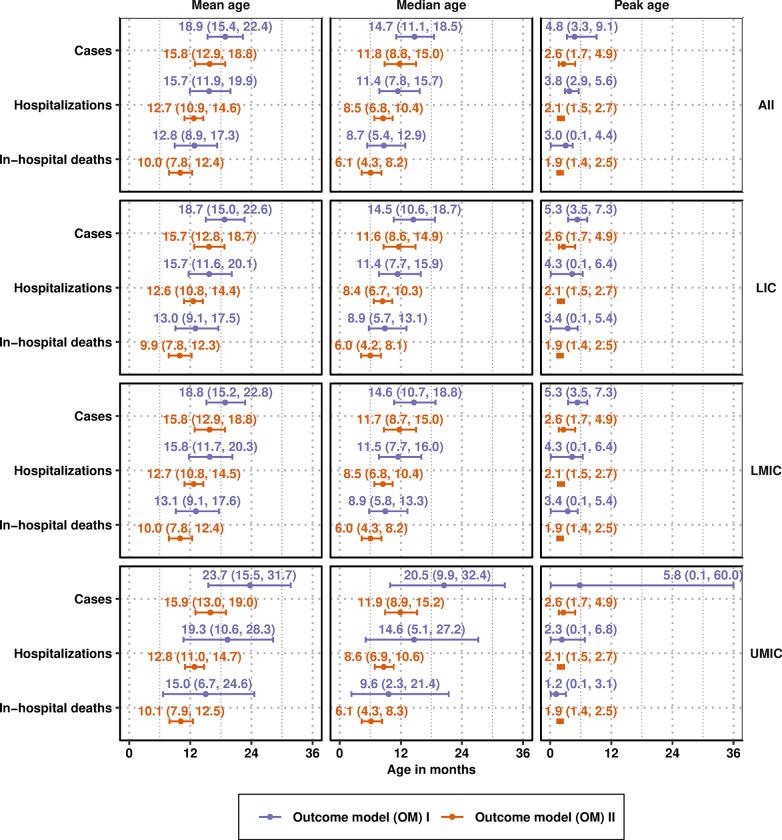
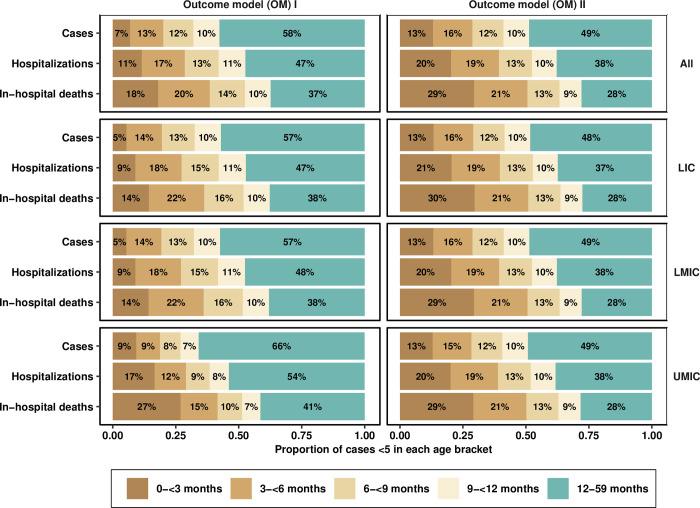
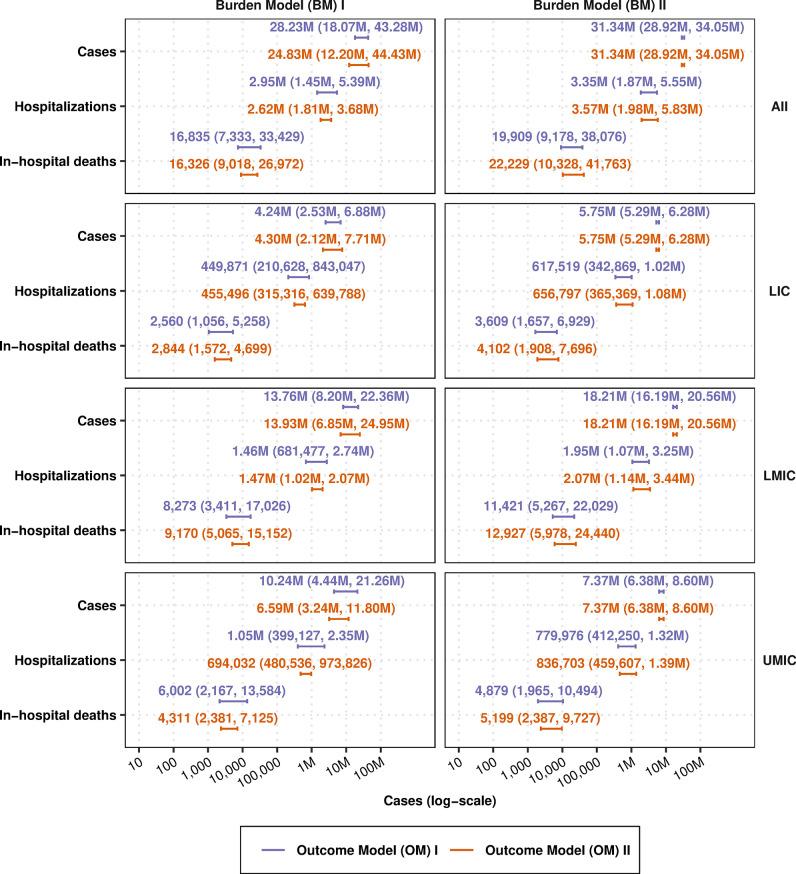
We leverage the RSV data collected on cases, hospitalizations, and deaths in a systematic review in combination with flexible generalized additive mixed models (GAMMs) to characterize the age burden of RSV incidence, hospitalization, and hospital-based case fatality rate (hCFR). Due to the flexible nature of GAMMs, we estimate the peak, median, and mean incidence of infection to inform discussions on the ideal "window of protection" of prophylactic interventions. In a secondary analysis, we reestimate the burden of RSV in all low- and middle-income countries. The peak age of community-based incidence is 4.8 months, and the mean and median age of infection is 18.9 and 14.7 months, respectively. Estimating the age profile using the incidence coming from hospital-based studies yields a slightly younger age profile, in which the peak age of infection is 2.6 months and the mean and median age of infection are 15.8 and 11.6 months, respectively. More severe outcomes, such as hospitalization and in-hospital death have a younger age profile. Children under 6 months of age constitute 10% of the population under 5 years of age but bear 20% to 29% of cases, 28% to 39% of hospitalizations, and 38% to 50% of deaths. On an average year, we estimate 28.23 to 31.34 million cases of RSV, between 2.95 to 3.35 million hospitalizations, and 16,835 to 19,909 in-hospital deaths in low, lower- and upper middle-income countries. In addition, we estimate 17,254 to 23,875 deaths in the community, for a total of 34,114 to 46,485 deaths. Globally, evidence shows that community-based incidence may differ by World Bank Income Group, but not hospital-based incidence, probability of hospitalization, or the probability of in-hospital death (p ≤ 0.01, p = 1, p = 0.86, 0.63, respectively). Our study is limited mainly due to the sparsity of the data, especially for low-income countries (LICs). The lack of information for some populations makes detecting heterogeneity between income groups difficult, and differences in access to care may impact the reported burden.
CONCLUSIONS
We have demonstrated an approach to synthesize information on RSV outcomes in a statistically principled manner, and we estimate that the age profile of RSV burden depends on whether information on incidence is collected in hospitals or in the community. Our results suggest that the ideal prophylactic strategy may require multiple products to avert the risk among preschool children.
背景
呼吸道合胞病毒(RSV)感染是全球 5 岁以下儿童死亡的主要原因之一。即将出现的许多 RSV 预防干预措施的一个显著挑战是它们的保护期短,这使得年龄特征成为预防策略设计的关键关注点。
方法和发现
我们利用系统评价中收集的 RSV 病例、住院和死亡数据,并结合灵活的广义加性混合模型(GAMM),对 RSV 发病率、住院率和基于医院的病死率(hCFR)的年龄负担进行了特征描述。由于 GAMM 的灵活性,我们估计了感染的峰值、中位数和平均值,以讨论预防干预的理想“保护窗口”。在二次分析中,我们重新估计了所有低收入和中等收入国家的 RSV 负担。社区发病率的峰值年龄为 4.8 个月,感染的平均年龄和中位数分别为 18.9 个月和 14.7 个月。使用来自医院研究的发病率来估计年龄分布会得到一个稍微年轻的年龄分布,其中感染的峰值年龄为 2.6 个月,感染的平均年龄和中位数分别为 15.8 个月和 11.6 个月。更严重的后果,如住院和院内死亡,具有更年轻的年龄特征。6 个月以下的儿童占 5 岁以下儿童的 10%,但占病例的 20%至 29%、住院的 28%至 39%和院内死亡的 38%至 50%。在平均年份,我们估计在低收入、中下收入国家有 2823 万至 3134 万例 RSV 病例、29.5 万至 33.5 万例住院和 16835 至 19909 例院内死亡。此外,我们估计在社区有 17254 至 23875 人死亡,总计 34114 至 46485 人死亡。全球范围内的证据表明,社区发病率可能因世界银行收入组别而异,但医院发病率、住院概率或院内死亡概率并非如此(p≤0.01,p=1,p=0.86,0.63,分别)。我们的研究主要受到数据稀疏性的限制,特别是对于低收入国家(LIC)。对于某些人群缺乏信息,使得难以检测收入组之间的异质性,并且获得医疗保健的差异可能会影响报告的负担。
结论
我们已经展示了一种以统计原则综合 RSV 结果信息的方法,我们估计 RSV 负担的年龄分布取决于是否在医院或社区收集发病率信息。我们的研究结果表明,理想的预防策略可能需要多种产品来避免学龄前儿童的风险。


 Zotero 插件